Rome Travel Guide

Rome Architecture, History, Art, Museums, Galleries, Fashion, Music, Photos, Walking and Hiking Itineraries, Neighborhoods, News and Social Commentary, Politics, Things to Do in Rome and Environs. Over 900 posts

Showing posts with label Frederika Randall. Show all posts

Saturday, May 7, 2022

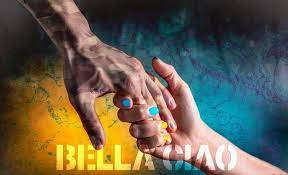
"Bella Ciao" comes to Ukraine


"Bella Ciao," Italy's anthem of freedom, resistance, and sacrifice, is now being sung, in translation, by Ukrainians in their epic struggle against the horrific Russian invasion of their country. Here's a link to a Ukrainian rendition, with translated Ukrainian lyrics, posted on Facebook several weeks ago: 

https://www.facebook.com/watch/?v=4989089647852306

and on YouTube with new lyrics, here: https://www.youtube.com/watch?v=VsJYGzwOhKM


In 2010, Frederika Randall, a dear friend and a brilliant translator and journalist, wrote about "Bella Ciao" for this blog. "Most musicologists," she wrote, "believe Bella Ciao was adapted from a [late 19th-century] work song of the mondine, the women who worked in the rice fields of northern Italy." 

Between 1943 and 1945, the song was adapted by the Italian resistance movement that helped liberate Italy from the Nazi occupation and Mussolini's Fascist dictatorship (although it's not clear it was ever sung by the Partisans). After the war it achieved world-wide circulation. The lyrics, as sung today, were first published in 1953, and the song grew in popularity in the 1960s. Some years later, it circulated within the dissident movement in Iran. The song has been covered some 25 times in Italian and in many other languages. Today it is sung in Italy on April 25, Liberation Day, celebrating the country's liberation from the German/Nazi occupation. 

Here's the link to Frederika Randall's post (republished in April 2020), which focuses on a controversy that developed over students at a middle school in Prati singing a portion of the song. The post includes the Italian lyrics to "Bella Ciao" as well as an English translation.  

https://romethesecondtime.blogspot.com/2020/04/liberation-day-politics-of-bella-ciao.html

It is with great sadness that we must write that Frederika died in May, 2020, a month after publication of the re-post above. 


Tuesday, May 26, 2020

In Memoriam: Frederika Randall's review of Mario Sironi exhibit at the Vittoriano


Frederika Randall, an exceptional person, writer, and friend, died Tuesday, May 12 at her home in Rome, where she lived with her husband and loving and intellectual companion, Vittorio Jucker. Born in Western Pennsylvania, Frederika lived the last 35 years of her life in Italy. Her keen eye and judgment made her a valued public intellectual (a term she asked us not to use - you can't complain now, Frederika), publishing trenchant cultural and political commentary in The Wall Street Journal, The Nation, and elsewhere. Her bio of herself here explains her life journey and also her lifetime of significant accomplishments and awards. She was a translator of the nearly-untranslatable, bringing to life authors as diverse as the 19th-century Ippolito Nievo ("Confessions of an Italian") and 21st- century Giacomo Sartori ("I am God").

In Frederika's memory, we are re-posting several of the posts--which remain popular--she wrote for RST. We re-posted  "Liberation Day: The Politics of  'Bella Ciao'" just 3 weeks ago (not knowing how precarious her life was at that point) for Italy's locked-down Liberation Day. Ten days ago we re-posted her review of a Renato Guttuso exhibit. Here we re-post her 2014 review of a show at the Complesso Vittoriano featuring the 20th-century Italian artist Mario Sironi. The review illustrates everything we've just said about Frederika - her keen eye, her trenchant criticism, her lyrical writing. She will live on in our--and all her friends' and family's--memories, and in the eclectic body of work she left to the world.

---------------------------------------------------------

Sironi, Self Portrait
You have a great artist in your midst, perhaps the greatest of these times, and you don’t know it. Picasso, addressing feckless 20th-century Italians, was talking about Mario Sironi. It was a peculiar tribute, coming from a man who belonged to the Communist party until the day he died. While Sironi, on the other hand, was a believing Fascist even before 1921, when he began working as graphic artist for Mussolini’s paper, Il Popolo d'Italia and the review Gerarchia. He even adhered to the Republic of Salò, the German-backed Italian puppet state of 1943-45, and that was much more of a minority camp than Fascism ever was.

For a taste of this political outlier—and yes, great painter—I recommend Sironi 1885-1961 show at the Complesso del Vittoriano in Rome until February 8, 2015. There are ninety paintings, graphic works and sketches for murals neatly organized to follow the artist’s life path: born in 1885, studies in
engineering, a nervous breakdown, art school, meeting Boccioni and Balla, Futurism, the Novecento, bleak urban landscapes, a brief Metaphysical phase, Fascist illustration, publicity for automaker Fiat, an Expressionist turn, followed by the huge murals commissioned by Mussolini for new Fascist public buildings in Milan and Rome.

Things looked bad for Sironi when the Liberation came on April 25, 1945. He took the road out of Milan toward Como and Switzerland, like many Fascists who feared partisan reprisals, and not wrongly. On foot, his dog on a leash by his side, Sironi was stopped at a partisan checkpoint, and only when the poet and children’s writer (and partisan) Gianni Rodari stepped in, was he saved from being shot. After the war, Sironi continued painting, and the vein of melancholy that colors everything he produced seems to have deepened into something like despair. There was no place for a man like him in a postwar Italy where all the artists and intellectuals were anti-Fascists.
This exhibit, the first in Italy dedicated to Sironi in twenty years, was curated by art historian Elena Pontiggia, who provides a very useful biographical framework to hang the artwork on, both in a short film and the good wall quotes.


This doesn’t quite compensate for the fact that not many of Sironi’s greatest paintings are on
display, or that this show is much smaller than that of 1994, which had 400
artworks. But Pontiggia does bring out a crucial fact: that Sironi was a life-long depressive, a man of melancholy who it would seem should have been quite unsuited to the Fascist regime’s celebration of might and right.

Even as a young man Sironi would close himself up in his rooms, seeing no-one, drawing obsessively. “He’ll copy a Greek head 20 or 25 times!!!” reported  Boccioni (exclamation marks his). The Futurists disapproved of antiquated art.
Urban Landscape, 1922
Yet Sironi’s most powerful works are those that don’t celebrate Fascism, modernity, or industry. His urban landscapes, some of them painted in the early 1920s, others after World War II, are haunting, and haunted. When in 1922 he produced one of several paintings titled Urban Landscape, Sironi was staying alone in a cheap hotel in Milan, too poor to bring his new wife there to live with him. Dusty white and brick-colored industrial buildings, a great black swath of train track, a tiny tram and a tiny truck. The only thing that looks animate in the composition is the lowering green and grey sky.

The Yellow Truck, 1918
In another cityscape shown here, an ashy black truck stands immobile where two utterly empty streets of factories and warehouses intersect. There is no life or movement in the painting, just beautiful volumes. Once again, only the sky is alive, with big brushstrokes of smoke and cloud.
The Yellow Truck, 1918, is another work from this period. Big rough brushstrokes, in part painted on newsprint, it suggests a Futurist enthusiasm for the vehicle itself that is utterly absent in urban scenes done even a few years later.


Urban Landscape, 1920


In another urban landscape painted in 1920, a hard brown wall hides what seems to be a construction site. Again, the night sky is roiling overhead. Sironi is no longer celebrating the dynamism of the machine that was Futurism’s trademark. The only thing that’s dynamic is the air. When it comes to the work he did in the 1930s, Fascism’s heyday, the show tries to persuade us that although he worked for the cause, his murals and wall decorations (here, sketches for his mosaic Justice Between Law and Force in the Milan Court of Assizes) were never propaganda for Fascism. But like so many efforts to rescue Sironi from his politics, this doesn’t really ring true. Fascism was not just Blackshirts and castor oil; it was a political creed based on just the kind of myths that Sironi produced in his large allegorical murals. They embody a kind of immobilism, an image of the best of all possible worlds that need never change. Sironi was happy to accept those mural commissions because he wanted to make art for the people, not for bourgeois sitting rooms. But that, too, was a thread of Fascism.

Urban Landscape, 1922

My Funeral, 1960
After the war, Sironi continued to paint, and there are several more gloomy cityscapes here, often painted in a thick impasto of brown, blue and white, that are very striking. He died in 1961, not before producing a small tempera work, My Funeral, in which a tiny hearse in one corner of the picture is followed by a tiny handful of mourners. “Let us hope that after so many storms, so many gales, so much bestial suffering,” he wrote, “that there will nevertheless be a port for this miserable heart to find peace and quiet."  

Fifty years later, his reputation as an artist has been largely detached from his role as a Fascist, but you couldn’t exactly say he rests in peace.

Frederika Randall, Rome


Saturday, May 16, 2020

In Memoriam: Frederika Randall's review of Renato Guttuso exhibit at the Vittoriano

Frederika Randall, an exceptional person, writer, and friend, died Tuesday, May 12 at her home in Rome, where she lived with her husband and loving and intellectual companion, Vittorio Jucker. Born in Western Pennsylvania, Frederika lived the last 35 years of her life in Italy. Her keen eye and judgment made her a valued public intellectual (a term she asked us not to use - you can't complain now, Frederika), publishing trenchant cultural and political commentary in The Wall Street Journal, The Nation, and elsewhere. Her bio of herself here explains her life journey and also her lifetime of significant accomplishments and awards. She was a translator of the nearly-untranslatable, bringing to life authors as diverse as the 19th-century Ippolito Nievo ("Confessions of an Italian") and 21st- century Giacomo Sartori ("I am God").

In Frederika's memory, we are re-posting several of the posts--which remain popular--she wrote for RST. We re-posted  "Liberation Day: The Politics of  'Bella Ciao'" just 3 weeks ago for Italy's locked-down Liberation Day. Here we re-post her 2013 review of a major 20th-century Italian artist, little known in the US, Renato Guttuso. The review illustrates everything we've just said about Frederika - her keen eye, her trenchant criticism, her lyrical writing; a review that ends with the words "memento mori." She will live on in our--and all her friends' and family's--memories, and in the eclectic body of work she left to the world.


RST has admired the work of Renato Guttuso since we first came across it, perhaps a decade ago.  So we were disappointed when we learned that a major exhibition of the artist's work was to take place in Rome when we weren't present.  Our solution was to commission a review of the show from Frederika Randall, translator extraordinaire, writer for The Nation and the Italian weekly Internazionale, and former arts reporter for the Wall Street Journal.  Frederika has also written for RST on the Roman poet Giuseppe Gioachino Belli and on the partisan anthem Bella Ciao.   The Guttuso exhibition closes February 10. 

Self-Portrait, 1936
The painter Renato Guttuso was famous  in the 1970s, when he served as something like the Italian Communist Party’s  (PCI’s) official artist. He won the Lenin Peace Prize in 1972 and, beginning in 1976, held office as a Senator with the PCI. He was a figurist, unlike most of his contemporaries who were devoted to abstraction. Not everyone in the art world admired him; the Party’s imprimatur was a double-edged blessing. His “realist” style looked suspiciously like socialist realism to those who adhered to the abstract creed. But Guttuso, who died in 1987, and the PCI, whose demise came in 1991, now belong to history, and the time is right to take a fresh look.

I recently spent a fascinating hour and a half doing just that at “Guttuso”,  one hundred paintings, drawings and theatrical sketches on show until February 10 at Rome’s Complesso del Vittoriano--the big white monument in Piazza Venezia, the one the Romans used to liken to a set of dentures, before there were implants. The earliest work in the show is an accomplished water-color of a Sicilian garden that young Renato, born to free-thinking middle-class parents in Bagheria near Palermo in 1911, made when he was twelve.  One of the last ones, painted two years before his death, is an indifferent sketch of a reclining nude, in the slightly smutty rear haunch view with garter belt that the artist favored when his powers  were declining.

Crucifixion, 1941
With perhaps those two exceptions,  there is little realism on display at “Guttuso.” One of his gods, instead, was Picasso, whom Guttuso first studied in reproductions during  the  Fascist 1930s and who later became the Italian painter’s great friend when he spent time in Paris after the war. Early works like La fuga dall’Etna (Flight from Etna, 1938) or the harsh, doleful Crucifixion of 1941, with their tangle of limbs and loins, human and animal, although they resemble no particular works by Picasso, share Cubism’s restlessness, and have all the human and political urgency of a Guernica. His Crucifixion, steeped in the cruelty and suffering of war and of late Fascist Italy, brought Guttuso some attention, not all favorable: the Church abhorred the picture and actually ordered Catholics not to look at it.

Blue Window, 1940
But politically engaged paintings were only part of his production.  A convinced anti-Fascist, Guttuso would take part in the Roman resistance in 1943, yet through the 40s and 50s he also continued to paint portraits, landscapes and still lifes, often deploying the fruits and vegetables of his native south, sometimes with jarring elements thrown in, such as the pair of sharp scissors that accompany a bevy of lemons. Color became a powerful element in his compositions:  La finestra blu (Blue Window, 1940) [right] being a particularly successful example. Guttuso  designed stage sets and costumes and even illustrated books. The moody artichokes and raffia-covered flask of wine he drew for the cover of English cookbook writer Elizabeth David’s 1954 classic Italian Food, and the ink-drawn illustrations of its opulent ingredients, so exotic to early post-war Britons, were the first glimpse many outside Italy had of his art, albeit only as book illustration. My own copy, bought in 1970, was in many ways my introduction to Italy, which I’ve never stopped seeing though Guttuso’s sharp, expressionist optic.

Blackbird, 1940
His small, early paintings, some of them, like the marvelous Il Merlo (Blackbird) of 1940 [left] veering toward abstraction, are the surprise of the exhibit, but they did not represent Guttuso’s highest aspirations. “I’ve always believed a painter’s honor depends on painting large pictures,” he said. And indeed he is best known for his large narrative paintings: “history paintings” as the genre was once aptly named.  Large pictures, but not murals, he specified. Works of art in their own right, not works of illustration, pedagogy or exhortation.

Togliatti's Funeral, 1972


Togliatti’s Funeral, 1972, a battlefield of red flags and black and white figures representing the great pantheon of Communism assembled in honor of the departed PCI secretary, is perhaps the best-known of these, its style a cross between history painting and graphic art. Caffè Greco features De Chirico and Buffalo Bill in the crush of a Roman bar;  Beach, set at the people’s beach of Ostia, is a tumble of brown Roman bodies with a trim, spry Picasso drying himself on a green towel. 

These most ambitious of his paintings don’t always manage to transcend  muralistic description. One, however, is truly outstanding:  his great portrait of the Palermo street market, La Vucciria, of 1974. Three meters by three, a challenging square canvas. Into those nine square meters Guttuso has spilled a great cornucopia of cardoons and fennel, tomatoes and eggs, octopus and squid, swordfish and tuna, lemons and melons, cheese and sausages, a side of beef showing all its ribs and a butcher carving away at it. Nature’s merchandise is so exuberant and so vital it saturates every inch of the space, except for a narrow corridor down the middle, where a small huddle of shoppers move through the scene on a vertical axis. The figures, none of which engage the viewer or each other, are cryptic, slightly ghostly. As a proper still life should, this one makes us think of mortality.

The Vucciria market, Guttuso said, was one of his first discoveries when he moved to Palermo as a student in the early 1930s. “When I began to paint, among my first subjects were those colors, those planes of light.” But his great painting of the market was not done until 1974, when he was living in Varese, Lombardy, “under the pallid light of the north.” He said the picture was “a great still life” imbued with all the noise, the energy and the violence of “the markets of poor countries.”
La Vucciria, 1974

          In order to paint from life, Guttuso had an agent ship him the eggs, the cardoons, the tuna, by air from Palermo to Milan. He then persuaded a local butcher to loan him a side of beef “for no more than two hours” so he could sketch it into the composition. The minutes ticked by, and then the hours. The butcher was counting how long his beef would survive without refrigeration.  Guttuso, meanwhile, was molding those ribs and haunches into his most powerful memento mori.
Frederika Randall

Friday, April 24, 2020

Liberation Day: The Politics of "Bella Ciao"


RST attended three April 25, 2015 Liberation Day ceremonies.  At 2 of them, and possibly 3 (we left before the end of the 3rd one, televised by RAI 1), the "Bella Ciao" anthem was sung.  To further understanding of the importance of the song and its place in Italian culture, we are republishing a revealing 2010 piece by writer and translator Frederika Randall.  Following her commentary, Randall presents the song's lyrics in Italian and English.

Frederika Randall returns as guest blogger with this post, that begins with a curious but telling incident at a Rome public school. Randall has written about Italian society, the arts, literature, film and culture for the New York Times and the Wall Street Journal, and now reports on politics for the Nation and the Italian weekly Internazionale. She lives in Rome.


The G.G. Belli is a middle school in Prati, named, as state schools in Italy are, for famous men--in this case, the great 19th C Romanesco sonneteer Giuseppe Gioachino Belli. (Just about the only schools honoring famous women are those named after female saints and martyrs.) On an ordinary day, not much happens at the G.G. Belli beyond the usual stuff that happens in a school full of budding teenagers. But May 27 was no ordinary day.

The school orchestra had been invited to the Education Ministry in Trastevere, to give a special concert for several illustrious members of the Berlusconi adminstration including the Undersecretary for Education, a certain Giuseppe Pizza (I had to look him up, a former Christian Democrat politician, I learned from the Corriere della Sera, who never merited a single dispatch by the national wire service ANSA in his first forty years of service.)

And so the kids performed their program and after they had finished, they played, by way of an encore, a few bars of Bella Ciao, a rousing partisan song dear to the Italian Resistance, and a piece of music known around the world.

Bad choice.

Minutes later, the Belli’s principal was fit to be tied. She immediately dashed off a letter to the teaching staff, students and parents calling the encore rendition “a deplorable act” and suggesting it had been prompted by some unnamed adults.

So what was wrong with playing Bella Ciao?
Only a few years ago the anti-Fascist Resistance was practically sacred in Italy, for it was the resistance movement that had battled the Nazi invaders and the Fascist dictatorship and gave birth to the Italian Republic in 1946, and the constitution in 1948. But for some on the right, Berlusconi among them, the Resistance smacks of disobedience, of insurrection, of the Communist brigades among the partisans who fought Mussolini and who some once feared would inherit power after the war. Berlusconi--who regularly campaigns on an anti-Communist platform despite the fact that the Italian Communist Party was dissolved in 1991, before he entered politics—not only governs with the support of the former neo-Fascists, he has often had kind words for Mussolini, who he seems to think has an underserved bad rep. A lot of people on the right don’t like Bella Ciao. In parts of Northern Italy, where the extreme rightists-separatists of the Northern League govern, the song was banned this year on April 25, Liberation Day.

We can only guess that the Belli school principal had all these facts in mind when she chastised the kids for playing Bella Ciao. The performance had “cast a lingering shadow of discredit, placing the entire school in difficulty,” she warned. “We must never forget our duties toward our hosts,” she added, urging the parents to send letters of apology to the ministry. God knows these are grim days for school budgets, but her reaction seemed, well, a little excessive.

The parents thought so, too.
After a flurry of organizing on Facebook, a little group of kids and parents (see above left) turned out one morning to sing Bella Ciao in front of the school as the students were going in. For a video of the event, see http://tv.repubblica.it/copertina/bella-ciao-al-belli:-un-coro-contro-la-censura/48424?video
******

Prequel: In the summer of 2008 my husband and I were traveling through Montpelier, Vermont when we heard a busker playing Bella Ciao on the street. “It’s a beautiful old Italian partisan song,” the musician told Vittorio, who’s not only Italian but old enough (just) to remember the Resistance. They sang it together, Vittorio in Italian and the busker in English.
Strange to say, there is some uncertainty about the origins of the song. Although there’s general agreement on the lyrics, they do vary slightly from rendition to rendition. Those below come from Wikipedia, which also offers several English translations. Mine, below, is an attempt to provide a singable text that follows the meter of the Italian. To that end—sorry about that--some of the Italian words have been preserved.

Most musicologists believe Bella Ciao was adapted from a work song of the mondine, the women who worked in the rice fields of northern Italy, standing knee-deep in cold water, picking out tiny weeds. But recently, an amateur musical historian noticed that the melody of Bella Ciao was astonishingly similar to a klezmer song called Koilen, recorded in 1919 in New York by a Gypsy klezmer performer from Odessa named Mishka Tsiganoff. It was theorized that perhaps the song had made its way to Italy via returning Italian immigrants in the 1930s. Although an Italian origin is more likely, it does seem odd that a work song (and a stirring resistance melody) would be so melancholy, so minor key, as this one.

And now, for the good news: for the first time in many years, the National Association of Italian Partisans not only didn’t shrink in size as its members aged and died, but actually grew by some 20,000 members, many of them young people from 18-30 years of age.
So maybe there is a future for the Resistance after all.

Bella Ciao [this version is devoted to the Iranian dissidents]


Una mattina mi son svegliato,
o bella, ciao! bella, ciao! bella, ciao, ciao, ciao!
Una mattina mi son svegliato,
e ho trovato l'invasor.
O partigiano, portami via,
o bella, ciao! bella, ciao! bella, ciao, ciao, ciao!
O partigiano, portami via,
ché mi sento di morir.
E se io muoio da partigiano,
(E se io muoio sulla montagna)
o bella, ciao! bella, ciao! bella, ciao, ciao, ciao!
E se io muoio da partigiano,
(E se io muoio sulla montagna)
tu mi devi seppellir.
E seppellire lassù in montagna,
(E tu mi devi seppellire)
o bella, ciao! bella, ciao! bella, ciao, ciao, ciao!
E seppellire lassù in montagna,
(E tu mi devi seppellire)
sotto l'ombra di un bel fior.
Tutte le genti che passeranno,
(E tutti quelli che passeranno)
o bella, ciao! bella, ciao! bella, ciao, ciao, ciao!
Tutte le genti che passeranno,
(E tutti quelli che passeranno)
Mi diranno «Che bel fior!»
(E poi diranno «Che bel fior!»)
«È questo il fiore del partigiano»,
(E questo è il fiore del partigiano)
o bella, ciao! bella, ciao! bella, ciao, ciao, ciao!
«È questo il fiore del partigiano,
(E questo è il fiore del partigiano)
morto per la libertà!»
(che e' morto per la liberta')

--Anonymous


And here, in English is that “beautiful old Italian partisan song”

Early one morning, as I was waking
Oh bella ciao, bella ciao, bella ciao, ciao, ciao,
Early one morning, as I was waking,
I found the foe was at my door.

O partigiano, please take me with you
Oh bella ciao, bella ciao, bella ciao, ciao, ciao,
O partigiano, please take me with you,
For something tells me I must die.

If I should die then, as a partigiano,
If I should die in the hills, in the hills up there,
If I should die then, die in the hills there,
Then you must dig for me a grave.

Up in the hills there, dig me a grave then,
O bella ciao, bella ciao, bella cia, ciao, ciao,
Up in the hills there, lay me to rest there,
There in the shade of a flowering tree.

So all who pass by, so all who pass by,
O bella ciao, bella ciao, bella ciao, ciao, ciao,
So all who pass by, so all who pass by,
Will see a splendid flowering tree.

The flower of freedom, of the partigiano,
O bella ciao, bella ciao, bella ciao, ciao, ciao,
The flower of freedom, of the partigiano,
Who died so all may now be free.
It’s the flower of freedom, of the partigiano,
Who died so all may now be free.

--tr F. Randall

Thursday, January 16, 2020

Intriguing Independent Book Stores - those that remain - in Rome

English-language book stores (or bookshops, as the English call them) in Rome have dwindled over the years (along with map stores, to our chagrin) - I have an RIP at the end of this post for a couple of them.

Marcello at the desk of Anglo-American Bookshop, with his favorite book
(just kidding)
We unfortunately see the same trend in the US, as reading of books in print declines and screens and earphones take over. Yet, there are 2 older stalwarts in the independent book store market that remain in Rome, plus an upstart. These three are all appealing options for those looking for English-language books. We have personal ties of sorts to all of them (and they all carry Rome the Second Time and Modern Rome).

The most Italian of these is Anglo-American Bookshop at via della Vite 102, founded in 1953, when, as it says on its site, "This choice was very courageous as the English language was not yet considered a recognized language worldwide for any type of exchange (economic, cultural, tourist etc.)." Hmmm.  [The "Story" is still only in Italian on the site, but you can click your 'translate' button to get it in English.] 


We've always appreciated Anglo-American because our Italian friends shop for their English language books there, and because they sell more of our books than anyone else (except, unfortunately, Amazon). They are still ordering Rome the Second Time 10 years after its publication. Marcello, who manages the shop, is friendly and helpful. The location is ideal, very near the Spanish Steps. The shop is large, with lots of sections, magazines, and book paraphernalia.


The most American/English of the three is Almost Corner Bookshop in Trastevere at via del Moro 45. Owned for many years by Dermot O'Connell, who moved from Saudi Arabia in the 2000s to buy it (from the founder, who opened it in 1991), the bookshop recently was sold. It's tiny and chock full of books. You'll find Scottish patriot Anita Ross at the desk, as she has been for years; she's very knowledgeable and helpful.


Translator Frederika Randall and author Giacomo Sartori,
of "I Am God" at Almost Corner Bookshop.


We also like Almost Corner because of the events there, many involving our friends. Frederika Randall brought in now-Paris-based Italian author Giacomo Sartori, whose fascinating 2016 novel "I Am God" she translated and sheparded to US publication (named one of the NYT's best books in translation a year or so ago - look for a review in this space soon). 

And we had a terrific free trip to the nearby hilltown of Montecelio and its surprisingly excellent Archaeological Museum "Rodolfo Lanciani" (Museo Civico Archeologico "Rodolfo Lanciani") where Notre Dame (in Rome) Professor Ingrid Rowland gave a reading from her extensive scholarship on Italy (our favorite of hers, her book on Giordano Bruno). 


Ingrid Rowland being introduced at the Montecelio Archeological
Museum in an outing sponsored by Almost Corner Bookshop.
That day as I recall she read from her Pompeii book and talked about the mystic German monk, Athanasius Kircher, who ended up in the monastery, Santuario della Mentorella, well behind Tivoli (near Guadagnolo), which we hiked up to and almost killed ourselves hiking down from (it's on a precipice; we took the wrong path - and I hadn't read yet the part about Kircher's heart being burned in the church on his death - maybe that should've been an omen). Photos of our near-death trip and the sanctuary are at the end of this post.


In Montecelio's excellent Museo Civico Archeologico
"Rodolfo Lanciani."


The author readings and trip were all courtesy of Almost Corner. Again, great book store location, helpful and friendly staff. There's a nice story on prior owner Dermot O'Connell here: https://books.substack.com/p/notebook-bookselling-at-the-crossroads


The appealing entrance to Otherwise
Bookshop near Piazza Navona.

And then the upstart. To open an independent bookstore in these trying times is indeed courageous.  Otherwise Bookshop is just off Piazza Navona, in fact practically on Piazza Pasquino on via del Governo Vecchio.


Otherwise is across the street from its Italian counterpart, Altroquando, which has a pub and reading area in its basement. It was at that pub that we gave a talk on our approach to Rome - talk about the need for courage! - to Romans. Otherwise has a full schedule of events, including book clubs, poetry slams, and music.
Audience for our talk on our "second time" take on Rome at
Otherwise Bookshop's pub below its sister bookshop, Altrove.


Just before our talk at Otherwise began.
I also originally cited Feltrinelli International, which WAS an adequate bookshop selling books in languages other than Italian near Piazza della Repubblica - part of that immense publishing house and chain and soulless compared to these other three. Just before this post went live, Feltrinelli announced it was closing several stores, among them this international bookshop.

So the RIPs besides Feltrinelli International?  Among them, The Lion Bookshop, the grand dame of English-language bookshops in Rome, which simply closed one day in 2011. And, the Trastevere Open Door Bookshop which exists, but has turned into only a used-book store.

Dianne


The rock-perched Santuario della Mentorella where
the philosophical monk Kircher hung out.


Taking the wrong path (the view down was precipitous). Note the path is marked (lower right) and there's a cable to hold onto, upper right--suggesting the steepness of the hill.  

Tuesday, October 13, 2015

RST Makes History: 600th post!

It would nice to claim that we've been writing this blog longer than Jon Stewart hosted the Daily Show.  Unfortunately, it's not true.  Stewart's first show was January 1999, and RST didn't premier until February 17, 2009.  We're disappointed, to be sure.  But it's reassuring to know that we've been "on" almost as long as Hannity (no, we don't watch), and longer than Late Night with Jimmy Fallon, Parks and Recreation, Castle, Glee, and The Good Wife.  2429 days.  

The occasion for all this self praise is our 600th post, an average of one every 4 days, roughly.  It has helped to have Rome as our subject city, rather than, say, Keokuk or Kankakee (in the words of an old song, no insult intended--we're from Buffalo, after all).  To paraphrase a Rome friend, whenever we wonder what to write about, or think we may have finally exhausted the city's possibilities, we just walk outside.

To celebrate our longevity and persistence, we thought we would offer our readers a few blasts from the past, links to posts they may not have seen when they first appeared, but have witnessed large numbers of page views over the years (in this context, "large" means more than, say, 500 hits--sometimes much more).  You could find these, we know, by using the site Search button, or through a Google search, but you probably didn't, or won't.  Besides, we've done some winnowing.

Here are 11 we think you'll enjoy.  And thanks for your support!  Now if Hannity would only get fired.

Making Limoncello

Rome's Modern Churches Are Worth the Trek

The Politics of an Anthem: Bella Ciao

Walking the (Aurelian) Wall: Wall Walk I of our series


Libya and Italian Colonialism

Garibaldi in Rome

Ethiopian Abebe Bikila, winning the 1960 marathon,
running barefoot


The 1960 Rome Olympics

The Building Wars: MAXXI vs MACRO

World War II at Home: Via Tasso

Gabbo: The Death and Life of Gabriele Sandri


Born Again in Piazza Fiume
la Rinascente, Piazze Fiume

Sunday, January 29, 2012

Luigi Meneghello: Deliver Us

The cover of the English edition,
featuring a street in Malo.
It is difficult to be too concise in an introduction to an introduction.  Here are the basics.  With the permission of Northwestern University Press, and Frederika Randall, we are pleased to present excerpts from Deliver Us (2011), Luigi Meneghello's charming and wise 1963 memoir of growing up in the 1920s and 1930s in Malo, a village in northern Italy, as well as selections from translator Randall's elegant introduction. 

The book is special, but so, too is Ms. Randall's first-and-only English translation.  When Meneghello's second book, The Outlaws (available online), an account of the author's experience with the partisans in World War II, appeared in English in 1967,  the inside jacket noted the existence of the earlier book--"highly praised by Italian critics," but despaired that it would ever appear in English because it was "virtually untranslatable."  It's been done.  Below, Ms. Randall introduces the book and describes some of the challenges she encountered.

From the jacket:

Luigi Meneghello (1922-2007) was among Italy's most acclaimed twentieth-century writers.  After taking part in the resistance during the war, he founded a highly influential Italian Studies department at the University of Reading in England, which he led until his retirement in 1980.  Meneghello's book about the resistance (The Outlaws, 1967), can be found online. 

Frederika Randall's translations include Sergio Luzzatto's Padre Pio (2010) and The Body of Il Duce (2005) and Ottavio Cappellani's Sicilian Tragedee (2008).  A journalist in Rome, she has written for the New York Times, The Nation, the Wall Street Journal, and many other publications.  [For the RST blog, she has written on the complex effect of current Italian politics on the anti-Fascist Resistance song, Bella Ciao, and on Rome's beloved 19th century writer, Giuseppe Gioachino Belli, whom Pasolini called "the greatest Italian poet."]
Bill
____________________________________________________________________
From the "Translator's Introduction: The Dispatriate" (by Frederika Randall):

The area around Malo.  Padua
is at lower right. For a
clearer map, click here.
There is no good way to reproduce the sparking sense/nonsense of Libera nos a malo, the title of Luigi Meneghello's first and best-loved book.  "Deliver us from evil": the well-known phrase, in Latin, comes from the Paternoster, of course, but it also evokes pure childish fun, for Malo is the name of the country town near Vicenza in northeast Italy where Meneghello was born and raised.  That malo pronounced during the mass set off a chain of associations for a native, not only because it bizarrely summoned up a real place on the local map, but because the vernacular male means not just evil but also pain, suffering, illness, and harm, practically the sum total of everything terrible....

By turns sharp, amused, ironic, light-handed, and sometimes vigorously rude, Meneghello's memoir is a recollection of childhood in a time and place--rural Italy of the 1920s and 1930s--that was already disappearing when it was published in 1963.  Although the events in his story take place less than a century ago, Meneghello describes a world in some ways closer to the peasant Italy of the Middle Ages than to the twenty-first-century urban sprawl that characterizes the region today....

It was a territory ruled by hard work, the Church, and Il Duce.  Here, as in many other parts of Italy, the Catholic Church exerted a powerful hold on morals and on the popular imagination.  The newest element in this universe was Fascism....Questioning authority, whether that of the Church, the state, or the family, was not encouraged by anyone.  And yet the people of Malo constituted their own part-archaic, part-modern society, through which the laws and language of the priest and the prefect trickled down only partially and imperfectly.  In some ways the town was fiercely controlled from on high; in other ways, it was strangely free.... 

[Deliver Us is] a work of memory that implicitly acknowledges the pitfalls of memory--lapses, anachronisms, exaggerations, mistakes--but it is told with the utmost respect for the truth....

Closest of all to his heart were reflections on language and the experience of using multiple languages: one spoken, one written, one only vaguely apprehended in church during the mass....

Libera nos a malo is not an easy book to translate, particularly into a language like English, which has no real counterpart to the Vicentino dialect that is such an important element in Meneghello's portrait of his native place....

The problem for a translator is not so much to render the meaning of dialect expressions, which are usually made clear by the author, as to convey the experience of having two different kinds of languages at one's disposal: an exclusively oral, richly expressive local idiom, and a more learned, less flexible, standard national language....

He had become, as he termed himself in a 1993 book, a "dispatriate."  Not an expatriate, nor an exile longing for his native ways and language.  Not an emigrant driven by economic forces, or a refugee fleeing political chaos.  But someone who had taken a good, hard look at his mother culture even as he was adopting a second one....Dispatriation: it was an experience that is probably even more pertinent and more eloquent today that it was when Meneghello first used the term, in this era when so many of us are now crossing and recrossing the borders of our globe.

Frederika Randall
____________________________________________________________________

From Deliver Us, by Luigi Meneghello:

    On the Vernacular
     We'd laugh with the servant girls:
     Bianco rosso e verde
     color delle tre merde
     color dei panezèi
     la caca dei putèi.

     White, red and green
      the color of the tree turds
      diaper-color, like
      baby shit.
Meneghello, in a cornfield in
Veneto, where polenta originated.
     This wasn't meant as a criticism of the tricolored national flag, not at all.  The flag was run up on Aunt Lena's balcony, it was described in "Thoughts" at school.  The three turds were lined up in the garden under the Count's wall, as shiny as paint, big flies buzzing around them, and Colomba came and tossed a wet diaper over them and mixed the colors together into a yellowish mess.
     White, red, and green was just a phrase in Italian; all the rest was its counterpart in dialect.  But there was a polemical side to all of this: we sensed that dialect gave immediate, almost automatic access to a sphere of reality that for some reason adults wanted to contain and control.  We sensed, too, that adults were playing games about this, and we admired that young, anonymous man of the people--inimitable, alas--who protested so radically as to attack the very fundamentals of our society, Family and Religion....

     A man's personality is made of two strata: on top, lie the superficial wounds in Italian, French, Latin, or whatever; down below, the older wounds that, healing, made scars of the words in dialect.  Touch one and it sets off a chain reaction, very difficult to explain to someone who has no dialect.  There's an indestructible core of material that has been apprehended, picked up with the prehensile shoots of the senses.  The dialect word is eternally pegged to reality because the word is the thing itself, perceived even before we begin to reason, and its power doesn't diminish with time, given that we've been taught to reason in another language.  This is true above all for the names of things.  

     On soccer
     We would accept and reject applicants [for the team] with great hauteur,  I holding in hand the symbol of power, the ball, and Piareto with the scowl of a senior executive.  An aspiring left wing, however, surprised us with an unexpected move: he put his hand in his pocket and asked how much the position cost.  Right then and there we hatched the idea we might be able to get twenty cents, maybe thirty; Piareto thought we should aim high, forty cents or nothing.  But the candidate, the son of a barkeeper, cut us off and pulled out a franc.  That colossal bad made us lose our heads, and the coaching staff began to jump up and down with joy and hug the prosperous left wing.


     In the Piazza
Piazza Marconi, Malo
MIDDAY, SUNSHINE, WHEN the summer still feels endless, at the bar in the piazzetta with a glass of white wine.  My father and I not saying much, waiting for friends, observing people we know.

      Utter, supreme joy, out of time, in the very heart of town, as if beyond the reach of death.  I shiver under the sun. 

    
Monte di Malo rises above the town.
    
The Town
The town of the past had its qualities: it shaped a human community that was modest but organic.  We all knew everone, relations between the young and the old were more natural, relations between human beings and things were stable, ordered, lasting.  Houses, public works, furniture, the objects of daily life: all lasted a long time.  Everything was encrusted with experiences and memories thickly laid one over the other.  Domestic utensils had a sharper personality, you could sense the hand of the craftsman who had made them and the very parsimony of life lent them importance.  Even children's toys were more consequential: fewer plastic toys, less foolishness.  Everything cost and was worth more; even the marbles we played with, the toy soldiers, were treasures.

     Schoolmates
     In the abstract, schoolmates were neither to be loved or abhorred; the injunction to love made no sense in dialect (and for that matter, it is a strange injunction even in Italian, and not even my teachers in Vicenza and Padua were able to teach me what it actually meant).  Schoolmates were like everyone else; you got along with some of them, with others you didn't, and it varied day to day.

     Family
     The principle virtues pertained to the circle of the family, and were connected with
the necessities of life, or with work.  The word "duty" in the moral sense is unknown in dialect; we have instead the word "need," in the sense in that there's no escaping something, as in one "must needs die."  One must needs work, also, for one's dòna, one's woman, for el me òmo, "my man," for the children and for the elderly who can no longer work.  You must needs work not eight hours, or seven hours or ten hours a day, but practically always, perhaps with pauses, interruptions, or slowdowns but continuously and without looking at the clock, more or less from when the sun rises well into the night....Here again, I refer not to deeds but to ideals, for not everyone worked this hard: there were the do-nothings, the slackers, the perfectionists....For most, life was extremely hard: it was hard in the fields, in the foundries, in the craftsman's shop, in the spinning mills, and it was very hard indeed for the women at home and in the family.  And even the jobs considered least demanding--the shopkeepers, the tavern keepers, the merchants, the traders--were very hard by today's standards. 

     Ethics
     Someone who was unusually correct in business dealings would be called "honest," a quality considered both admirable and a bit unwise, a luxury and a refinement on the part of an eccentric, usually a gentleman, that is, someone who could afford not to worry about the consequences.  The opposite of "honest" was not "dishonest" but "someone who looks after his own interests."  The town equivalent of "dishonest" would be un poco de bòn, a no-good, meaning someone who cheats in those spheres where it's not permitted, or cheats without any real necessity.  The chicken thief is neither honest or dishonest, he's a thief....
    The canonical sins--envy, pride, wrath, greed, etc.--were thought of as psychological traits, not moral concepts.  As children we were taught to accuse ourselves of them during confession, and we did so scrupulously, but growing up they seemed irrelevant, like searching our consciences about being "disobedient." 
   
Luigi Meneghello with his wife, Katia, a close
collaborator. 

Marriage
Christian marriage is a sort of mission in partibus infidelium, to the land of the unbelievers.  Males are naturally pagan, and it is the job of the Christian bride, not so much to covert her husband as to save his soul.  The savage male drinks, gambles, swears, molests women, gets into fights.  The missionary wife does not try to counter these habits, she just takes care of the essential, that minimum of masses, sacraments, and worship necessary to remain on good terms with heaven--so that his soul can be picked up directly on his deathbed. 

   The Sermon
    Don Antonio, who was then still known as the Capellanello, the junior chaplain, also preached with great economy.
     "The Virgin Mother," he said one time as he settled into the pulpit, and then fell silent, bowing his head.  He was silent for half a minute, utterly mute.  Then he said, "the Most Holy Virgin," and fell silent again, his head down.  Whole minutes went by, the hypnotic hush grew into an enormous silence, and Mino's grandmother was terribly embarrassed.  Then Don Antonio slowly raised his face and said, "Let Jesus Christ be praised," and stepped down.  To me, it was a moving sermon.

     Belief
     Finally, the important thing was not to understand, but to know.  Doubts were discouraged, and if necessary, prohibited.  Doubts were supposed to become less childish and foolish as we grew, like Jesus, in wisdom and age--but age, rather than assist in resolving doubt, seemed to make it more difficult.  With tme, you ended up falling back on the position taken by nearly all adult males: now that you were no longer a child, these things were best left to children and devout women.  To children who recited the Sins That Cried Out to Heaven, to women who muttered prayers in incomprehensible jargon.  Such things must mean something, but what they meant was no business of ours, it was church business.  There was no connection between these abstruse lists of Vices and Virtues and everyday real life. 

     Spoken Art, and Il Duce
     This modest spoken art is dying rapidly, and in recent years, more rapidly than ever.  All that one can do is testify that it once existed, and say that a good night at Felice's tavern was at the level of an evening at the Establishment Club in London. 
     When Felice would "do" Il Duce, it was as if for the brief duration of his performance, Il Duce was really among us.  The show was mute and without hand gestures.  Employing minute, imperious contractions of his face muscles, the Founder of the Empire arrived in Malo, came into the bar wearing a sweater, sat down at the table next to ours, and painlessly electrocuted us with his predatory eyes. 

Luigi Meneghello, Deliver Us (1963)