Rome Travel Guide

Rome Architecture, History, Art, Museums, Galleries, Fashion, Music, Photos, Walking and Hiking Itineraries, Neighborhoods, News and Social Commentary, Politics, Things to Do in Rome and Environs. Over 900 posts

Showing posts with label graffiti. Show all posts

Monday, March 2, 2026

Valco San Paolo. A Fascinating Walk and a Street We Should Not Have Taken

Valco San Paolo. Most Romans haven't been there, and won't know where it is. We returned in October, 2025, having heard that the Rossellini Film Institute that takes up part of the area had been the site of pro-Pal (pro-Palestine) demonstrations. 

Valco San Paolo occupies several acres inside a bend in the Tevere river, bounded on the other side by multi-lane viale Marconi. Coming from the Marconi neighborhood, we crossed the bridge over the river and, bypassing the first road (Lungotevere Dante), took the 2nd road, via della Vasca Navale. Ahead on the right, some boys were playing basketball and, courtside, a table of after-school high school kids were chatting and looking at their cell phones. 

Just ahead to the left, what remains of a greyhound racing track (fading decoration by the artist Blu), and its modernist signature sign, "CORSE di LEVRIERI." 


To the right, the CINODROMO (dog-racing track).  


A graffiti-lovers paradise.


Just across the parking lot is vicolo Savini, a long straight street that we wouldn't take again. (We took it, and wrote a post on it, 10 years earlier, here.) On one side of the street is a massive, modern, recently-constructed building, running the length of the street, which we assume (we don't know) will house all or part of the Rossellini film campus, now located in other buildings. A few feet down Savini we passed by a colorfully dressed woman, having a walk with a young boy. She greeted us with a healthy "buona sera," which we returned. Ahead, some activity on the street. Dianne advised turning around. We kept walking, taking no photos. A man, noticeably uncomfortable, was delivering a newish automobile. Excited children opened the doors and reclined on the shiny hood.

Across from the long modern building were the homes of people (we assumed) senza fissa dimora (with no fixed residence). As we entered this "neighborhood," a man we had just passed called out, "dove andate?" (where are you going?), said with a genuine smile. I turned toward him and said (my Italian mostly failing me), "un giro," meaning (to me) "we're just taking a walk." Still smiling, he replied "girare!", perhaps to suggest that "taking a spin" on that particular street was a curious thing to do. And it was. We were not threatened, but neither did we feel safe. For a few minutes, we were unusually vulnerable. 

When we reached the end of the street (and the residences, and the activity), I took a photo from a distance of about 100 meters. 


Here, enlarged from the above photo, is the street action we walked through:


At the intersecton, a man was rummaging through some trash.


Turning left, here's what the long modern building looks like from the other side.


Not far ahead was a sports complex linked to the community of Garbatella. Just to the right of the entrance to the complex, a woman entered another area of informal housing of those without "fissa dimora."


Around a bend, several departments of the University of Rome (Roma Tre), including nuclear physics!  


Then, and still on via della Vasca Navale, a mural of Alfred Hitchcock, the first of many that signaled our arrival at R. Rossellini State Institute of Cinematography and Film. 


This one, referring to Robert DeNiro's famous scene in "Taxi Driver," seems to have gotten the line wrong: "You talkin' to me?"


Around another bend (and heading back toward the dog track), several massive pieces of wall art:


Above, "Work kills you because life is perilous" - at least one translation (from us).

Across the street, the entrance to still another encampment, this one looking more permanent, or at least more "fixed." 


And the parking lot, with vans and campers serving as homes:


Up the road and out, and across viale Marconi, to a corner bar and a shared bottle of Peroni.


Another world.

Bill 


Tuesday, February 25, 2025

The Hospital Where Pope Francis Is Being Treated: Policlinico Gemelli in Rome

Main hospital buildings, with statue of Pope John Paul II (and smokers).

We wish Pope Francis well. The news media are full of reports of his hospitalization at Rome's Gemelli Hospital (Policlinico Gemelli). It's in a location few non-Romans know. We thought some of those non-Romans might appreciate photos of more of the sprawling complex where the Pope is being treated. We went out there (and it is to most people "out there") one day looking for wall art. In the process, we explored the hospital and learned something about it. Most of our photos of the hospital complex are at the end of a December 2019 post that we have reprinted here mostly as it was published then.

We learned (after our 2019 visit) the Gemelli complex has 5,000 employees and hosts about 30,000 people on any given day. Hence, my reference below to a "small city" - perhaps not so small.

Getting to Gemelli and finding the works was another issue. The complex is so enormous that we had problems even finding our way in - it's not made for pedestrian access.  Once in, most people - and we asked a lot of them, including at the front desk and in the library - had never heard of the work of the street artist we hoped to find there, even though he had recently completed the Leonardo shown below.  And, the Caravaggio (also explained below) is in a building quite a distance from the main ones, on a hill. At one point, due to my poor translation, I thought we were looking for 7 works by Ravo (mistaking the "Seven works of mercy" - also a failure of my training in art history- sorry, Mrs. Reinhart from Stanford-in-Italy).

Bill hauled us out to Trionfale and the hospital complex (no mean feat - these are not roads meant for anything but high-speed autos) on a day when no rain was predicted.  So, of course, it rained (recall, we are on a scooter).  Ultimately, the adventure was successful.  We saw two magnificent pieces of wall art, a glimpse into the life of hospitals in Rome (not that I haven't had others - very close up and personal), and the rather unfortunate story that most people don't even know these paintings exist.


To some, the painting above may be familiar.  It's Caravaggio's 1607 "Seven Works of Mercy," the original now in Naples, here replicated on the immense exterior wall of one of the many buildings of the Policlinico Gemelli (Gemelli hospital - more like a small city) in Rome's northern Trionfale quarter.

The artist signs himself Ravo; full name Andrea Mattoni, a Swiss-Italian whose hallmark is replicating the Old Masters or, as Ravo states it, "the recovery of classicism in the contemporary."  The Caravaggio above, completed in December 2017, was the most complex wall painting Ravo had done to date. In an interview, he stated (not my translation): 

Closeup of Ravo's painting; "Visit the
imprisoned and feed the hungry."


“It’s like if I was a conductor who present a symphony drawing from an immense repertoire and my theater is the territory itself. I become a transmission channel that follows the ancient tradition of the copy of the work, a practice that was once widespread for the diffusion of paintings. I try to present them to a larger and unexpected audience, carrying forward also my background: graffiti. In fact, the spray is the common thread that connects with my past, where I come from, and it is precisely for this reason that I chose the spray can as my running stick.”  

(You can see the work in process in late 2017 here.)

He is, of course, speaking our language when he inserts the unexpected - in this case the classical - into an unattractive contemporary landscape - the suburban hospital complex.

Ravo completed a second work at Gemelli this past Spring. We saw it shortly after it was completed.  "Madonna Litta," a late 15th-century painting in the Hermitage, is attributed to Leonardo. Ravo painted it in commemoration of the 500th anniversary of Leonardo's death.  It sits above a busy road within the hospital complex:


For photos of the Leonardo work in process, see here (article in Italian).


Ravo also has a Facebook page. One of his posts (they are in English) started with this quote: "All art is contemporary, or it was at some point."

One can debate whether replicating great art is itself art. It has been historically. And we like what Ravo is doing to our often isolated and forbidding urban landscapes


Below, more of our hospital pix.  

Dianne
The entrance to the complex is rather unassuming,
though somewhat intimidating for pedestrians.


The hospital seems to have its own highway system.


And its own bridges...Calatrava step aside!


Hard to capture the effect with this small photo, but this
 could have been the largest - and busiest -  hospital cafeteria
we've ever seen. We didn't even try to get a coffee.

No post is complete without a scooterpark pic.
(The sign says "motorcycle exit.") Ravo's Leonardo
painting is up on the right.


Sunday, October 6, 2024

Dreaming--ala Romana


Sognare: to dream. Sogno: a dream

Everyone dreams. But it's also possible that cultures dream differently, or think differently about what it means to "dream." More concretely--and based only on a few weeks of walking Rome's streets and reading the newspapers--it seems to us that the word "dream," and variations on it, is used more frequently in Rome than it would be in an American city and, arguably, that it's used differently.

One Sunday morning this year, looking for an open newsstand in the neighborhood of San Lorenzo, we came upon this piece of shutter art. "Who is keeping us from dreaming," it asks, as if the act of dreaming was somehow being frustrated, by someone, or some entity, or some condition.

In nearby Piazza dei Sanniti, where Pier Paolo Pasolini ate his last meal, the words "Balla, Sogna, Lotta"--Dance, Dream, Struggle--beneath an artwork by Sten and Lex, suggest something similar: not only the need to dream, but the difficulty of doing so in a world--and a society--that challenges the dream.

In this case, the dream is particularly intense because the message is affixed to one of San Lorenzo's most contested structures, a building that is a symbol of community, creativity, and social commitment and, during covid, a place where one could find food. Once the home of a movie theater, it was occupied by progressives in 2011, to prevent it from becoming a casino. A decade later, the authorities kicked everyone out. In this case, to "dream" means to hold onto the idea of what the building once was--maybe even hold onto the building--while opposing the plans of developers. A photo of the buildings in Piazza dei Sanniti is at the end of this post. 

"Dance, dream, struggle. Even now, in the cold. Look at us. I love flowers"

This last-minute addition, by way of "The King," was found in Ostiense: "Follow the dream, wherever it may take you."

The newspapers present different varieties of dreaming. A travel article describes the beaches of the Marche region as "un mare da sogno"--a sea to dream about. The Roma soccer club, having tied a crucial match only to lose on an "own goal," earns the headline: "Paredes fa sognare la Roma, poi la beffa" (Paredes [who had two goals, both on penalty kicks] allows Rome to dream, then the mockery)--again, the dream as frustration. 


And the "sogno" of having 24-hour Metro service in Rome, as cities in the United States do:

Just days before that Sunday morning, some 1400 people signed up to take the exam to fill 439 positions driving a bus. Among the applicants were women and many young people with Bachelor's degrees. "Molti sognano," reads the newspaper account, "di fare l'autista di bus" (many dream of being a bus driver). Maybe ironic--and maybe not. 


This window advertisement by BNL Bank appears to use a Bassett Hound [could be a Dachshund] (and a pun involving the word Bassotta [a combination of two words meaning low: basso and sotto]) to announce "low" rates that will help you achieve your Roman dreams:

And this bit of graffiti, on the wall of a prominent San Lorenzo park, fronting on via Tiburtina: "Solo sognare ci terra' svegli." Our Roman friend M., a skilled translator, helped us with this one: "Only dreaming will keep us awake." "The apparent contradiction" (between dreaming and waking), he noted, "makes me think of the necessity and constant effort of keeping dreams alive. And I guess here the writer was thinking of the great dreams of humankind, such as love, peace, and equality." 


Thanks so much, M., for your translation and thoughtful elaboration. Perfect.

Bill 

Nuovo Cinema Palazzo is at left. The restaurant frequented by Pasolini is at right. 

Wednesday, August 21, 2024

The Art Scene of San Lorenzo: The Faces of Anna Laurini

 We first saw Anna Laurini's work--her woman, here, in two pasteups--on a phone booth on via Tiburtina in San Lorenzo, just a stone's throw from where the great consular road begins. A stylized woman's face, with a musical score as background. 


In the days and weeks ahead, as we walked the San Lorenzo neighborhood, well known for its radical, working-class, and student politics, its tolerance of any kind of graffiti or wall art, and its suffering from the 1944 American bombing, we saw more Laurinis, variations on the theme--some pasteups, some modest-size wall paintings, apparently accomplished some time ago. In one variation, the lips were not red, and the background was not a music score:


In another, older and painted, the lipstick conforms to the mouth, the eye is blue (and the pupil more pronounced), and the background is even-older wall graffiti:


This one seemed to be merging two, or three, faces. And the eyes (and hair) were purple.


One pasteup was in black and white, another was colored only in orange. Below, Laurini apparently used existing graffiti for the lip color. You can see there's a lot of competition for attention on San Lorenzo's walls. 


One painting was "framed," by the blue hair of two women facing each other. 


And this one, in pink and black, with the color of the pink lips "contained" but also emphasized by the surrounding pink, used drips to dramatic effect.


We couldn't resist the opening and vernissage, an event that was the norm pre-covid and now is much less common. It took place at the Proloco gallery at via Dei Latini 52, in San Lorenzo. We were immediately offered a glass of wine and joined the crowd, inside and outside the gallery (as is the custom--see photos at the end of this post). 

Usually we introduce ourselves to the artist, but this time we did not. We are quite sure she is the 2nd from the left in this photo:


And that this is her mother, shooting a video: 


A gallery flyer described Laurini as well known in the underground circuits of London, Paris, and Lisbon. It described Laurini's work as merging the "sophisticated" and the "simpler," and her style as both "rapid" and urban, "almost like an ideogram of the soul and identity." Her work "invites the viewer to reflect on the multiple identities that mix in the great cities." "The enigmatic faces painted by Anna Laurini act as mirrors of the soul, asking observers to look inside themselves to confront their own essence." 

I (Bill) was intrigued by the work, as this post reveals. I think I was taken by its simplicity of color and form, by the ways in which the basic model could be differentiated, and by what I saw as the presence of Pablo Picasso, here employed by an artist generations removed. I don't think it helped me look inside myself in search of my essence, but that would have been a lot to ask. 

Bill 


Buon vernissage!


Monday, December 26, 2022

Via Casilina Vecchia: the "Funky" side of Rome

If you're searching for Rome's "funky" side, you can't do much better than a stretch of via Casilina Vecchia, running southeast off via Castrense, a street that connects the Tuscolano neighborhood with Pigneto. (We're not talking about via Casilina, a nasty street for walkers that runs parallel with "Vecchia" on the other side of some railroad tracks). 

The first thing you'll see is the massive complex of Casa Santa Giacinta--a Catholic charity serving the poor and elderly


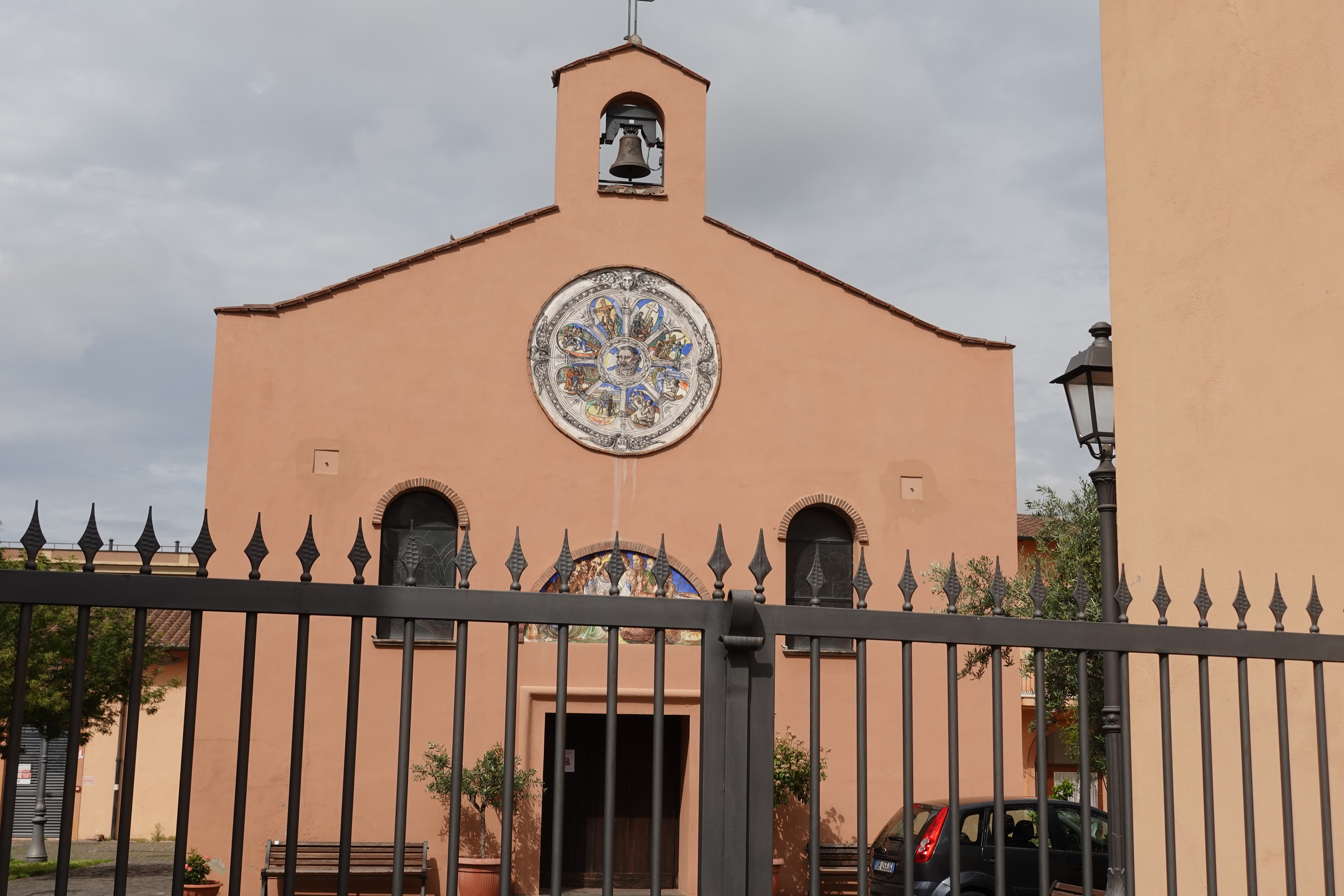
And next to it, tucked in a bit, a cute 20th-century chapel in something akin to mission style. 

Just beyond, as the street narrows, there is (or was just months ago), a mural by Alice, a prolific Rome street artist. Part of Alice's original work (she's known for painting young women) is visible behind the cars that are usually parked there, and part has been covered by graffiti "artists." A portion of her mural is visible upper right. 


The lower left portion of this wall proved fertile territory for this "accidental art"/found art photographer, a portion of it (below) ending up as his business card.


Following the road, you'll come upon an arch, usually highly decorated by the spray-paint crowd. Why it exists we have no idea. Here is Dianne, photographed with the arch, though from the other side. 


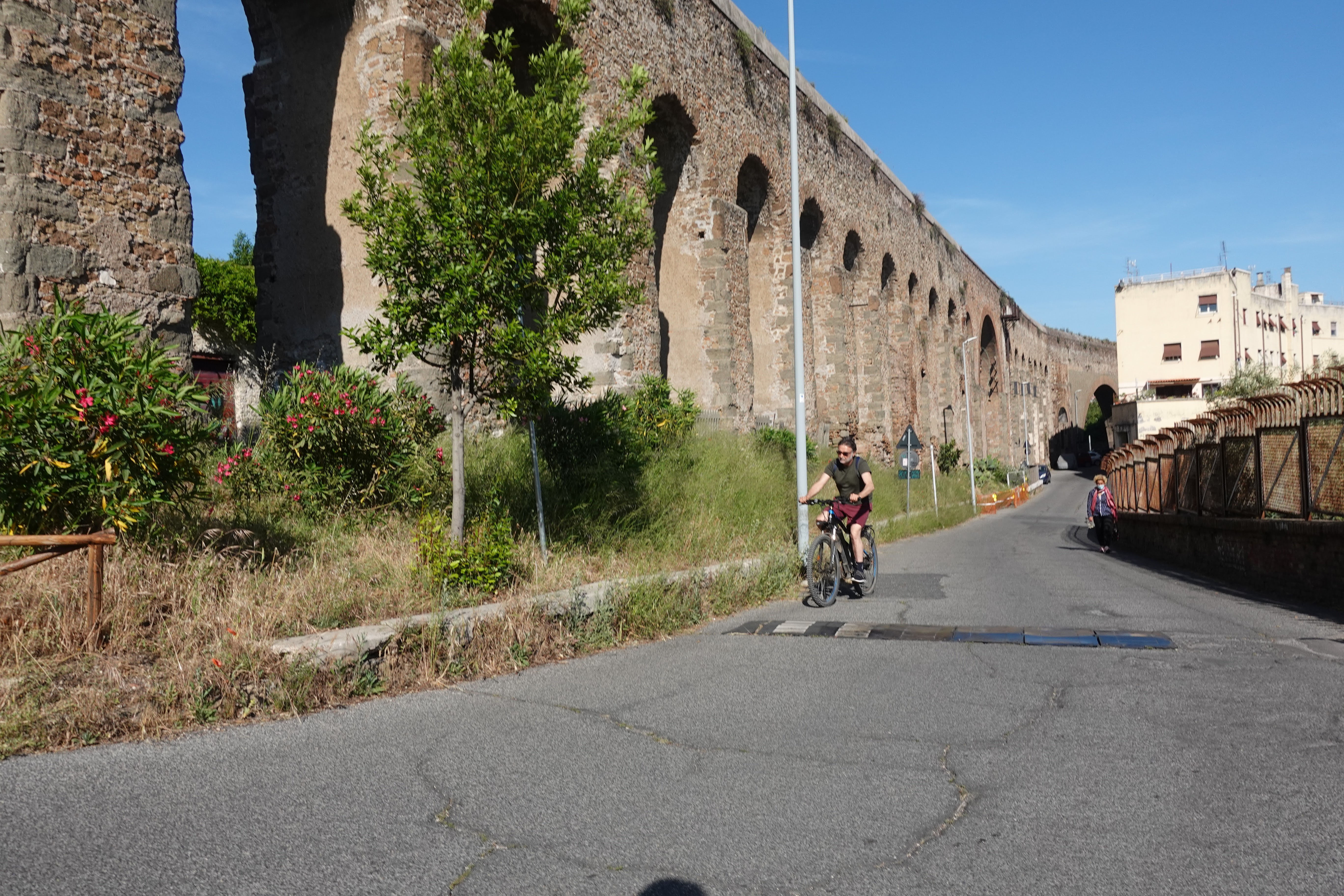
Ahead, the centerpiece of the journey, the aqueduct Acqua Felice. It's not ancient. Dating to the late Renaissance, it was constructed under Pope Sixtus V. Still it's very cool, and here are there it utilizes the columns of Aqua Claudia (of ancient origin). "Felice" is over 28km long--and you can see it rise from ground level a few miles out at the Parco degli Aquedotti (Park of the Aqueducts). 

Just as the road looks like it's going to go through an aqueduct arch, it turns sharply left, crossing the tracks--just one lane, and quite a bit of traffic. Not the safest spot for a pedestrian. 


Then the road turns again, runs through the aqueduct--and you'll find yourself walking on its western side. 


Although most of the arches date to the late 16th century, a few--they will be obvious--were constructed at the turn of the last century to allow access for trains.


Further along, you'll find homes on one side of the street, the aqueduct (and apparently some homes and businesses) on the other. 


One of the businesses, located in and through an aqueduct arch, specializes in copies of statues and other ancient and Renaissance pieces:


This staircase seems to lead through the aqueduct to a home:


Inside one of the arches, someone has created a devotional tableau:


When via Casilina Vecchia dead ends, turn left, through the aqueduct, then immediately right onto via del Mandrione. Poet, novelist, and film director Pier Paolo Pasolini spent a lot of time in the Mandrione neighborhood, seeking the "real" Rome.  [D: all signs of inhabitants where he once strolled are now gone. No doubt in the name of "slum clearance."]


About 200 yards ahead, there's a narrow passage-way off right. 


Turning left out of the pass way, a few yards down you'll find another lane off to the right, leading to a staircase--and beneath it, the Tuscolano 'hood. Turn right at the first street and work your way back to  Piazza Lodi--and through the wall to via Castrense, and your starting point. 

Another side of Rome. Sweet!

Bill