Rome Travel Guide

Rome Architecture, History, Art, Museums, Galleries, Fashion, Music, Photos, Walking and Hiking Itineraries, Neighborhoods, News and Social Commentary, Politics, Things to Do in Rome and Environs. Over 900 posts

Thursday, March 30, 2023

To Dub or Not to Dub? Rome Has the Answer


The prestige of Italian dubbers is obvious in this projection on Rome's Coliseum of dubber Gigi Proietti the day after his 2020 death at 80. Proietti "voiced" Robert De Niro, Sylvester Stallone, Richard Burton, Richard Harris, Dustin Hoffman, Paul Newman, Charlton Heston and Marlon Brando.

To dub or not to dub; that is...not a silly question. Italians especially have taught us the value of a dubber (doppiatore, literally a “doubler”), make that “voice actor,” a respected profession in Italy.

The value Italians give to the craft is exhibited by what are known as the “Italian Oscars”—The International Grand Prize of Dubbing, il Gran Premio Internazionale del Doppiaggio. The 14th annual prizes were handed out at the recent March 27 ceremonies. Italians’ attraction to dubbed films was also underscored recently, when the dubbers went on strike for 3 weeks, protesting a contract that expired 12 years ago. As a consequence, no dubbing took place, and no shows were aired dubbed. When, during the strike (it’s now on pause), Sky TV streamed the 7th episode of HBO’s smash hit “The Last of Us” in its original language, English, Italian audiences reportedly were disoriented.


Above, Simone D'Andrea, who won the jury prize
for "Best Male Voice" this year for his dubbing
of Colin Farrell in "The Banshees of Inishirin.
"
He's also known for anime voicing.


Chiara Colizzi won this year's jury
award at the International Grand
Prize for Dubbing for "Best 
 Female Voice" for her dubbing of
 Michele Williams in "The
Fablemans." She's also been
the voice of Nicole Kidman
and Kate Winslet.


Unlike most Italians, Americans generally devalue dubbed films. For those of us who were introduced to “foreign films” in church basements or tiny art houses, “dubbed” films were considered vastly inferior to subtitled ones. We might not have known one word in Swedish, but we considered it critical to hear the sounds of the original actors in those Ingmar Bergman classics. Were we wrong?

Edward Lynch, a dual citizen and multi-lingual professor in Rome, who created a website devoted to films in original language showing in that capital city, seems to be the perfect person to defend subtitles. But, like us, he’s modified his views somewhat over the years. “I used to see dubbing as something really bad. But maybe it’s not all that bad. The problem in Italy was that there wasn’t much of a choice in the past. All films were dubbed.”

Above, the dubbers at left of three leads in "The Godfather."
From the top, Giancarlo Giannini (a famous actor in his own right)
 for Al Pacino, Leo Gullotta for Joe Pesci, and Stefano De Santo 
for Robert De Niro.

Lynch points to “Parasite,” the 2019 Korean movie that went on to win the Oscar for Best Picture, one of the few foreign films to do so. He saw it with subtitles, and says that by spending time focusing on reading the words, “I think I missed a lot.” He adds, “Even if it’s in a language I don’t know, I want to see it in the original with subtitles. But maybe I’m being too stubborn. I think I would have liked to have seen ‘Parasite’ dubbed.”

Dubbing may be coming more into its own internationally with streaming. The film that won this year’s Oscar for Best Foreign Film, Germany’s “All Quiet on the Western Front,” was offered (on Netflix) in several versions, including a dubbed English version. A non-German speaker can choose to watch it either dubbed or subtitled. Streaming at home would seem to encourage this multiplicity of versions.

At least in Rome, one also has some of that choice at Director Nanni Moretti’s “Nuovo Sacher” theater in Trastevere, where the programming alternates showing a film one night dubbed in Italian and another in “v.o.”, versione originale (original version, i.e. with subtitles). Lynch asked the Nuovo Sacher box office whether one version was more popular than the other, and they responded that each attracted about the same number of viewers. Bear in mind, Nuovo Sacher is essentially an art house, attracting a clientele that might lean more towards subtitles than would the general public.

Italians’ attraction to dubbing means that Italy is one of the world’s premier dubbing countries. Along with France and Germany, it historically resisted subtitling on the grounds that dubbing would better promote the country’s native language. A perhaps unintended consequence is that people in Northern European countries (like the Scandinavian ones) speak English more readily, because they’ve been hearing the original more often.


This map of dubbing and subtitling depicts
in red the countries where dubbing is used 
exclusively in film and TV; in blue, the countries
where dubbing is exclusively for children's fare
and all else is subtitled. Orange are countries that
use dubbing occasionally, but otherwise only subtitling.

By now the Italian public is accustomed to dubbing, a practice dating back to the Fascist era. The first dubbing facility opened in Rome in 1932. Under a 1934 law, dubbing was required to be done in Italy by Italians to obtain screening permits. Other reasons given for the more expensive practice of dubbing, over subtitling, is that Italy had a relatively high illiteracy rate in that era, 21% in 1931, and that standard Italian did not start to become widespread until the 1950s (helped by dubbers). Apparently part of the Marshall Plan money after World War II also went into dubbing so that American movies could be popularized in the Italian market. Dubbing (as well as subtitling) also allowed a kind of stealth censorship. In 1943’s “Casablanca,” Rick (Humphrey Bogart) helped the Ethiopians against the Italian Army. In the Italian dubbed version, there’s no mention of this; instead Rick fought with Spaniards against the Fascists.

In 2018, 570,000 minutes were dubbed by professionals in Italy, and likely even more are being dubbed today. A 2019 headline in the Hollywood Reporter blared, “Netflix’s Global Reach Sparks Dubbing Debate: ‘The Public Demands It.’” One of their VP’s explained, “People say they prefer the original, but our figures show they watch the dubbed version.” Netflix now works with more than 100 facilities worldwide to meet increasing demand for dubbed content. It has 7 dubbing-approved studios in Italy, 6 of those in Rome.


Proietti, right, who voiced Gandalf (Ian McKellen)
in the "Lord of the Rings" series.

There are schools and programs in Italy today dedicated to dubbing. It’s considered a high art form there, equivalent to regular acting. The voice actors, as they prefer to be called, are famous throughout the country, as the “Italian Oscars” demonstrate. Roman Gigi Proietti, who died in 2020 at age 80, began as a stage and film actor, but he was most famous for his voice acting. As with many other voice actors, Proietti was the voice of multiple stars, among them Robert De Niro, Sylvester Stallone, Richard Burton, Richard Harris, Dustin Hoffman, Paul Newman, Charlton Heston and Marlon Brando. When Hoffman, De Niro or Stallone make new films, Italians will have a tough adjustment to make.

Italians like dubbed films because, says Lynch, “they can recognize all the dubbed voices. It’s something that the Italian audience gets used to, these actors who dub and always dub the same actors.”


Proietti was recently honored with
an enormous mural on a wall in the
Tufello quarter of Rome, the
working class area where he was
born and raised.

It’s hard not to see those many flyers and ads around Rome that promote dubbing schools. The field generally is referred to as audiovisual translation or AVT, and is popular in all of Europe. Massimo Vizzaccaro is a professor at one of the more illustrious of those schools (one that doesn’t have to slap paste-ups on telephone poles). The program at his university is an intensive 12-month Master di Primo Livello (“Master’s first level”; the full name is Master in traduzione e adattamento delle opere audiovisivi e multimediali per il doppiaggio e il sottotitolo - “Master’s in translation and adaptation of audiovisual and multimedia works for dubbing and subtitling” or Master TEA for short). To apply, one must have a (minimum) 3-year undergraduate degree.

“It’s a hands-on course,” says Vizzaccaro, “because these students are physically taken into dubbing studios; so they see how you need to work.” It’s the longest standing program of its type in Italy, founded some 20 years ago by Sergio Patou Patucchi, a scholar of the subject who was the voice of, among others, Yogi Bear and his companion Boo-Boo. The program also provides a number of different courses, including Vizzaccaro’s own “British and American Civilizations.” His course is essential, the Roman professor points out, because to be good at their trade, dubbers need to understand the culture that produces the content they are dubbing.


Ferruccio Amendola, left, the "king"
of voice actors before his 2001 death,
with one of his actors: Sylvester Stallone.


Schools notwithstanding, a lot of the business in Italy is passed through the family, like many other Italian professions (e.g. notaries – a much more important position there than in the U.S.), Vizzaccaro notes. (“Nepo babies” are also common in Hollywood, as we know.) Carlo Valli, the voice of Robin Williams among many others, and Cristina Giachero (voice of Scarlett Johanssen and Laura Dern among dozens) are the parents of two voice actors, Ruggero and Arturo, both of whom got their start as voices of children or animated figures (Arturo as the young Andy in “Toy Story”). Ferruccio Amendola, considered the “king” of voice actors (before his 2001 death, he voiced De Niro, Stallone and Hoffman), was married to voice actress Rita Savignone (Vanessa Redgrave, Whoopi Goldberg).

Carlo Valli, right, who was the voice of
Robin Williams.


Dubbing, as well as subtitling, raises fascinating issues of cultural exchange and transmission, as does any translation. Decisions have to be made about everything from titles of films (“Scandalo a Filadelfia” [“Scandal in Philadelphia”] instead of “Philadelphia Story” [1940]) to names of characters (Rossella O’Hara instead of Scarlett O’Hara in “Gone with the Wind” [1939]), from regional accents to puns. Example of the last is how does one differentiate in Italian “where wolf”/“werewolf” to make a joke make sense in 1974’s “Young Frankenstein”? Apparently that was one of the more successful translations; we've quoted the English and Italian versions at the end of this post.

“Translating” regional accents into dubbed foreign language versions can be a challenge as well. According to Vizzaccaro, it's generally not feasible in Italian; the equivalent would be more cultural than regional and might be offensive or perceived as silly. There are attempts to make the transition. In the TV show “The Simpsons,” the Protestant Reverend Lovejoy has a Southern accent. In Italian, points out Italian language and cultural educator Valeria Mancuso, his dubber speaks with a Sicilian or Calabrian accent. Apu, the Indian proprietor of the Kwik-E-Mart in that series, in Italian speaks with a sing-song cadence and grammatical errors, both indicating he’s an immigrant.

The dubber also has to provide content that at least minimally resembles the words coming out of the actor’s mouth, basically lip-synching. Except in one anomalous case. Vizzaccaro pointed out Scarlett Johansson was an awards nominee for Best Actress for 2013’s “Her,” in which only her voice is present. In Italy, the dubbed version obviously featured someone else. As a result, Italian audiences had no chance to witness the award-winning performance. We might think it strange to have the same voice coming out of the mouths of Dustin Hoffman and Marlon Brando, but the Italians don’t. The “famous” quality of voice actors may have its counterpart in American animated features that often employ Hollywood stars, like Tom Hanks playing Woody in the “Toy Story” series.

Lynch also points out that some Italian films in the past were dubbed—Italian into Italian—because the dubbers have better voices. Elsa Martinelli won best actress at the 1956 Berlin film festival for her role in Mario Monicelli’s “Donatella,” even though her voice in the film is that of another actress. The Italian Wikipedia lists the doppiatori—there were at least 9—for the film (https://it.wikipedia.org/wiki/Donatella_(film)). This point evokes the transition in American films from silents to talkies, which, it’s generally agreed, ended the career of some of those whose voices didn’t match their screen personas.

The prestige of dubbing over subtitling is reflected not only in the economic and artistic commitment Italians have to the craft, but also in some cartoons. We end these ruminations on dubbing with this reminder of that prestige:

The top figure is labeled "Italian Dubbing"
and the bottom, "Subtitled Original"
Dianne

From "Young Frankenstein":

Inga: Werewolf!
Frankenstein: Werewolf?
Igor: There
Frankenstein: What?
Igor: There wolf, there castle!

Inga: Lupo ululà
Frankenstein: Lupo ululà?
Igor: Là!
Frankenstein: Cosa?
Igor: Lupu ululà, castello ululì!

Monday, March 6, 2023

Exploring Romanina


When we told our Roman friends that we had spent the afternoon in Romanina, one said "that's not even a place." That's a harsh judgment, but not entirely inaccurate. Romanina is a third-or-fourth-ring suburb of Rome, southwest of the Center and flanked on one side by via Tuscolana. It has the feel of an area, rather than a town or village. There's some commerce on the streets that course around it, but there's little to be found on the residential streets. The furniture store in the photo above is "the exception that proves the rule" (one of our favorite phrases, guaranteed to win most arguments). Despite our friends' cool response to our venture into Romanina, we came away once again appreciating what we found--the "Roman" experience.  

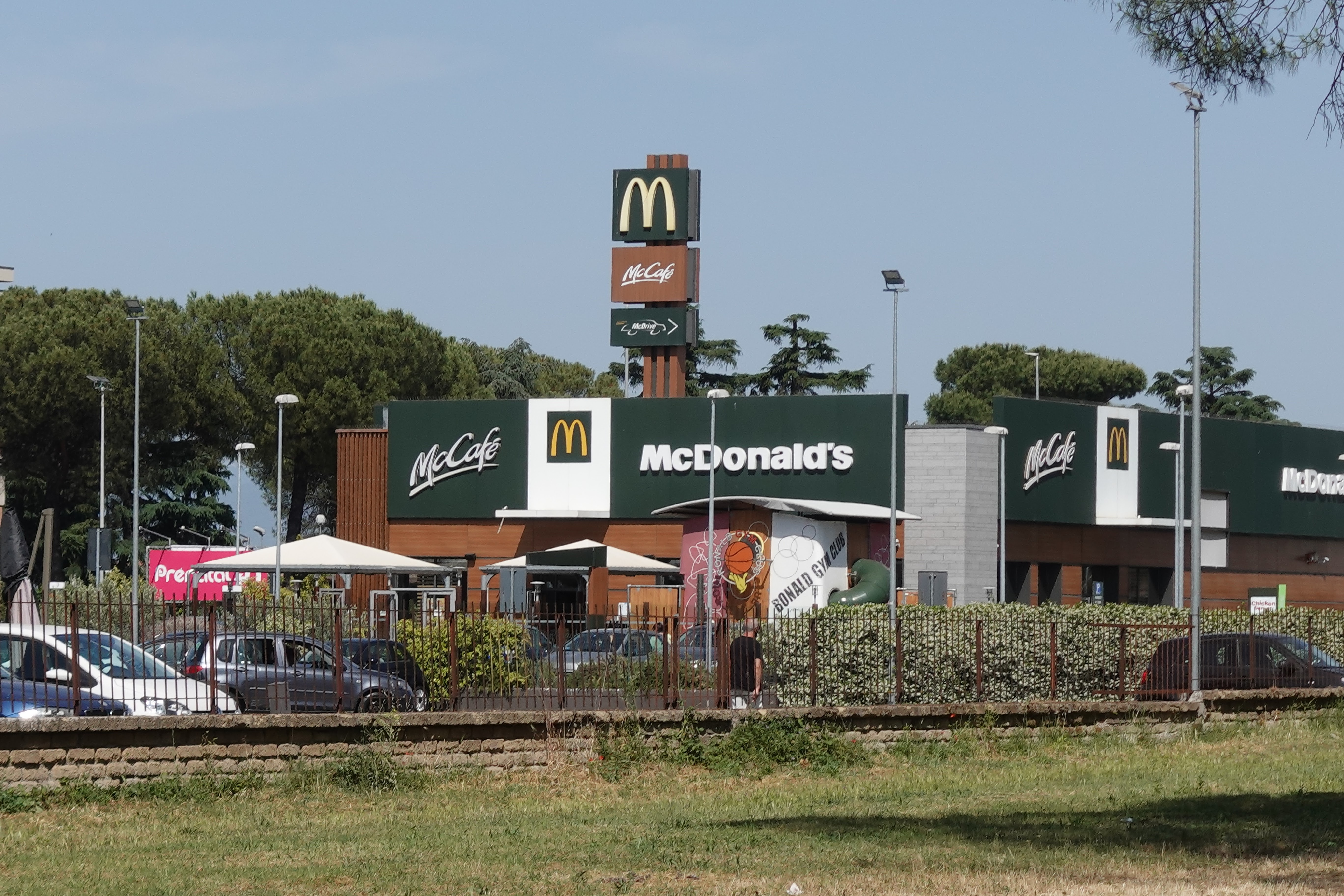
We parked our scooter at a McDonald's--here seen from in back--on one of the area's major thoroughfares. 


Down the street was an establishment that could have been in "beautiful downtown Burbank" (as Johnny Carson put it) or in Waco, Texas--or anywhere. The signage on the long building with a classic suburban parking lot reads "Old Wild West," and inside the structure, part of it was (in English) a "Steak House."


Across the busy street was a very Italian-looking building, whose function was impossible to determine.


Within 5 minutes we'd located the area's treasure--a long, thin, slightly curving park: Parco della Romanina. At each end, a painted arch welcomed patrons to (at that time) its parched grounds. Pine trees bent from prevailing winds.


It was mid-day and hot, and not much was happening in the park.


On one wall, a painted sign featured drawings (and names) of two women, presumably from Romanina, and the words "For all the women who struggle against the mafia(s)."


In contrast to the somewhat inviting Parco della Romanina, a small neighborhood park was overgrown to the point of being unusable--not uncommon in Rome and environs. 


We always enjoy looking at housing, including apartment buildings.


And we found an unusual single-family residence with a castle-like turret. Perhaps abandoned. Or they're just not picking up their mail.


The La Mela Hotel, not far from the western entrance to the park, had some interesting high balconies. 


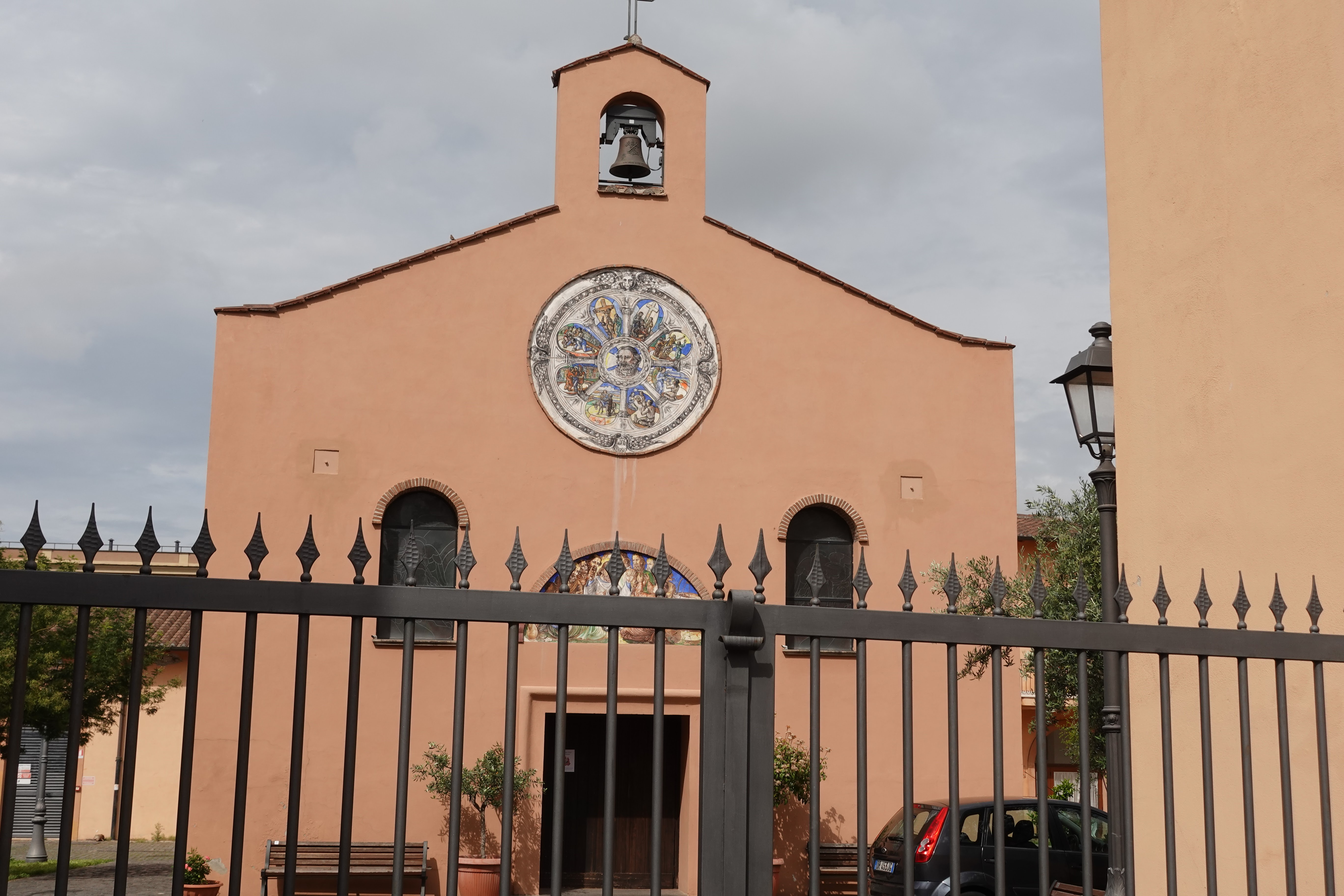
We found an open (and worthy) church to explore and admire.


After combing the neighborhood for some time, we finally came across a compact shopping area. It's a relief to know you can buy stuff in Romanina. Dianne appears uninterested.


Exhausted by the richness and splendors of Romanina, we returned to McDonald's--and our scooter.  

Bill


Monday, February 13, 2023

Following Fermi: The Great Physicist in Rome

Traces of Enrico Fermi, one of the world's greatest theoretical physicists, are visible in Rome, the city of his birth and where he was driven out by Fascism.

Fermi, an acknowledged prodigy in math and science, started his work on a street now more known for its night-life, via Panisperna in the Monti quarter. He and his associates were dubbed "I ragazzi di via Panisperna," - "the boys of via Panisperna," and are captured in the photo below:


Enrico Fermi at far right. The
other "ragazzi" 
from left to right, Oscar D'Agostino,
Emilio Segrè, Edoardo Amaldi,
and Franco Rasetti. The photo
 was taken by a sixth, Bruno Pontecorvo.
The background looks very much
like the buildings on via Panisperna
today, though #90, where the institute
supposedly was, is an older church.
As a result, we are not sure exactly where on 
via Panisperna the institute was located.


Fermi's location beginning in 1935 is well-known, and now bears his name, as well as sporting a plaque commemorating his extraordinary research there. And that's in the main campus of Rome's storied university, La Sapienza, or La Città Universitaria, designed by Mario Piacentini and opened in 1935 (the subject of prior posts, including one on Gio Ponti's math building and another on Mario Sironi's "Aula Magna" mural - Great Hall - painted in 1935).

In May 2018 we joined a guided tour of the University's physics department, located in one of Piacentini's original set of buildings. 


Left, the Department of Physics is named for Fermi.


The Physics Institute itself is named for another Nobel-winning Italian physicist (and member of the Fascist Party, as was Fermi at one point), Guglielmo Marconi, as seen here:

The plaque below - inside the building - reads:
"In this institute from 1927 to 1938 Enrico Fermi taught and studied. Here he investigated the structure of materials and discovered the radioactivity caused by neutrons [actually neutrinos], opening new avenues in the world. To the knowledge and power of man." [As noted, the institute was located on via Panisperna until about 1935.]


What the plaque does not say is that in 1938, when Fermi, age 37, went to Stockholm to accept his Nobel prize in physics, he kept going - to the United States, fleeing with his family from the racial laws of Italy that had already affected the lives of many of his colleagues and potentially would affect his wife, who was of Jewish heritage.

The tour included parts of Fermi's lab (left), and a cabinet of Fermi tools and books (below, right).


Besides the photo of i ragazzi di via Panisperna, other photos on display on the tour included the one below of Fermi with two other giants of theoretical physics, Werner Heisenberg and another Italian, Wolfgang Pauli (below, the German Heisenberg in the center, Pauli on the right), at Lake Como (date unclear).


The Nobel Prize website has a good biography of Fermi and lay-person descriptions of his scientific breakthroughs (at least one of which was developed based on Pauli's research).

Dianne


Thursday, January 19, 2023

A New Stadium for A.S. Roma: a Walking Adventure in Rome's near-in Countryside

Rome's A.S. Roma football club has been looking to build a new stadium for years. One effort collapsed when it became clear that the location--Tor di Valle, to the southwest of the city--would produce traffic chaos whenever there was a game. The latest idea (and at this writing it seems more likely to come to fruition) is to place the new stadium in an area of (more or less) unused land, at the intersection of Tiburtino and Pietralata--and across some railroad tracks and a highway from Piazza Bologna. Here's a map, with the location of the proposed stadium at center left (inserted as if it's there, below the road, just above the red Metro sign and to the right of the large P).

In early May, we set out to have a look at the area--not a place we had ever been. We parked our scooter on via dei Durantini (to the best of my recollection) and it didn't take long to come across a "Centro Revisioni" (for getting your vehicle its yearly test), located in a shack-like building at via del Casale Quintiliani, 115.

Not far beyond, we discovered the isolated Quintiliani Metro station (and bus turnaround). Heading down into the station, we didn't see a single person. Nor did the bus, which turned around while we were there, drop anyone off or pick anyone up. If and when the stadium arrives, the station will be busier--at least during soccer season. See the map above for the location of the Metro station. 


Plenty of graffiti, but no passengers

Up a hill, there's a carrozzeria (a car repair place), in as remote a location as the Metro station. If you can get your car there, it doesn't need repair.


Then, more run-down buildings.


We found lots of open land, sprinkled with roads (some of them of fairly recent origin) that are no longer in use--a project or projects that never panned out.


Some nice views of the nearby "city" (Piazza Bologna in the distance)?


And lots of poppies on the roadsides.


A rusted sign that I later converted into "accidental art." Ala Georges Braque (I know: "he's no Braque")


A few more businesses, including this small iron and aluminum foundry, not far from the Tiburtina Metro and train station:

A tunnel in use, but to where?


Off via dei Monti Tiburtini, a path into the future stadium site (we did not take it). This is a not a street for pedestrians--no sidewalks; we had to run now and then to avoid being on the street. 


Turning off via dei Monti Tiburtini, we found a nice coffee shop, chatted with the owner about the prospect of a stadium nearby, and returned to our scooter. A grand adventure!

Bill 


Monday, December 26, 2022

Via Casilina Vecchia: the "Funky" side of Rome

If you're searching for Rome's "funky" side, you can't do much better than a stretch of via Casilina Vecchia, running southeast off via Castrense, a street that connects the Tuscolano neighborhood with Pigneto. (We're not talking about via Casilina, a nasty street for walkers that runs parallel with "Vecchia" on the other side of some railroad tracks). 

The first thing you'll see is the massive complex of Casa Santa Giacinta--a Catholic charity serving the poor and elderly


And next to it, tucked in a bit, a cute 20th-century chapel in something akin to mission style. 

Just beyond, as the street narrows, there is (or was just months ago), a mural by Alice, a prolific Rome street artist. Part of Alice's original work (she's known for painting young women) is visible behind the cars that are usually parked there, and part has been covered by graffiti "artists." A portion of her mural is visible upper right. 


The lower left portion of this wall proved fertile territory for this "accidental art"/found art photographer, a portion of it (below) ending up as his business card.


Following the road, you'll come upon an arch, usually highly decorated by the spray-paint crowd. Why it exists we have no idea. Here is Dianne, photographed with the arch, though from the other side. 


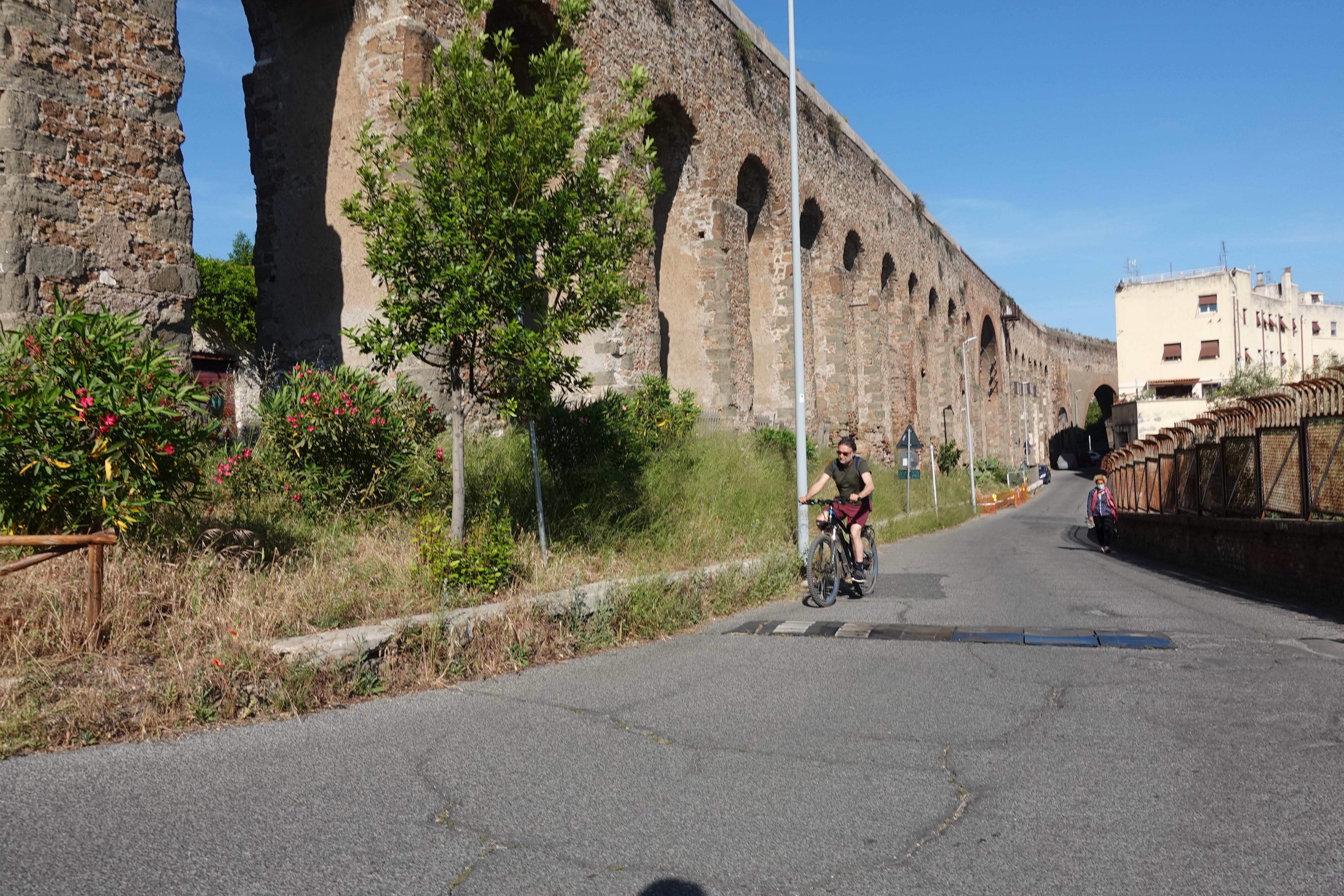
Ahead, the centerpiece of the journey, the aqueduct Acqua Felice. It's not ancient. Dating to the late Renaissance, it was constructed under Pope Sixtus V. Still it's very cool, and here are there it utilizes the columns of Aqua Claudia (of ancient origin). "Felice" is over 28km long--and you can see it rise from ground level a few miles out at the Parco degli Aquedotti (Park of the Aqueducts). 

Just as the road looks like it's going to go through an aqueduct arch, it turns sharply left, crossing the tracks--just one lane, and quite a bit of traffic. Not the safest spot for a pedestrian. 


Then the road turns again, runs through the aqueduct--and you'll find yourself walking on its western side. 


Although most of the arches date to the late 16th century, a few--they will be obvious--were constructed at the turn of the last century to allow access for trains.


Further along, you'll find homes on one side of the street, the aqueduct (and apparently some homes and businesses) on the other. 


One of the businesses, located in and through an aqueduct arch, specializes in copies of statues and other ancient and Renaissance pieces:


This staircase seems to lead through the aqueduct to a home:


Inside one of the arches, someone has created a devotional tableau:


When via Casilina Vecchia dead ends, turn left, through the aqueduct, then immediately right onto via del Mandrione. Poet, novelist, and film director Pier Paolo Pasolini spent a lot of time in the Mandrione neighborhood, seeking the "real" Rome.  [D: all signs of inhabitants where he once strolled are now gone. No doubt in the name of "slum clearance."]


About 200 yards ahead, there's a narrow passage-way off right. 


Turning left out of the pass way, a few yards down you'll find another lane off to the right, leading to a staircase--and beneath it, the Tuscolano 'hood. Turn right at the first street and work your way back to  Piazza Lodi--and through the wall to via Castrense, and your starting point. 

Another side of Rome. Sweet!

Bill