Rome Travel Guide

Rome Architecture, History, Art, Museums, Galleries, Fashion, Music, Photos, Walking and Hiking Itineraries, Neighborhoods, News and Social Commentary, Politics, Things to Do in Rome and Environs. Over 900 posts

Showing posts with label Caravaggio. Show all posts

Tuesday, February 25, 2025

The Hospital Where Pope Francis Is Being Treated: Policlinico Gemelli in Rome

Main hospital buildings, with statue of Pope John Paul II (and smokers).

We wish Pope Francis well. The news media are full of reports of his hospitalization at Rome's Gemelli Hospital (Policlinico Gemelli). It's in a location few non-Romans know. We thought some of those non-Romans might appreciate photos of more of the sprawling complex where the Pope is being treated. We went out there (and it is to most people "out there") one day looking for wall art. In the process, we explored the hospital and learned something about it. Most of our photos of the hospital complex are at the end of a December 2019 post that we have reprinted here mostly as it was published then.

We learned (after our 2019 visit) the Gemelli complex has 5,000 employees and hosts about 30,000 people on any given day. Hence, my reference below to a "small city" - perhaps not so small.

Getting to Gemelli and finding the works was another issue. The complex is so enormous that we had problems even finding our way in - it's not made for pedestrian access.  Once in, most people - and we asked a lot of them, including at the front desk and in the library - had never heard of the work of the street artist we hoped to find there, even though he had recently completed the Leonardo shown below.  And, the Caravaggio (also explained below) is in a building quite a distance from the main ones, on a hill. At one point, due to my poor translation, I thought we were looking for 7 works by Ravo (mistaking the "Seven works of mercy" - also a failure of my training in art history- sorry, Mrs. Reinhart from Stanford-in-Italy).

Bill hauled us out to Trionfale and the hospital complex (no mean feat - these are not roads meant for anything but high-speed autos) on a day when no rain was predicted.  So, of course, it rained (recall, we are on a scooter).  Ultimately, the adventure was successful.  We saw two magnificent pieces of wall art, a glimpse into the life of hospitals in Rome (not that I haven't had others - very close up and personal), and the rather unfortunate story that most people don't even know these paintings exist.


To some, the painting above may be familiar.  It's Caravaggio's 1607 "Seven Works of Mercy," the original now in Naples, here replicated on the immense exterior wall of one of the many buildings of the Policlinico Gemelli (Gemelli hospital - more like a small city) in Rome's northern Trionfale quarter.

The artist signs himself Ravo; full name Andrea Mattoni, a Swiss-Italian whose hallmark is replicating the Old Masters or, as Ravo states it, "the recovery of classicism in the contemporary."  The Caravaggio above, completed in December 2017, was the most complex wall painting Ravo had done to date. In an interview, he stated (not my translation): 

Closeup of Ravo's painting; "Visit the
imprisoned and feed the hungry."


“It’s like if I was a conductor who present a symphony drawing from an immense repertoire and my theater is the territory itself. I become a transmission channel that follows the ancient tradition of the copy of the work, a practice that was once widespread for the diffusion of paintings. I try to present them to a larger and unexpected audience, carrying forward also my background: graffiti. In fact, the spray is the common thread that connects with my past, where I come from, and it is precisely for this reason that I chose the spray can as my running stick.”  

(You can see the work in process in late 2017 here.)

He is, of course, speaking our language when he inserts the unexpected - in this case the classical - into an unattractive contemporary landscape - the suburban hospital complex.

Ravo completed a second work at Gemelli this past Spring. We saw it shortly after it was completed.  "Madonna Litta," a late 15th-century painting in the Hermitage, is attributed to Leonardo. Ravo painted it in commemoration of the 500th anniversary of Leonardo's death.  It sits above a busy road within the hospital complex:


For photos of the Leonardo work in process, see here (article in Italian).


Ravo also has a Facebook page. One of his posts (they are in English) started with this quote: "All art is contemporary, or it was at some point."

One can debate whether replicating great art is itself art. It has been historically. And we like what Ravo is doing to our often isolated and forbidding urban landscapes


Below, more of our hospital pix.  

Dianne
The entrance to the complex is rather unassuming,
though somewhat intimidating for pedestrians.


The hospital seems to have its own highway system.


And its own bridges...Calatrava step aside!


Hard to capture the effect with this small photo, but this
 could have been the largest - and busiest -  hospital cafeteria
we've ever seen. We didn't even try to get a coffee.

No post is complete without a scooterpark pic.
(The sign says "motorcycle exit.") Ravo's Leonardo
painting is up on the right.


Tuesday, October 17, 2023

36 Hours Around Piazza Navona

 A friend recently asked us for suggestions of what to do around Piazza Navona and Campo de' Fiori. She was clear that she and her companion would be in Rome only 3 days, had seen the big sights and did not want to go back to those this time, and they did not want to do much walking. So maybe this is "36 Hours in Piazza Navona and Campo de' Fiori." 

We put our heads together, created a list and a map for her, and enjoyed the exercise enough that we have made it into 2 blog posts, the first on Piazza Navona and the second on the Campo. Here's our map of Piazza Navona for starters, and you'll see #1 is Bernini's Fountain of the Four Rivers - not exactly Rome the Second Time, but a good place to begin any walking around.

Below is the code we gave our friends (with a few elaborations; and note she has been a French teacher - so there are a few Francophile hints here) for our suggested meanderings in and around the piazza. Bear in mind our idiosyncrasies, and that we leave all restaurant suggestions to Katie Parla (https://katieparla.com/city-guides/rome/)

Piazza Navona and environs:

1.         Fountain of the 4 Rivers (Fontana dei fiumi – Bernini)

Piazza Navona can be a magical space, especially when no one's around, like at dawn.

Piazza Navona at dawn. Borromini's Sant'Agnese in Agone (see #2, below) is at left. 

But not always. In 2014, we encountered Bernini's lovely fountain while city workers were repairing the stone pavement around it. And the piazza has its sometimes tawdry, commercial side. 


2.         Sant’Agnese in Agone – (church) by Borromini  

            So between #1 and #2 here you get a feel for the great rivalry of architects/sculptors: Bernini  - the sculptor who was an architect - and Borromini, the architect whose architecture is sculpture. You'll have to look up for yourself the apocryphal story that one of Bernini's figures in the 4 Rivers Fountain has his head turned away so as not to see Borromini's church (the statue was erected first).

3.         Embassy of Brazil – often has art shows you just walk into. We like these one-off exhibits that often are open all day, are free, get you inside a classic palazzo, and often are very good - usually contemporary -  art.

4.        Palazzo Braschi – excellent museum (generally Rome, 17th century on), sweet café – easy to walk thru – often free shows on the ground floor – beautiful cortile - https://www.italofile.com/museo-di-roma-palazzo-braschi/ - this article says “best museum in Rome you’ve never visited." Re the free shows: it was here we learned about Raffaele di Vico and his extraordinary contributions to Rome's cityscape in the 20th century, and saw a moving photo/quotation exhibit of women trapped in abusive relationships. As noted, the shows are wide-ranging.

5.         Portuguese Institute – We have been to shows here (met the architect Julio Lafuente one evening - we are taken with his buildings), but can’t locate it nor a site for it – walking around Piazza Navona just looking is a pleasure anyway (if you can avoid all the hawkers).

6.        Stadio di Domiziano (Piazza Navona was built over it) - underground archeological site – small and interesting – not sure of opening times; sometimes has exhibits as well. This is a good way to get your ancient history fix, and to learn more about Piazza Navona - https://www.tripadvisor.it/Attraction_Review-g187791-d196846-Reviews-Stadio_di_Domiziano_Navona_Square_Underground-Rome_Lazio.html
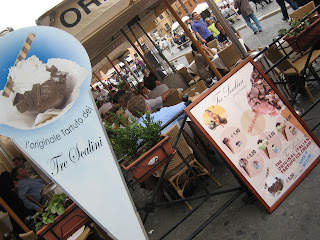
7.         Tre Scalini tartufi – just go and get one of those to split – amazing gelato dessert – make sure you go to this corner and not across the little street to a copy cat. Tre Scalini is the real deal. We wrote about the tartufo war in 2010: https://romethesecondtime.blogspot.com/2010/08/tartufo-truffle-war.html


8.        Hotel Raphael – one of the city's best rooftop bars and lobby – interesting political stories about it too – on the way to Santa Maria della Pace and Chiostro Bramante -

The imposing exterior of the Hotel Raphael,
as it was 15 years ago. 
https://daphnecaruanagalizia.com/2017/04/30-april-1993-angry-crowd-throws-coins-bank-notes-bettino-craxi/


9.         Chiesa di Santa Maria della Pace – lovely, limited hours

10.      Bramante Chiostro & exhibition space - https://www.chiostrodelbramante.it/?lang=en  Beautiful cloisters and has a café, plus current show is Pistoletto –the contemporary Italian artist famed for his use of mirrors.
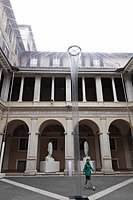
Bramante Cloister  - can't recall the
name of the show but fairly
certain those 2 "head" sculptures
are by the Spanish artist Jaume Plensa


A work by Pistoletto--this one at the State Department.


11.      Piazza di Pasquino – the original “talking statue” - https://romethesecondtime.blogspot.com/2012/10/pasquino-lite-romes-talking-statue-gets.html

Pasquino, right, with his messages relegated to a board next to him.


12.      Cul de Sac – on Piazza di Pasquino – considered one of the best wine bars in Rome – has food – don’t go to the salad place by mistake

13.      Otherwise bookshop – English one, just steps from Piazza di Pasquino  - on via del Governo Vecchio – nice street with boutiques, tho’ getting a bit gentrified

14.      Caravaggio – San Luigi dei Francesi – 3 amazing Caravaggio paintings – the French church in Rome

15.      Caravaggio – Basilica di Sant’Agostino – 1 Caravaggio – and the once Papal library next door is gorgeous – worth just walking up and looking at it (Biblioteca Angelica)

16.      Sant’Ivo – a Borromini masterpiece (church)

17.      Palazzo Napoleonico -  interesting for its French connection https://romethesecondtime.blogspot.com/2014/01/when-rome-was-french.html - it is NOT Palazzo Altieri – the entrance to Napoleonico is on the Lungotevere.

18.      Baracco museum – ancient sculpture – we think it’s free – we’ve never been in it!


Tuesday, December 3, 2019

Street Art Comes to the Hospital


To some, the painting above may be familiar.  It's Caravaggio's 1607 "Seven Works of Mercy," the original now in Naples, here replicated on the immense exterior wall of one of the many buildings of the Policlinico Gemelli (Gemelli hospital - more like a small city) in Rome's northern Trionfale quarter.

The artist signs himself Ravo; full name Andrea Mattoni, a Swiss-Italian whose hallmark is replicating the Old Masters or, as Ravo states it, "the recovery of classicism in the contemporary."  The Caravaggio above, completed in December 2017, was the most complex wall painting Ravo had done to date. In an interview, he stated (not my translation): 

Closeup of Ravo's painting; "Visit the
imprisoned and feed the hungry."

“It’s like if I was a conductor who present a symphony drawing from an immense repertoire and my theater is the territory itself. I become a transmission channel that follows the ancient tradition of the copy of the work, a practice that was once widespread for the diffusion of paintings. I try to present them to a larger and unexpected audience, carrying forward also my background: graffiti. In fact, the spray is the common thread that connects with my past, where I come from, and it is precisely for this reason that I chose the spray can as my running stick.”  

(You can see the work in process in late 2017 here.)

He is, of course, speaking our language when he inserts the unexpected - in this case the classical - into an unattractive contemporary landscape - the suburban hospital complex.

Ravo completed a second work at Gemelli this past Spring. We saw it shortly after it was completed.  "Madonna Litta," a late 15th-century painting in the Hermitage, is attributed to Leonardo. Ravo painted it in commemoration of the 500th anniversary of Leonardo's death.  It sits above a busy road within the hospital complex:


For photos of the Leonardo work in process, see here (article in Italian).


Ravo also has a Facebook page. One of his posts (they are in English) started with this quote: "All art is contemporary, or it was at some point."

One can debate whether replicating great art is itself art. It has been historically. And we like what Ravo is doing to our often isolated and forbidding urban landscapes

We later learned the Gemelli complex has 5,000 employees and hosts about 30,000 people on any given day. Hence, my reference to a "small city" - perhaps not so small.

Getting to Gemelli and finding the works was another issue. The complex is so enormous that we had problems even finding our way in - it's not made for pedestrian access.  Once in, most people - and we asked a lot of them, including at the front desk and in the library - had never heard of Ravo's work, even though he had recently completed the Leonardo.  And, the Caravaggio is in a building quite a distance from the main ones, on a hill. At one point, due to my poor translation, I thought we were looking for 7 works by Ravo (mistaking the "Seven works of mercy" - also a failure of my training in art history- sorry, Mrs. Reinhart from Stanford-in-Italy).  

Bill hauled us out to Trionfale and the hospital complex (no mean feat - these are not roads meant for anything but high-speed autos) on a day when no rain was predicted.  So, of course, it rained (recall, we are on a scooter).  Ultimately, the adventure was successful.  We saw two magnificent pieces of wall art, a glimpse into the life of hospitals in Rome (not that I haven't had others - very close up and personal), and the rather unfortunate story that most people don't even know these paintings exist.

Below, some of our hospital pix.  

Dianne
Main hospital buildings, with statue of Pope John Paul II (and smokers).
The entrance to the complex is rather unassuming,
though somewhat intimidating for pedestrians.


The hospital seems to have its own highway system.


And its own bridges...Calatrava step aside!


Hard to capture the effect with this small photo, but this
 could have been the largest - and busiest -  hospital cafeteria
we've ever seen. We didn't even try to get a coffee.

No post is complete without a scooterpark pic.
(The sign says "motorcycle exit.") Ravo's Leonardo
painting is up on the right.


Saturday, October 6, 2018

Palazzo Barberini Opens Up with Show Juxtaposing Renaissance and Contemporary Art

Giulio Paolini's contemporary "Eco nel vuoto" (Echo in the void)
 in the same room as Caravaggio's "Narciso" (Narcissus) (1597-99) (also below right).
Palazzo Barberini - that staid old lady in the Centro housing major Renaissance paintings and sculpture - has something new to offer. Following an accord between the Ministers of Cultural Heritage and Defense, the entire South wing of the building, comprising 10 rooms and a small chapel, has been turned over to public use.

From 1934 until this agreement in 2015, the "circolo" - or social center - for the Armed Forces occupied these rooms, perhaps not their highest and best use. We saw some of these odd uses when we highlighted the grounds of the Barberini in a 2014 post. Pursuant to this unusual agreement, the Defense Ministry contributed almost €2 million (about $2.3 million). And they get to use the rooms for 40 days/year - for "reasons of high representation."

That curious story aside, the rooms are magnificent and the opening show - which closes at the end of this month (Oct. 28), is a great one with which to open the South wing. Titled Eco e Narciso ("Echo and Narcissus"), it's a creatively curated matching of Barberini Renaissance works and contemporary pieces. I admit, I'm a sucker for that type of juxtaposition dating from when I saw a show entitled "Antiques in the Modern Home" - or something like that - in the Palazzo Strozzi in Florence in the 1960s.
Bernini's sculpture of Pope Urban VIII flanked by Yan Pei-Ming's
paintings of Pope John Paul II (2005) and Mao (1999?)


Paired for example are Gian Lorenzo Bernini's sculpture of.Pope Urban VIII (Cardinal.Francesco Barberini) with paintings of Pope John Paul II and Mao by Yan Pei-Ming; Renaissance paintings of women with Kiki Smith's sculptures; a room richly frescoed by Pietro da Cortona with Luigi Ontani's "Le Ore" ("The Hours").
Ontani's "Le Ore" (1975) in the large salon with
 da Cortona's ceiling fresco, "Allegory of Divine
 Providence"  (and Barberini Power), 1633-36.


The theme is portraiture and self-portraiture, and certainly Ontani about whom we've written before, fits the "Narcissus" theme.

Signature works by Caravaggio and Raphael are also prominent in this show, which features 19 more masterpieces from the collection of the Gallerie Nazionali, in dialogue with 17 contemporary works from MAXXI or loans, with three works realised for the occasion (including 2 for which there are photos here - by Giulio Paolini (top photo) and Yinka Shonibare (last photo).
Ontani again.

The juxtaposition of works was created by a Renaissance art curator and a contemporary art one: Flaminia Gennari Santori, of the Barberini/Corsini galleries, and Bartolomeo Pietromarchi, director of the 21st- century MaXXI Arte.  There's another piece to the show at MAXXI, featuring one Renaissance and one contemporary work.
Kiki Smith's "Large Dessert" (2004-05) against the backdrop of female portraits
by Rosalba Carriera and Benedetto Luti (both late 17th to early 18th centuries).

After the current show closes, the entire collection will be re-arranged. For those familiar with the Barberini, this likely is welcome news.  For those of us who visit intermittently, we probably won't notice the difference, except for one change - visitors now will enter on the Bernini stairs and descend on the magnificent Borromini stairs (left), until now closed to the public.  

More pictures of the show below. 

Dianne 
Pierre Subleyras, "Nude from behind," 18th century, paired with
Stefano Arienti's piece below.

Arienti's "SBQR, netnude, gayscape,
orsiitaliani..." 2000.


Yinka Shonibare's "The Invisible Man" (2018) with Marco Benefial's "Portrait of the Quarantotti Family (The missionary's family)" 1735.

Monday, October 30, 2017

Martin Luther: an Itinerary in Rome for the 500th anniversary of his "95 Theses"

On this the 500th anniversary of the day Martin Luther posted his rebuke to Catholicism, his "Ninety-five Theses" (October 31, 1517), we recommend an itinerary reflecting Luther's visit to Rome, 6 or 7 years earlier.

Luther confronting the Catholic hierarchy

                                      
     That four-week visit to Rome was crucial to Luther's observations of the excesses of Catholicism.  For a brief summary of his trip, see the the write-up of scholars Ron and Abby Johnson, St. Mark's Lutheran Church, Springfield, VA.  While this was a seminal period for Luther, the details of his visit remain sketchy, even the dates, as the Johnsons point out. Nonetheless, we think the following itinerary will satisfy those interested in this figure critical to modern religious thought. 

Luther's first view of Rome could have been from this spot on Monte Mario.
St. Peter's dome would not yet have been constructed.

Monte Mario:  Luther described his first sight of Rome as being from the "mountain" outside the city walls.  He is supposed to have said on his first look, "Holy Rome, I salute thee."  Of course, years later he said, "If there is a hell, Rome is built over it."

The city looked very different in the early 1500s than it did even at the end of that century, and of course very different from today, although the views would have been stupendous, as they still are.  Rome in the early 1500s was in the midst of an enormous church building spree.  The city was coming out of its "irrelevance" during the Middle Ages.  The population had grown to over 50,000 from a low of about 12,000, after being almost one million during the Roman Empire.  
The via Francigena on Monte Mario.  Where we encounter 4 British pilgrims
on their way from Orvieto to St. Peter's.
Luther would have seen the beginning of the Renaissance, though not its flowering.  Construction of the modern St. Peter's began in 1506.  In 1508 Michelangelo began painting the Sistine Chapel.  And Luther came before the 1527 Sack of Rome.  We've always found Monte Mario great 'trekking' and recommend it as a starting point for an itinerary for those who can handle the moderate heights and walking.  It's 1.2 miles from Ponte Milvio on the north bank of the Tiber to the entrance to the walk up Monte Mario, and less than a mile (and about 400 vertical feet) up to the top of Monte Mario (Lo Zodiaco).

Via Flaminia: From Monte Mario, it appears Luther came back down to via Flaminia, rather than approach St. Peter's, as do today's pilgrims on the via Francigena (St. Francis's way).  All pilgrims from the north would have walked along via Flaminia, which crosses into Rome over Ponte Milvio.  While we find the modern via Flaminia interesting (much of it is on one of our itineraries in Modern Rome: 4 Great Walks for the Curious Traveler), it has little left of the medieval city.

Ponte Milvio:  Luther would have crossed the Tiber at Ponte Milvio, where on October 28, 312 Constantine, who later converted to Christianity, the first Roman Emperor to do so, defeated his rival Maxentius.  The bridge retains its medieval style, though it's mostly known now for lovers who put padlocks on its rails. Once across the bridge, it's about a two-mile walk to the northernmost entrance to the city, Porta del Popolo, and the church for which it's named. 
Ponte Milvio.  Part of the 14th century toretta (little tower), which Luther would have seen, is still standing.
Porta del Popolo: Today's highly decorated, enormous "porta"--city gate--is vastly remodeled from the smaller porta Luther came through.  The porta had been built in the 1400s, as had the renovated church (1477), but on a smaller scale than they would have once rebuilt and remodeled.
The porta is on the far left; the church of Santa Maria del Popolo to the right of it.  Luther came through a smaller porta and was at the church. No cars and scooters in Luther's day.  Nor was the obelisk in the piazza.  Though brought
 to Rome in 10 BC, the obelisk was lost, then discovered in 1587 (in the photo the base is covered for restoration).
Inside Santa Maria del Popolo today - with crowds viewing the Carravagio
paintings.
Santa Maria del Popolo.  Luther no doubt next went to Santa Maria del Popolo, the small church on the piazza, now famous mostly for its 17th-century Caravaggio paintings of Saints Paul and Peter.  Even in the 1500s the church was a favorite of the Popes and had been substantially enlarged and remodeled from earlier versions.  

There is some debate over whether Luther stayed in the rooms adjacent to the church.  They would have been the only lodging in Rome belonging to an Augustinian order.  There is agreement that he either stayed at or visited Santa Maria del Popolo - so we've kept it on the itinerary.  Luther's journey was connected to disputes between the Observant and Conventional monasteries of the Augustinian Order.  Luther belonged to the Germanic Observant group, and Santa Maria del Popolo belonged to an order of Observant Augustinians as well, although Luther seems to have rejected the lavish meals he was served at whatever monastery at which he lodged. 

We recommend a two-part itinerary, and you can end part one at Piazza del Popolo.  You can make a very un-Luther like stop at the famous cafe Canova, where Director Federico Fellini had his morning coffee.


Scala Santa: Even though his 95 Theses rejected the concept of indulgences, Luther, on his trip to Rome, "was as eager to rack them up as anyone," according to one scholar.  "He even regretted that his parents were not still alive so he could earn a few for them."  (For more on what indulgences meant to Catholics, and Luther in particular, see Tom Browning's piece.)  Luther earned indulgences for ascending these steps on his knees, an act you can still see pilgrims performing.  One story states that Luther said, "Who knows whether this is true?" when he got to either the top of the stairs, or possibly when he quit half-way through.  Again, the details of his trip are sketchy, but it is clear his doubt was developing.  The Scala Santa, supposedly the stairs Jesus climbed on his way to his trial with Pilate and that were later transferred to Rome, are across a road (now) from San Giovanni in Laterano.  If you are doing the seven churches, described below, you can add these to your itinerary when you visit San Giovanni.

San Giovanni in Laterano, rebuilt after Luther was there.
The Seven Churches:  Another way to earn indulgences was--and is--to walk to the seven churches of Rome (see suggested itinerary below).  Luther surely did that.  They are worth a visit, even without an indulgence at stake.  Besides Saint Peter's and San Giovanni in Laterano, the historical seven are three outside the city walls--San Paolo fuori le mura ("St. Paul's without the walls"), San Sebastiano, San Lorenzo fuori le mura--and two more within: Santa Croce in Gerusalemme and Santa Maria Maggiore.  The street by the name "Sette Chiese" ("7 churches") still runs between San Paolo fuori le mura on via Ostiense and San Sebastiano on the via Appia Antica.  
Luther would have seen the 7th century mosaics
of St. John the Baptist at the San Giovanni baptistery

While you are at San Giovanni in Laterano, don't miss the Lateran Baptistry behind it, which Luther must have visited  It is one of the oldest buildings in Rome, dating to the 4th century, although substantially remodeled over the years, including by Borromini (post-Luther).  Luther would have seen an exterior much like the one today, however, and much of the same interior, since Borromini kept most of the existing building.  And it's one of my favorites in Rome.

Here's a suggested route for the seven churches: Start with Santa Maria Maggiore, the most central of the seven churches.  Walk 1.6 miles to San Lorenzo (outside the walls).  From San Lorenzo, walk 1.2 miles to Santa Croce in Gerusalemme (which is inside, and abutting the walls); then .9 miles to San Giovanni in Laterano (again, abutting the walls - you'll walk along the inside of the walls for this stretch; it was part of one of RST's wall walks--there's a google map here to guide you on that walk); then 2.6 miles to San Paolo fuori le mura; and from there, the walk along via Sette Chiese to San Sebastiano (again, outside the walls), 2-plus miles due east.  To add St. Peter's to the walk, begin with St. Peter's and then walk to Santa Maria Maggiore, 2.3 miles. Total: about 10.5 miles.  
San Sebastiano. 1610 facade.

More specific directions and a slightly different order of churches are available here.  Some suggest a modern version that substitutes the sanctuary Divino Amore, 9 miles from San Giovanni, for San Lorenzo.  I'm a San Lorenzo fan and, of course, Divino Amore would not have been on Luther's route.  And, if you go to Divino Amore, take a bus.

Piazza Martin Lutero:  In a nod to ecumenism, a piazza in Rome recently was renamed for Luther.  It took 6 years to get the piazza named for Luther, and the delay meant it did not get renamed in time for the 500th anniversary of his 1510 (if that's the date) trip to Rome. The Vatican went along with the re-naming, even though Luther was excommunicated in 1521. This piazza seems an appropriate end point for the itinerary.  The piazza is in a park, away from streets and therefore unlikely to be paved over anytime soon.  It's near the Coliseum, with a large Fascist-era fountain (1928-29 by Raffaele De Vico, for trivia lovers), trees, and views.  It's on the southeastern side of Colle Oppio, not too far from the Domus Aurea and above via Labicana.  The piazza is less than 1/2 mile from San Giovanni in Laterano, in the direction of St. Peter's.  You will note Luther's first name is not converted to Italian (that would be Martino), and his last name is.  But not even "Luther" was his name at birth; he chose it.  See the Johnsons again.  The sign erected in the piazza in 2015 describes Luther ("Lutero") simply as a "German Reform Theologian."  

Dianne


Sunday, November 23, 2014

Galleria Doria Pamphilj - the Third Time

Courtyard - hard to believe this is off via del Corso
Galleria Doria Pamphilj (or Pamphili) is a stupendous gallery of  paintings and sculpture in the heart of Rome.  For many years it has been on the path of those seeking to see all Caravaggios in Rome and perhaps a few others, in a seen-better-days enormous palazzo sitting on Piazza Venezia.

Bagno di Diana
I always loved the gallery, where I first went in 1993 with Nancy DeConcillis and her intrepid group of international women "stuck" in Rome while their husbands worked (that was me!).  I had been back once about 10 years ago, but returned this year and found the Galleria and the Palazzo totally transformed.  Hard to believe John Cheever lived in an apartment here (and didn't like it, as I recall). I tried to go in through the entrance on the nondescript Piazza del Collegio Romano, which is more a parking lot than a piazza, but even the entrance had changed to the more accessible via del Corso.

You now enter through a lush courtyard and are taken immediately to a previously inaccessible, exquisite "bath" - "bagno di Diana" - built by Prince Filippo Andrea V for his British bride, Mary Talbot.

A family room (!)  Space for foosball--or soccer.


The next set of rooms are the "family" rooms.  These are the main objects of  restoration in the last decades.  Prince Jonathan Doria Pamphilj (the British-raised adopted son - he lucked out!) is your audio-guide voice for the family rooms, and he does a wonderful job of conveying the wealth and restoration while not seeming arrogant - no mean feat for a prince.  The audio guide is free with your ticket.


You must pay an additional Euro 4 for permission to photograph (in the middle of the upstairs galleries at a small bookshop, not when and where you buy your ticket).  Worth it, I think.

Gallery

Most of the sculptures are in this odd room; turns out the sculptures were from the
Pamphilj gardens and moved inside for protection (from the proletariat after
unification?), but the roof of this room collapsed, damaging most of them.
This room now also has the 3 Caravaggios, seen here.


Family chapel
The art galleries themselves are, of course, what one comes for. With more than 500 paintings, among them works  by Caravaggio (3), Guido Reni, Annibale Carraci, Titian, and Raphael, and sculptures, including ones by Bernini.  The audio guide for the paintings is also excellent, allowing you to tune in when you want to and providing just the right amount of information.


Via del Corso, 305 (first block after Piazza Venezia), open 9 a.m. - 7 p.m. every day except Christmas, New Year's, and Easter.  In other words, it's often open when other galleries are not. At 11 Euros not cheap, but you get your money's worth.  There's now a nice cafe in the palazzo as well.

There is more information on the Web site: http://www.doriapamphilj.it/ukhome.asphttp://www.doriapamphilj.it/ukhome.  There are concerts held here at times too.

Worth a visit the second time, or even a third, or fourth or more.

Dianne

Fra Lippo Lippi's Annunciation

Donna Olimpia Aldobrandini - a sole heiress,
she combined the fortunes of the Doria, Pamphilj
and Aldobrandini, and bought a whole lot of art
in the 1600s.