Rome Travel Guide

Rome Architecture, History, Art, Museums, Galleries, Fashion, Music, Photos, Walking and Hiking Itineraries, Neighborhoods, News and Social Commentary, Politics, Things to Do in Rome and Environs. Over 900 posts

Monday, June 26, 2023

Sculptor Arnaldo Pomodoro and Fendi Put On a Show

Bill in front of the 'opening' piece, Le Battaglie ("The Battles" 1995), which Pomodoro says was inspired by Paolo Uccello's "La Battaglia di San Romano" ("The Battle of San Romano" - first half of 1400s) in Siena. (Hisham Matar's "A Month in Siena" has many incisive pages devoted to this painting.)

A little late to the game, we "discovered" Arnaldo Pomodoro, thanks to a newspaper ad on the opening of a new exhibition of some of his large-scale works at Fendi's gallery at the restored Palazzo della Civilta' Romano in EUR. It's not that we hadn't seen his work before - we have long appreciated the globe/sphere in front of the Farnesina, the Italian "state department" in Rome. His "sphere within a sphere" are all over the world, we now know.

The exhibition at Fendi  - Il Grande Teatro delle Civilta' - "The Great Theater of Civilizations" - is remarkable for its installation of numerous enormous works - on the scale of Richard Serra's (though Pomodoro's are one-sided - one cannot walk in and around them).

The Palazzo (also known as the "Square Coliseum") is itself so imposing that at first we found Pomodoro's works installed outside of it simply too small and squatty.


Case in point, right.  Dianne tries to figure out what it is - against the backdrop of a much more imposing statue from the building's original design. Turns out it's Agamemnon, and the design was for a Greek theater production in 2014 in Siracusa and so, makes sense. It wasn't designed for this place.


Two aspects of the exhibit appealed to us. First, the delight of children grooving to the artwork, as at left.

Second, the excellent and informative flat material that gives shape to Pomodoro's lengthy career. He's about to turn 97 (the English language Wikipedia entry says his active years WERE 1954-2005 - whoops!). These are displayed in bright, large glass cases, slide-out drawers - both vertical and horizontal. We were intrigued by his work in the graphics medium.


And we learned about the placement of his works around the world. Newspaper articles and drawings showed that one of his obelisk-type sculptures had been installed on the Gianicolo, in a highly visible but unlikely spot - the traffic circle on the way up to the Bambino Gesu' Hospital that hosts the large entrances to the bus parking for the hordes visiting St. Peter's and the Vatican (you can also access the Caput Mundi shopping mall Bill wrote about recently from this underground parking venue). Below is the sketch - but it must have been there because there also were photos of it being installed. We missed it "in the flesh."


Left, Dianne checking out one of the drawers with sketches, newspaper articles, graphic works, and explanations. (If only my kitchen drawers worked this well!)


A hand-out at the exhibition shows the location of Pomodoro's works around Rome. We later were on a tour of Palazzo dello Sport (Nervi's ground-breaking building for the 1960 Olympics; Ali - as Cassius Clay - won his gold medal here), which features a Pomodoro obelisk in another once-traffic-circle (named Piazzale Pier Luigi Nervi), now abandoned and rather forlorn.
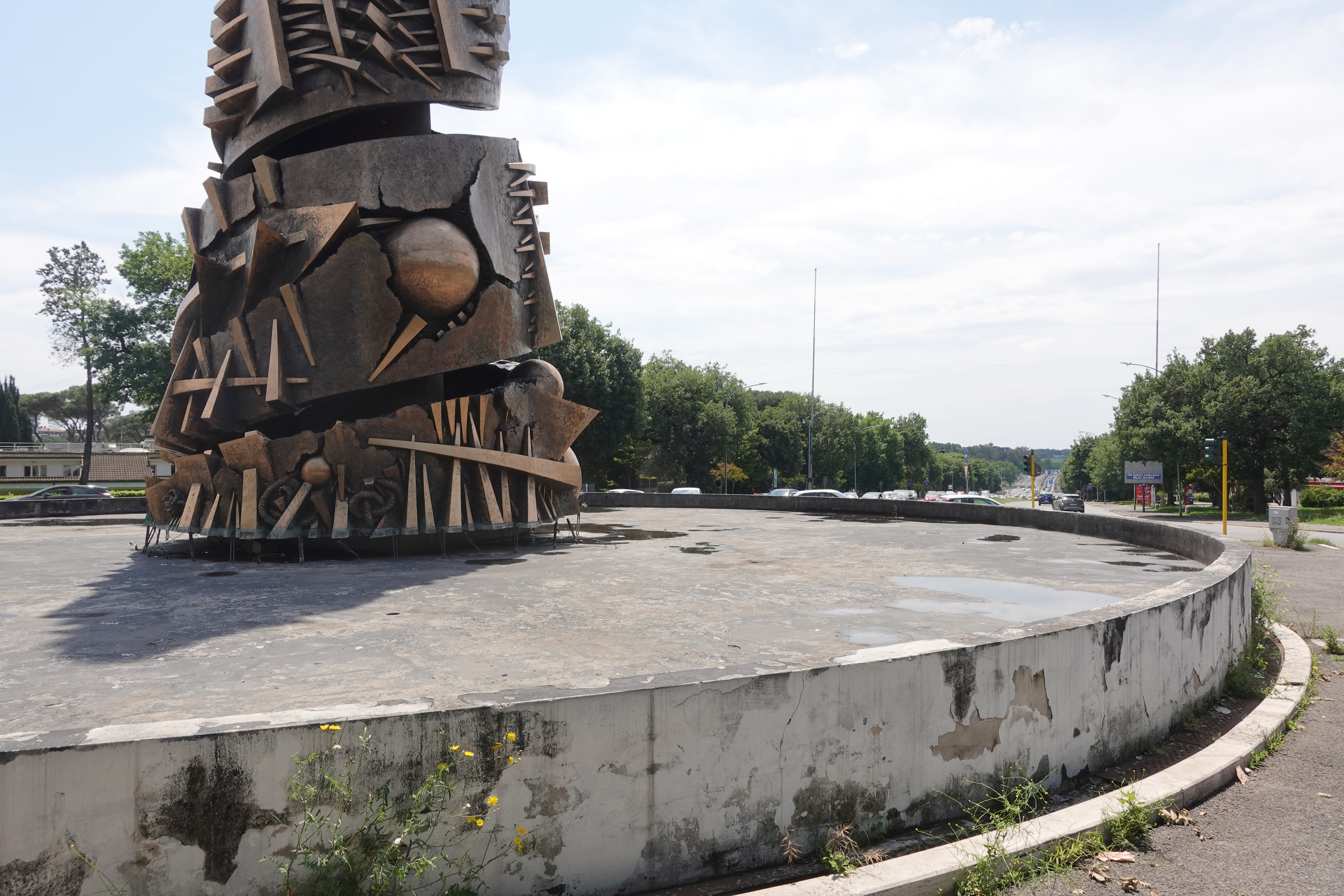

The photo at right shows the condition of the piazza and statue.

We've heard the complaint (and are tempted ourselves) to view Pomodoro as a "one-trick pony." If you unwrap the obelisk, it looks like the flat pieces. The shapes are similar throughout his work. 

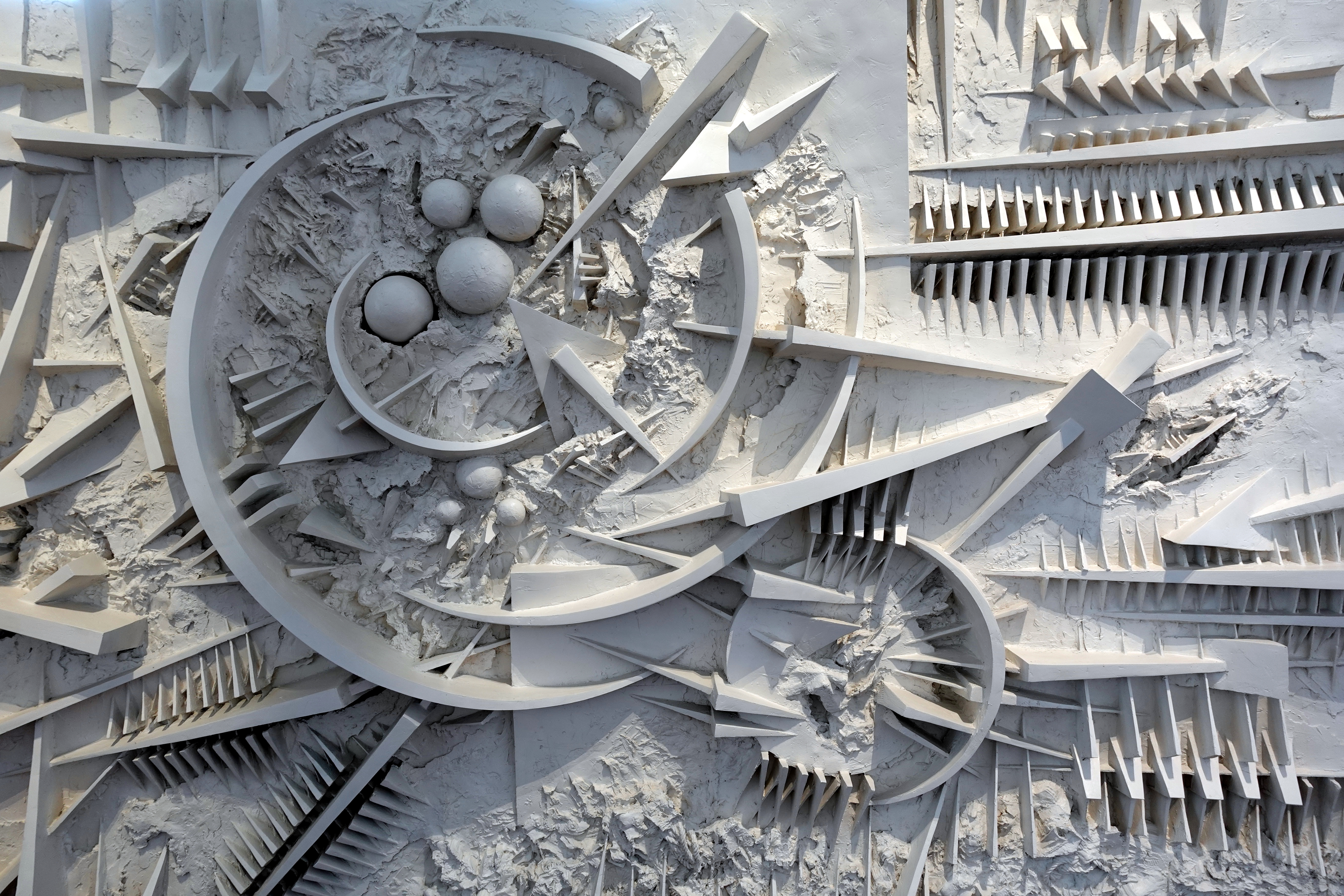
The exhibition at Fendi ends with a newer piece (1996-97, below) that is a complement in white to the introductory Le Battaglie that leads off this post.

To us, it didn't seem to move the needle much in terms of his art. 

The title of the work is Movimento in pieno aria e nel profondo ("Movement in free space and in the depths" - or something like that!).


Close-up at right.

On the other hand, if one looks at his costumes, graphic work, public art - the way it is placed in the world, his vision seems greater.  

We close with some of these other pieces, including our having fun with them - which is a benefit of art as well.


If you can't get to Rome to see Il Grande Teatro delle Civilta' - "The Great Theater of Civilizations" before it closes October 1, the website is comprehensive. It includes all the works, plus a visual tour, plus a map of his works all over the world.

In Italian and English here: https://arnaldopomodoro.fendi.com/en/

Dianne


RST with one of the costumes, this one from 1986 for Didone (Dido), one of my favorite tragic heroines. .


There's a relationship between the faux "printer's wheel" outside (Rotativa di Babilonia - Babylon's wheel, 1991) and the graphics-type work inside (Tracce I-VII - Traces 1-7, 1998) (above and below).


A close-up of Il cubo ("The Cube," 1961-62), one of the first works in the show, and one one of us found intriguing - maybe because it had some "white space" in it.


Below is the most recent of Pomodoro's sculptures in the exhibition - Continuum, 2010 - one that seems to highlight made-up hieroglyphics. Pomodoro's large, rectangular pieces remind us of Richard Serra's, but the Italian sculptor's are very much 2-dimensional with bas relief, not the 3-dimensional, run-around-and-through-it of Serra.


The artist with his barbed take on Fendi's Peekaboo bag - on display during the exhibition: 

(Image credit: Carlos & Dario Tettamanzi)

Thursday, June 8, 2023

Ostia's Garbatella - 1926 public housing and a WWII bomb shelter

Ostia, a town along the Mediterranean Sea not far from Rome - the new, not the ancient Ostia - is partly a creation of the Fascists. It was founded earlier, in 1884. Later the Mussolini government invested massively in it, resulting in many buildings of the 1920s and 1930s style architecture (the famous post office, among them).

Public housing ("case popolari") was first constructed in Ostia in 1926 and bears all the markings of the pre-modern architecture that was built shortly before the Fascists fell in love with modernism. The Ostia buildings most resemble those of Rome's Garbatella quarter, or of the quarter of Monte Sacro, built along the lines of a "garden city" in the1910s and 1920s. The state of the infrastructure is sadly poor, but the basic design of the complex is still lovely and worth exploring.

Above, one of the grand terraces, with an enormous Michelangelo-like cornice and citations to the Roman arches, that makes one think one is in Garbatella (as well as evidence of crumbling stucco).

The lead photo at the top gives a sense of the wonderful detail of early 19th century public housing, including small balconies, and especially portholes and the ship bas relief (top photo and photo at right), echoing Ostia's life as a port since Roman times.

The brief description of the tour we took described the housing project in these terms:

"There exists in Ostia a place where one seems to turn back in time to find oneself walking through Garbatella in the '20s...."  The architect was Camillo Palmerini, who designed the buildings "on the model of a building with an open courtyard. The arches, chimneys, the loggias, the small columns, the corners, the large cornices, all are examples of the so-called 'barocchetto romano,' a term coined by Gustavo Giovannoni in the '20s to identify the style used in Garbatella, today, an ideal dialog with the mosaics of Ostia Antica, colored with local elements of ocean inspiration - boats and marine animals."


In the basement (cantina) of the building complex were other reminders of history: exhortations to support Mussolini and the King, still visible on the walls of what was a bomb shelter for the residents. Below are two double V signs meaning "viva" or "long live" and then Il Duce and Il Re (the Duce, i.e., Mussolini, and the King) [love the brooms lined up against the wall too]/


We had a fairly intense discussion with a friend - a renown scholar of Fascism - who posits that retaining these "memories" of Fascism is not conducive to democracy. We appreciate the discourse, but in this case, disagree. [More photos of these 'writings' are at the end of this post.]


At left, the sign - in the same typescript - is an arrow pointing to the "Security Exit" (what Americans would term an Emergency Exit). Again, this is a leftover from the war, covered with modern electrical mechanics, and mostly ignored (like the one above) as text.


Above, our tour group in the basement/cantina.

The buildings also have beautiful staircases, with unusual angles, photo at right. We know the Romans love their staircases, witness the Bernini-Borromini Palazzo Barberini, as well as Luigi Moretti's in Trastevere's L'ex GIL (written about in our posts, as linked).


Our inside look at this complex, including its cantina, was courtesy of Open House Roma, which had a special focus on Ostia last year. At left, the crumbling arch through which we entered and sign at right of the OHR tour.


Adjacent to these beautiful, unrestored buildings is modern-day housing - which we eyed while having a coffee across the street.  Not bad, but one can't imagine having a tour of these 100 years after their construction.


Another stop on our tour was a brief look at this column, which once marked the end of via del Mare, the "road to the sea" that Mussolini constructed starting near the Colosseum and ending here in Ostia. The plinth now sports a bust of Pier Paolo Pasolini, the once "bad boy" of Italian arts, who was murdered on the outskirts of Ostia (another RST post features the park in his memory - near the murder site) [small photo above from Google Street View]. It once - as we recall - sported a bust of Mussolini. How times change (thankfully)!


More of the writings on the wall, beginning with the one below: "Mussolini - today more than ever - is right."

Below: not all the "saying" is visible, because of the light fixtures put over them (and note garbage cans below), but something to the effect of "don't worry about...who, for YOU it's best...."


Dianne

PS - another post on a location adjacent to Ostia is RST's on the self-built, basically squatter community of Idroscalo.


Wednesday, May 31, 2023

Monte Gennaro - "Rome's mountain" and a favorite hike


The view (away from Rome) from Monte Gennaro's decorated peak
(that's the base of the mountain-top cross at left).

Maybe not so much the season, as dreams of the season - one of our favorite hikes - and this is a real one, not a cushy one. Up "Rome's mountain" (though bearing the name of Naples's patron saint), the tallest mountain one can see from the city, Monte Gennaro, in the Lucretili range to the northeast of Rome. Yes, you can see it from the Gianicolo, and many other high spots in Rome.

There are marked trails up to the peak from many different directions, and we've tried them all. One of our favorites is one filled with "tornanti" or switchbacks (a switchback is also called "lo zigzag"), 25 in fact - they are even numbered. 

The starting point for parking - roads beyond
this are impassible with our vehicle. The
twin hilltop towns of Palombara Sabina 
(it would be quite a hike if one started from the town)
and Montecelio (far left) are in the background. The scooter
is our latest--a 2019 Honda Forza 300. 


The trail starts under a defunct funicular. Trail guides say its start is the town of Palombara Sabina (don't try to find a place to stay overnight there; we did, with no luck), but the trail's real start is up a rural road (yeah, we ran into farm dogs biting at our scooter heels on these roads) a few miles from the town itself. 


The defunct funicular (and its path up the first shoulder of the mountain.


Left, a close-up of the funicular "basket." 
Can you imagine stepping into 
one of these (they don't stop) 
and riding up that way? 
We have been on one like it,
in Gubbio, Umbria.


Shortly after the beginning of the trail one encounters a diorama set-up in the woods (photo below). We had seen it before, though it changes from time to time, and we took a closer look this day. 

Below the sign that includes "shame on you," is a turquoise globe,
wrapped like a baby (or patient), hooked up to a heart monitor.

We're not sure what the large underwear on Ken and Barbie mean, but the larger diorama is a critique of inaction over climate change. The lettered signs in the diorama read:

"It was the most beautiful planet of the universe; shame on you" and "Suicide" and, on the far left, with figurines of a creche, "Hope."


From a saddle (yes, the Italians use the word too, "sella"), one can see the path to a tower (right) - we've never bothered to go there, because it's private and the 'path' is a road. The trail marker has estimated hours to the destination, not the distance.


There are some "ruins"  where the funicular ended and a hotel was located. There are also way too many cell towers:

One can take a small loop starting at this point (and get lost, but not very lost, except if it's foggy at the top - believe me, we've done it all). 


Here's AllTrails view of the mostly up-and-back trail, with its great switchbacks:


We often run into a few people at the top. This day it was 2 trail runners (!!). They asked to have their photo taken with us, shocked at finding Americans on the peak, and then ran their merry way down the rocky summit.

The smaller peak with the tower is visible in the distance.
The two trail runners had an intense discussion below us about
their favorite power bars.

And the gorgeous woods the switchbacks wind through, as we finish the journey:


Dianne


Tuesday, May 9, 2023

Caput Mundi Mall: You'll have it all to Yourself--If you can Get There


We first learned about Caput Mundi, the new, luxury Rome shopping center that's a stone's throw from Saint Peter's, about a month ago, when it opened. The location seemed curious--elevated in an older building off via della Conciliazione--and we were eager to see how the developers had managed to squeeze a shopper's paradise into a crowded neighborhood of historic buildings. 

The best access, as we later learned, is down via Padre Pfeiffer Pancrazio--there's a less-than-spectacular sign for Caput Mundi at the end of that street. 


And beyond the sign, and closer to the front entrance, a less-than-inviting enclosure for the Carbinieri, taking something away from the welcoming Easter Egg. A typical hallway, ahead. 


But we missed what is intended to be the main entrance and found another, the "back door" entrance if you will, accessed off an underpass at Largo di Porta Cavalleggeri, almost directly south of the Vatican Obelisk. [It could be the "main" entrance is inside the "Gianicolo" bus parking garage - in an attempt to appeal to the thousands of tourists who "enter" the Vatican via tourist bus.]

On our back-door excursion: we found ourselves in a lengthy (estimate: 1/4 mile) passageway, gradually elevating as we trudged along, virtually alone, an occasional moving walkway assisting in the ascent. We thought maybe the architects had modeled this entrance after the Metro walkways we love so much. On the way we stopped at the restrooms--one marked WOMAN, the other MAN.

Heading on up to Caput Mundi. 


At the end of the trek, an elevator brought us to the 5th floor, the door opening onto: CAPUT MUNDI: THE MALL!


All on one floor, Caput Mundi has some of the feel of the most sophisticated of airport shopping areas: gleaming goods, perfectly arranged and presented: a bookstore, a candy shop, an upscale wine store, clothing of all kinds, several inviting places to eat, a pharmacy, a SONY pavilion where one can scratch the chin of an affectionate, responsive techno-dog, impressive art installations here and there (even a small exhibit of the work of Andy Warhol). A giraffe holding a lamp, or cage, or something, in its mouth. 


This says it all. In the foreground, a thinker-type art work. In the background, 
two workers taking advantage of the lack of customers to replace light bulbs.


Oops! A shopper!

Quite a place. Except....except there were no shoppers. Well, maybe a half dozen (high-end estimate). Maybe. A helpful clerk Dianne chatted up told us the lack of shoppers was par for the course, except on the weekend, which implies most shoppers are not tourists but Romans. Every shop has a clerk, every coffee shop or lunch space is complete with cooks and servers. But nobody to serve, nobody to cook for, nobody to buy anything. Well, not quite. Dianne made a stop at the para-pharmacy (all goods OTC).


Surreal. 

Bill 


Coochie Coochie