Rome Travel Guide

Rome Architecture, History, Art, Museums, Galleries, Fashion, Music, Photos, Walking and Hiking Itineraries, Neighborhoods, News and Social Commentary, Politics, Things to Do in Rome and Environs. Over 900 posts

Showing posts with label posters. Show all posts

Friday, June 28, 2024

At the University of Rome: Protesting the War in Gaza, May/June 2024

This spring, while living in two locations near the main campus of Rome's largest university--La Sapienza--we naturally were interested in exploring the role of the university, and especially its students, in engaging the conflict in Gaza. We made three purposeful excursions onto the campus. We had heard that a group of students were protesting Israel’s incursion into Gaza and "occupying" a portion of the campus. But (we're embarrassed to say), on our first trip to the campus we failed to find any evidence of a student occupation. There was evidence of a protest movement in the writing on some of the university's walls, and some posters, but no tents, or so we thought. 

At left, a pro-Palestinian phrase suggesting that 
Palestine should encompass all of what is now Israel. 
At right, "In Gaza there are no universities." 

All Eyes on Rafah (a city in southern Gaza, under siege)

The war has its origins here. Boycott!

One poster notified students of an upcoming student demonstration in Piazza Vittorio against the government of Giorgia Meloni, and including solidarity with Palestine:


A "Free Palestine" poster advocated shutting down Sapienza ("Blocchiamo Sapienza"), which these students understood to be complicit in the conflict:


In most respects, the campus seemed normal, undisturbed by the war in Gaza.

In this area of the campus, more centrally located and prominent than the site
occupied by the protesters, everything seemed normal. 

The second trip a couple of weeks later proved more fruitful. Rather than search the campus once again, we asked a maintenance worker if he knew of an occupation and, if so, where it might be. He pointed to a road leading to the back of the campus, behind the main piazza. And there it was, tucked in an area that was a few feet below ground--below the rest of the campus. About 30 pop-up tents. An information table. And, gathered around a picnic-type table nearby, a half dozen students--maybe planning something (or maybe not). 


The encampment was accompanied by kite-like stanchions, featuring slogans in script. The general theme seemed to be, "while you're eating a nice lunch, the folks in Gaza are starving."  

On the standard at left, the Palestinian flag and the word "Nakba," which means "catastrophe" in Arabic and refers to the dispossession of Palestinians during the 1948 Arab-Israeli war. The protesters apparently had WiFi. 


We also took more careful note of the anti-Israel, pro-Palestinian wall writing, this time looking for evidence of the students dislike of the way the Rector--Antonella Polimeni, a physician--was handling the issue. Although neither the wall writings nor the posters explicitly mention it, a key issue for the students was the university's participation in "il bando Maeci"--an agreement that institutionalized cooperation in science and research between Israel and Italy. 


Some sort of student march to protest the situation in Gaza took place off campus in the week that followed this second visit. We did not attend. But we did return to the campus to chronicle any changes. What we found was surprising: all that remained of the campus occupation were spots and indentations in the grass where the tents had been. 


We later read that the University may have driven the students out by scheduling "repair" work for that area; we had seen some of that nearby when the tents were there and wondered if the construction project wasn't a kind of harassment. We also read that the students had apparently decided to end the 6-week occupation voluntarily. A spokesperson for the students told Il Messaggero (a Rome daily newspaper) that the occupation had not, indeed, changed university policy, but that the students had learned that a change in tactics was necessary, one that featured increased contact and involvement with faculty and university departments, perhaps leading to a boycott. The students also looked forward to a protest on the 24th of June, on the occasion of a meeting of the university's academic senate.  

Bill 


Saturday, May 18, 2024

Rome's Election Billboards: Dinosaurs in the Age of Social Media?


This set of billboards, on via Tiburtina across from the Verano cemetery, is one of many in Rome intended for the the display of large political posters ("maxi-manifesti") that for decades have been a part of Rome's electoral campaigns, in this case European parliamentary elections that will take place in June. 

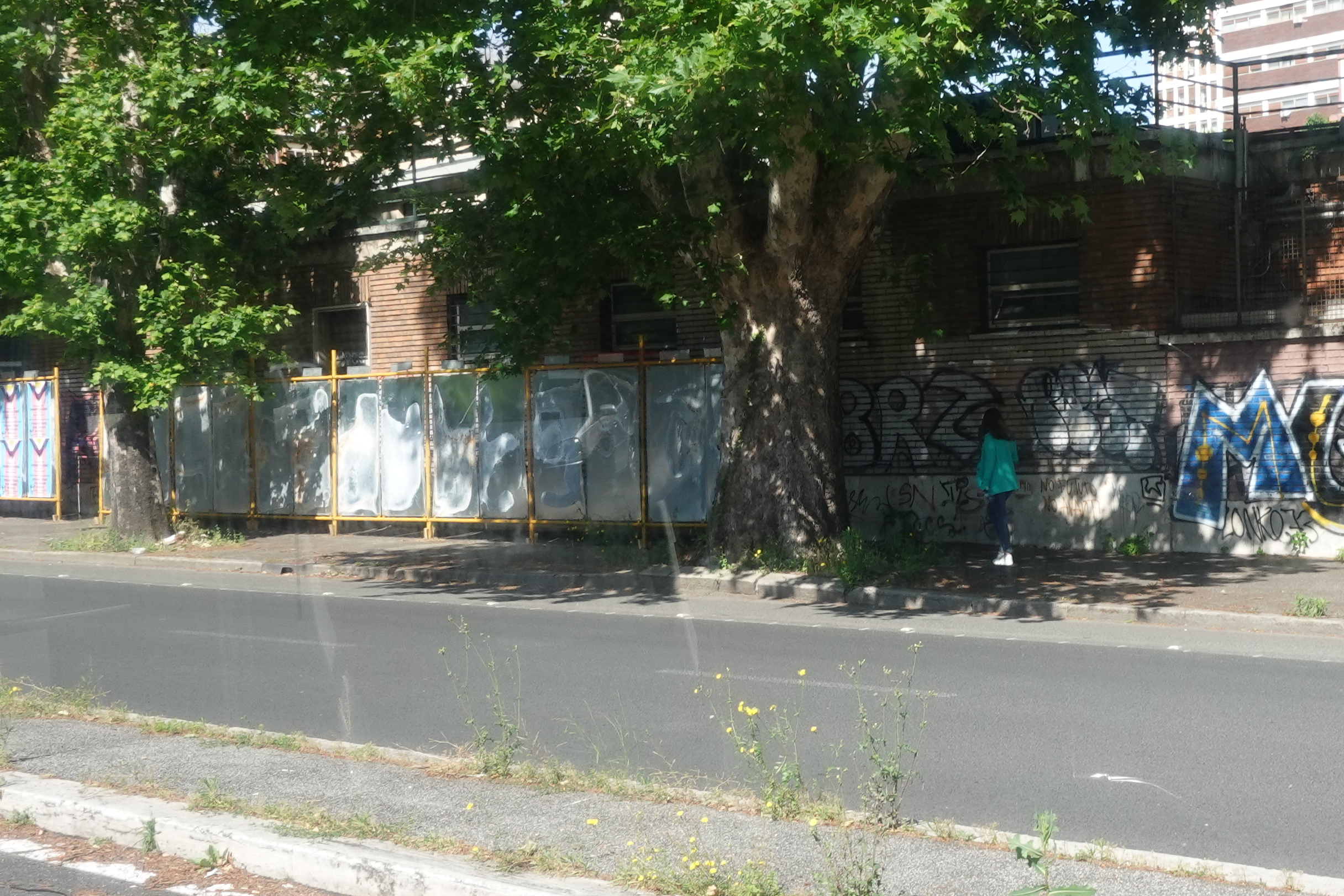
They are installed every year about this time on the city's sidewalks, which are mostly asphalt, then removed after the elections. Some say they interfere with the movement of pedestrians (especially those with disabilities), others that the installation process can damage the sidewalks. It is clear that they are costly; the cost each year to Rome taxpayers is about 300,000 Euro, or about $325,000. There are more than 5,000 of them, distributed in 166 locations within the 15 local jurisdictions in the capital. 

But the most interesting criticism is that they are increasingly irrelevant in an age when political communication takes place not through posters but on the social media, not to mention radio and television. A recent article in the Rome daily newspaper, Il Messaggero, describes the billboards as "immortal," resisting the inevitable: AI. One city official calls the billboards "medieval," an epithet that wouldn't have much resonance for Americans, but means something to Europeans. 

In 2023 critics advanced a proposal to eliminate the billboards. It failed because to do so would require changing a 1956 national law that established and underpins the system. 

Bill 


The set of billboards at center left have just been installed; they've been cleaned of old posters.


This set of billboards has also been recently installed, but already someone has put up posters for a trans/non-binary demonstration--probably an "illegal" poster.  


Thursday, January 9, 2020

Tufello: A Rebel Community


Vigne Nuove--we started here - no "new vineyards" in sight. 
On a sunny day in mid-May, we got on the Honda Forza 300 and headed north to Vigne Nuove.  The name refers both to the quartiere/neighborhood of Vigne Nuove, and to one of Rome's largest public housing projects (above), this one from the 1970s. Our plan was to have a look at the housing project (which we did--we plan a full report in a future post), then walk south into Tufello, an older, more human-sized enclave just to Vigne Nuove's south. If you're not on a scooter or in a car, Tufello is accessible, at its southern end, by the relatively new Jonio stop (one beyond Conca d'Oro) on Metro's "B1" line (though some refer to waiting for a Metro B1 as "waiting for Godot"). Vigne Nuove means "new vineyards." We're not sure when it got its name, but the area obviously was at one point an agricultural area with vineyards, and ruins of a 1st-century AD villa have been found there. And "Jonio" is also spelled "Ionio" as in the Ionian Sea between Italy and Greece.

"Welcome to Tufello, a Free and Rebellious Quartiere" - note the "Welcome" is expressed in BOTH the masculine and
feminine plural (very PC), instead of using the masculine plural to refer to both males and females - the classic use.
Tufello's "charm" comes in part from its geographical confinement; it's essentially a triangle with one angle at the top, bounded on the south by Viale Jonio, on the west by via Giovanni Conti, and on the east by via delle Vigne Nuove. At its center is Piazza degli Euganei (see below).

Just north of that piazza, off via Monte Massico, we encountered several apartment buildings--probably dating to the late 1940s or 1950s. The courtyards were less than elegant--not unusual for "public" spaces in Rome.  A few of the apartments had air conditioning, but here, as elsewhere in the city, clothes are dried by hanging them in the sun.


A sparse, uninviting courtyard.  Dianne checks the map. Yes, a print map.

This interior space had nice pine trees, but was overgrown
On one of the buildings, an ode to "Fabio," now deceased, "nel paradiso degli eroi" ("in the paradise of heroes").


Tufello has a cultural center, the C.C.P., or Centro di Cultura Popolare, offering a Yoga experience.


At the end of several blocks of this older housing, a new, more modern building:

Some new investment in the area
The main piazza has a large, somewhat awkward, modernist market, surrounded by the standard array of shops, many of them closed in the early afternoon, when we visited.


Many of Rome's neighborhoods have a "favorite son"--always a young man rather than a woman, and usually a political figure from the Anni di Piombo (Years of Lead), a period in the 1970s and early 1980s characterized by deep political divisions and violence. The identity of the favorite son defines the political identity of the neighborhood.

Tufello's walls tell the story.  In posters and wall art, the quartiere remembers Valerio Verbano.  Verbano was born into an anti-fascist family in 1961, and became an active militant during his high school years in the Rome neighborhood of Nuovo Salario.  He was a Communist and a member of Autonomia Operaia ("Worker's Autonomy" - loosely translated - perhaps "Power to the Workers" might be better).  In April 1979, Verbano was arrested and charged with fabricating explosive devices--basically, Molotov cocktails--in an abandoned building in San Basilio.  He was convicted and served 6 months in prison.


These signs appear on a gymnasium building (palestra). 
"Valerio Verbano--Militant Communist, Assassinated by the Fascist Skunks
An Idea Never Dies"
On February 22, 1980--three days from his 19th birthday--Verbano was shot and killed by three armed and masked men who had come to his home at via Monte Bianco 114, tied up his parents,and waited for Valerio to come home from school. Though the case was investigated many times over the years, it has never been solved--which may explain Verbano's prominence on Tufello's walls 40 years later. The Monte Bianco address places Verbano's home just south of Viale Jonio.

While much of the area's wall art and postering deals with Verbano, a good portion is more broadly political, marking the neighborhood as anti-fascist, militant and, after almost 80 years, still linked to the anti-Fascist/anti-Nazi partisans (partigiani) of World War II.  This wall immediately below links Verbano and Carla to the partisans.

"ieri partigiani"--yesterday, partisans
Identifying the enemies: money and Nazis--and something else

"Antifa Tufello"--anti-Fascist Tufello
Again, red and black flags

Cuore is heart, ribelle is rebels or rebellious. Not sure what a good translation would be
other than a literal "Rebellious heart". 
And the poster below reveals that Valerio is more than an idea; every year, on the anniversary of his death, the community marches in his memory, and for what he presumably stood for and against: against the "racism of the state," against the "war on the poor," "connecting the resistance."  A significant level of distrust of government here. (Tufello was cited in one of Conor Fitzgerald's novels as a neighborhood "wherthe police have not disturbed the criminal status quo." 


"1980...The Revolt Goes On...2019"

Bill

I've written many posts on "heroes" celebrated on Rome's walls, from both the left and the right. Here are some of them:
https://romethesecondtime.blogspot.com/2012/11/the-story-of-zippo.html
https://romethesecondtime.blogspot.com/2012/09/piazza-vescovio-anni-di-piombo-and.html
https://romethesecondtime.blogspot.com/2011/12/gabbo-death-and-life-of-gabriele-sandri.html
https://romethesecondtime.blogspot.com/2012/10/sites-of-anti-fascism-trionfale.html
https://romethesecondtime.blogspot.com/2015/06/a-tale-of-two-suburbs-balduina.html
https://romethesecondtime.blogspot.com/2019/10/villa-certosa-hidden-rome-neighborhood.html


Tuesday, January 2, 2018

Best Posters, 2017

I was encouraged to begin the 2017 version of "the year's best posters" by a remark made by Larry David, the creator of the popular television comedy series, "Curb Your Enthusiasm."  Asked about the show going into still another season--its 10th--David responded: "When one has the opportunity to annoy someone, one should do so."

So I'll get to it--annoying someone, that is.  Here's the first poster of this year's bunch.  It's included not for any aesthetic reason, but because it was the most widely disseminated poster of the year.  Ubiquitous and unavoidable.  Note the use of English. Intimissimi is one of the largest Italian lingerie chains.

I hope I haven't lost all my female audience, because the annoying part is pretty much over.  Actually, I'm a moderately sensitive guy on gender issues (yes, it was required).  To prove it, here's a poster from Ostiense (probably November 2016):
Call for meeting at Forte Prenestino, an avant-garde leftist space.  Solidarity.
The second line is famous:  "If I can't dance it's not my revolution."
The following poster, too, uses the words/slogan/manifesto "Non una di meno" (literally "not one less," though perhaps better translated "no one (female) left behind").  It calls for a struggle (lotto) and a global strike by women ("if our lives are not valued, we strike"). 

I also have a sense of humor. I found this one in the Re di Roma area, walking around while Dianne was getting her hair done.


The next one's a mystery.  Found in Trastevere, it seems to advertise an art fair--or more likely takes issue with the "art market."  It presents artists as mere money grubbers with silly ideas (the cover of the book seems to identify the work of street artists with sandwiches: "nuove figurini panini"). Wish I could blow it up just a bit more. 


In any given year, most of the posters are political, and 2017 was no exception.  I was intrigued by this poster, featuring Martin Luther King, Jr., on a corner in the ethnically mixed neighborhood of Torpignattara. 

The same community yielded the rather dramatic poster below.  It identifies a number of issues--unemployment, "cementification" (paving over paradise), and the distribution of wealth--that make the quartieri invivibili "unlivable."  The line in black reads:  "He who does not revolt remains a slave (male or female)."


Whether leftist or rightist or beyond politics, some made the list because they're colorful or pretty.
Of the three posters immediately below, the first two are products of the radical right.  The third advertises the annual flower festival in Genzano di Roma, in the Colli Albani (a wonderful event). For an explanation of the torch poster, we recommend Paul Baxa's history of Acca Laurenzia. 


Lovely
There's still some interest in Communism.  Don't miss the new biography of Lenin!  Not such a nice guy, we hear. 
"Power to those who work and those who are unemployed.  All power to the proletariat."
The next one's another mystery.  I looked up "Etere" on the internet but was unable to make much progress.  I originally translated it "to be or not to be," but it's not clear that Etere (one meaning is "ether") means "to be," even in Latin.  Help me out here.
At the intersection of Via Po and Viale Regina Margherita
Opposition to the European Union, here depicted as the chains of servitude, has been a  major poster theme for years. 


Bill
For some previous editions, see:
2016
2014
2013
2012
etc.


Tuesday, February 7, 2017

Best Posters of 2016


"Best" Posters has become a yearly feature of RST, and here we are once again, offering the "best" of 2016, all found in Rome in April, May and June.  Though the internet has doubtless eroded the presence and influence of posters in Italian culture, they nonetheless have a role here that they don't have in the U.S.--except perhaps in times of political upheaval like the late 1960s.  I am tempted to claim that postering is more common in societies with a significant leftist heritage--they were a significant feature of the visual landscape in China in 1979, for example, when we were there--but I can't say for sure that's true.

Postering also appears to aggregate in specific places.  Some locales in Rome--especially outlying suburbs--are more likely than others (e.g. the Centro) to have large numbers of posters.  We found an especially rich lode in Serenissima, on Rome's outer eastern side.

What makes a poster "best"?  Design.  A compelling message.  A story we haven't heard, or, if we do know the story, the sense that the poster reveals something quintessentially Italian or Roman.  In 2016, as was true in 2015, some of the best posters are those done by the far-right fringe.  They're angrier, and that can make for more compelling posters.  And most of the centrist political posters--ubiquitous during the run-up to the Rome mayoral election--are pedestrian.

Still, the left can produce some decent posters.  The one below at least goes beyond Vota Communista ("vote Communist").  It's both weird and refreshing to see that Italian Communism still exists; it all goes back to the important role played by Communists in the Partisan movement that battled the German occupation during World War II.  Today, according to the poster below, the enemies of the Communists are petty politicians (politicanti), the European Union, NATO, and the banks.
Enough! (vote Communist Party).
This poster (below), which appears to be part of the student mainstream at one of Rome's great universities--La Sapienza--strategically links the current generation of anti-fascists with the partisan wartime resistance:

Yesterday partisans, today anti-fascists.
What's with the German?

Resistance is also the theme of the poster below, authored by an organization (we presume) called Partizan.  Although the poster would seem to be appealing to thoughtful people ("Thinking people must resist"), the gas-masked figure looks anything but thoughtful.


Casa Pound, a right-wing bad-boys organization named after the American poet, Ezra Pound, who cozied up to the Mussolini regime in the early 1940s, is perhaps the most frequent posterer in Rome, helping to keep the form alive.  The Casa Pound folks are opposed to immigration, and beyond that they're big on not surrendering to the powers that be.  They appear to relish physicality and to locate their heroic heritage in ancient Rome.
Alcuni Italiani Non Si Arrendono!
"Some Italians Don't Surrender!"

"What is written with the blood of the fathers is not erased with the saliva of the politicians."
A close-up of the upper left portion of the above poster:
Scary dudes
The Blocco Studentesco ("Student Block"), responsible for the poster below, is a 2006 offshoot of Casa Pound, focusing on school issues.
Not quite sure what's doing on here.  "They Aassault/We Laugh!" Joyous resistance.
Once in a while the poster left gets its act together and posters against Casa Pound.  This poster grounds its opposition in an open immigration ideal--in Italian multiculturalism.
And mostly in English
As in the United States and England, there's strong opposition in Italy to international trade agreements that presumably cost workers jobs.  The message below is significant: No al TTIP refers to the Transatlantic Trade and Investment Partnership, a proposed trade agreement between the EU and the United States that's been in the works since 2014.  The anti-TTIP folks are concerned that the nation states of Europe will be victimized by transnational corporations--especially, according to the poster's graphic, American companies

"Let's liberate ourselves from the 'Liberators'"
 Also under attack are austerity measures advocated by wealthy, creditor countries (like Germany) and imposed on poor, debtor countries (like Greece, Spain, and, to some extent, Italy). A decent graphic here (Piano B [Plan B]), but the poster's too busy to be visually arresting.


One of our design favorites is this poster, of uncertain political ideology.  It reads Roma non si vende"--"Rome is not for sale."  And it communicates this message with a delightful image of the Coliseum in a shopping cart.


Another top-design candidate is this anti-immigrant political poster ("We'll Stop the Alien Invasion"):


The poster below is austerely anti-design.  And yet its message--Siamo Già Tra Voi ("We are already among you") and signed "(hashtag) Enemies of the City," is compelling in its mystery and threatening tone.


The "What Happened to Dino?" poster that we found near Porta Metronia was mysterious, too, because we had no idea who Dino was.
Do you know what happened to Dino?
The most common poster in April was, understandably, the one below, announcing Liberation Day: 25 April.  It's not obvious why the date April 25 was chosen in 1946.  Although Liberation Day in general celebrates Italy's liberation from the horrific German occupation--and honors the resistance to the occupation--the country was not actually entirely free of the Nazis until May 1, 1945.  According to some sources, April 25 is important because on that date the National Liberation Committee of Upper Italy (CLNAI) proclaimed in a radio annoucement the death sentence for all Fascist leaders (Mussolini was killed 3 days later).  Others note that April 25 was the day Turin and Milan were liberated from the Nazis.  More than you needed to know.


Bill
For the best of... 2014 and 2012, check the links.