Rome Travel Guide

Rome Architecture, History, Art, Museums, Galleries, Fashion, Music, Photos, Walking and Hiking Itineraries, Neighborhoods, News and Social Commentary, Politics, Things to Do in Rome and Environs. Over 900 posts

Showing posts with label Santa Maria Sopra Minerva. Show all posts

Sunday, March 5, 2017

Anna Magnani, Rome Icon


Anna Magnani died in 1973 in Rome.  The story goes that a passer-by at a funeral observance in Piazza della Minerva, behind the Pantheon (above), impressed by the enormous crowd--much too large for the space--asked one of the participants: "What's going on?  Did the Pope die?"  "No," was the reply. "Much more important than that--Anna Magnani."

Almost a half century later, the actress who personified postwar Italian neo-realist cinema remains an iconic figure.  Images of Magnani--her face, especially, but her body, too--continue to appear on


Rome's walls and, recently, on a set of stairs at one of Rome's large public markets.


In 2013, the artist Biodpi explored Magnani imagery in an exhibition at one of Rome's alternative galleries, an ex-factory space known as the Lanificio

Front gate of the Lanificio (wool factory)

Part of the Biodpi show on Magnani

A chic Magnani walking a hip she-wolf.  Biodpi  

An unattractive rendering, Pigneto


Anna Magnani was born in Rome March 7, 1908, and not at Porta Pia (as some claim) but in a house at via Salaria 126.  Her mother, Marina, was 20 years old, unmarried, and Roman; her father, who had left the household for good before she was born, was Calabrese.  For reasons that remain unclear, Marina spent much of Anna's childhood in Egypt, leaving her daughter in Rome to be raised by her grandmother and five aunts.  As a young child, Anna lived briefly in an apartment in Piazza Costaguti, then for some time in a substantial 4th floor apartment on via di San Teodoro--in a neighborhood between the Campidoglio and Circo Massimo.  She recalled those years fondly: a large living room, an expansive terrace, and a pet hen.

Pigneto 
When she was about 12 years old, Anna left elementary school and enrolled as a piano student (she took 6 years of lessons) at the Academy of Santa Cecilia in via Vittoria, not far from via del Corso (and still there).


At some point she discovered that the same building housed a well-known acting school--the Eleonora Duse Royal School of Acting--and at age 18 (1926), she began to study acting.  For several years she financed her lessons by singing in clubs while accompanying herself on the piano.  She was good enough to be known as the "Edith Piaf of Rome."  By 1930/31 she was traveling around Italy to take a variety of acting jobs.


Magnani married film director and script writer Goffredo Alessandrini in October 1935, in a civil ceremony at the Campidoglio, then took religious vows in December at the church of San Roberto Bellarmino in Piazza Ungheria (Parioli).  The couple lived for a time at viale Parioli 48. The marriage lasted until 1950.

Rome, Open City (1945).  Magnani as Pina, moments before her death.


Magnani became a star in 1945, in the now-classic film Rome, Open City.  She played Pina, the fiancée of Francesco, a resistance fighter.  With the Nazis occupying Rome, Francesco and others in the neighborhood are arrested in a Gestapo raid and put in a truck to be taken to a place of interrogation--or worse.  In one of the most famous scenes in all of Italian cinema, a distraught Pina runs after the truck, and is shot and killed.

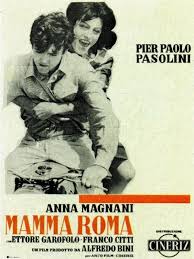
In Mama Roma (1963), the Pier Paolo Pasolini film set in Rome, Magnani played a prostitute and mother.

Magnani, wearing the wolf.  Rome's Nomentana train station, 2016. LAC 68.
In both these films, and in many others, Magnani played a tough, no-nonsense, working-class woman, usually wearing a simple house dress.  Perhaps as a result, she is often identified with the Lupa (the mythic she-wolf that nourished Romulus and Remus, the founders of Rome)--indeed, she was sometimes referred to as "La Lupa" or a "living she-wolf symbol."


Anna Magnani died in Rome in 1973.  She is buried in the Verano cemetery.
Bill

Somewhere

1962

Wednesday, October 8, 2014

In the shadow of the Pantheon: Santa Maria Sopra Minerva

As you exit the church of Santa Maria Sopra Minerva, you'll be in the
shadow of, and amidst the crowds swarming around the Pantheon
Santa Maria Sopra Minerva ("Saint Mary Above Minerva") is a treasure trove of artworks, as well as an emotional (to me) historic site.  Yet it is only lightly visited, perhaps because it is so overshadowed - literally and figuratively -  by the Pantheon, in its own Piazza della Minerva.

Construction began on this Dominican church in the 13th century, and it is an interesting, or perhaps unfortunate, mix of Gothic and baroque architecture.  "Sopra Minerva" is thought to derive from the Minerva temple over which the church may have been built.

Before one tries to identify all the magnificent art in the church, hie thee to the choir in the adjacent convent, reachable from the church, on the left side.  Here you can see where Galileo was tried - for history buffs, it doesn't get any better than this.  The tomb of Pope Paul IV (1555-59), the Great Inquisitor, appropriately is in this church.  Some church history is available online.  Also see http://romanchurches.wikia.com/wiki/Santa_Maria_sopra_Minerva.
Pope at rest

In the church itself, you can spend hours mesmerized by the art works that in every conceivable form commemorate death, as the Catholics do best.  You can start with Michelangelo's Christ Bearing the Cross, also known as Christ Risen, and then move on to Bernini's memorial to Maria Raggi and his tomb for Giovanni Vigevano.


Tombs to be walked on, or prayed against


Bernini's memorial to Maria Raggi


Bernini's tomb for  Giovanni Vigevano


You might save the best for last - Fra Lippo Lippi's Carafa Chapel frescoes from the late 15th century.  These are astoundingly beautiful, very accessible (no long lines and you can walk right up to them).  Have Euros available for the pay-light box; definitely worth it. A list of all the frescoes is online at: http://www.wga.hu/html_m/l/lippi/flippino/carafa/ 


The altarpiece painted by Fra Lippo Lippi in the Carafa Chapel;
 here St Thomas Aquinas is presenting Cardina Carafa to the Virgin Mary.
The angel on the left is the angel of the Annunciation,
and this fresco is sometimes described as The Annunciation.

And, of course, outside is the charming Bernini elephant atop a 6th century BC obelisk. The symbolism seems odd, but it has an historical basis.  The inscription, translated from Latin, reads: "Whoever you are, who sees here the figures of the Egyptian wise man carved on the obelisk carried by the elephant, the strongest of wild animals, understand the symbolism to be that a strong mind supports firm wisdom." 


The church is generally open 8 a.m. - 7 p.m., except not from 12:30-4 on Saturday and Sunday - long hours for Rome churches.  Check the times on the church's very basic Web site (in Italian).  You can also finish off your visit with a (expensive) glass of wine on the rooftop of the adjacent Hotel Minerva, with lovely views overlooking this piazza and the Pantheon.

In the piazza the last time I was there, a soccer game was set up.
The goalie (see photo above left) obviously disputed the call - with tears. 


You won't find lines like these, or waiting times at
Santa Maria Sopra Minerva

Thursday, August 6, 2009

Mixing religion and politics in the lively Campo de' Fiori


The dark metallic statue of Giordano Bruno, head lowered under his Dominican cloak and hood, has always seemed anomalous in the lively Campo de' Fiori. We force ourselves to think about a heretic burned at the stake in this center of Rome commerce and pleasure, where revelers party until dawn each night.

Bruno was burned alive in this piazza 409 years ago, on February 17, 1600, and the Church thought it had good reason. A defrocked monk, Bruno briefly joined the Calvinists (Protestants!) in Switzerland, and questioned a) Jesus as the Son of God, b) transubstantiation, c) the worship of Mary, and yes, d) all of the above (and more)--at least that's what came out in his trials under the Inquisition. He spent 1592-1600 in Inquisition jails. And, of course, unlike his contemporary, Galileo, he never repented.

Bruno was not only a heretic, but also a man ahead of his time. Before even Galileo, he held the stars were not fixed in the universe; he may have been the first person to theorize infinity. He combined scientific theory with a fascination for magic, making him a tough guy to appreciate in later centuries. [See Ingrid Rowland's new biography: Giordano Bruno: Philosopher/Heretic.] Bruno's work was intellectually revived (having been unknown for centuries) in the 19th century by the anti-Church forces, starting with (as usual) students at the University of Rome. After trying to make him into a figure of resistance to the Church through seminars on his work, the students came up with the notion of a statue. Intellectuals around the world, including George Ibsen and Victor Hugo, supported the cause.

The statue, designed by anti-cleric sculptor Ettore Ferrari, and erected in 1899, was the completion of the Italian conquest of Rome over the Papacy, "at least symbolically," according to historian David Kertzer in his 2006 book, Prisoner of the Vatican: the Popes, the Kings, and Garibaldi's Rebels in the Struggle to Rule Modern Italy (see Chapter 19: "Giordano Bruno's Revenge"). The planning for, and erection of the statue, was intended as a direct confrontation and affront to the Pope. When you're in Campo de' Fiori, imagine a parade of 10,000 people coming towards it, then only those with tickets in the Campo itself, over 130 members of Parliament on the reviewing stand, and the royal family and royal hangers-on not-so-discretely renting window seats in the then-poor apartments overlooking the square. There's still public acknowledgement of Bruno as a standard-bearer of "free thinkers" on February 17 each year.

So when you're throwing down a beer with fellow students at midnight, or having an 8 Euro glass of Fiano at the newest Campo wine bar at 7 p.m., or wrapped in nostalgia as the vendors set up their stands at 6 a.m., take the time to look closely as Bruno's presence. As one of the inscriptions says, "To Bruno - from the Century that he divined, here where he was burned at the stake."

If you're interested in more on the Inquisition tour, stop at the church just behind the Pantheon, Santa Maria Sopra Minerva. The monastery (open to visitors) attached to the church is where Galileo stood trial in 1633.

Dianne