 |
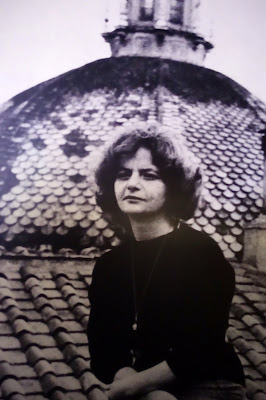
Elsa Morante from her terrazzo at via dell'Oca 27,
overlooking Piazza del Popolo and one of its
almost-twin churches, this one Santa Maria
dei Miracoli.. |
Elsa Morante was born, lived, and died in Rome. And her sprawling novel,
History ("La Storia"), presents Rome during and after World War II as one its main protagonists. The center of Rome was Morante's life-blood. She never cooked at home; she ate in the city's restaurants. She was part of the city's most vibrant literary scenes, and the literati too met in the cafes and restaurants. She lived in many different apartments in different parts of the city, and wrote in her city studio. She was moody and idiosyncratic, married to and divorced from, and, in the opinion of many today, unjustly overshadowed by, the literary lion Alberto Moravia (whose apartment - which he occupied with his second wife, Dacia Maraini -
we visited and wrote about in a 2013 post).
It seemed, then, a potentially rewarding and easy task to track Morante's life in Rome, starting with Lily Tuck's 2008 biography appropriately titled
"Woman of Rome: A Life of Elsa Morante." But the Rome of today is not the Rome Morante lived in; it's not even the Rome of the 1980s when she died.
 |
| La Stanza di Elsa - Elsa Morante's study, at via dell'Oca 17, re-created in the Biblioteca Nazionale. |
What IS available is the re-creation of Morante's study inside the Biblioteca Nazionale ("National Library") in Rome. Like many creative people, Morante had a particular way of writing, and, with few exceptions, wrote in her study. The re-assembling of her study, with all of her furniture, books, and art, was made possible through a grant to the library by Carlo Cecchi, her literary executor and close friend. The library also was given her archive - thousands of pieces. These include the notebooks on which she wrote - long hand - all but her last novel. Digital photographs of the notebooks also are available in the library.
 |
Piazza del Popolo today. The large apartment building to the right is where Morante lived
and where her study was located. The picture at the top shows her on the terrazzo of
this building, with the church dome behind her. The building's entrance, on via dell'Oca,
is on the side that is in back of Piazza del Popolo. |
For those of us who appreciate seeing how and where creative minds work,
La Stanza di Elsa (Elsa's Room) is a required stop in Rome. And
La Storia should take its place in the 20th-century canon of best literature. (I take issue with
Tim Parks who says it does not have "the charm...and dazzling imaginative richness" of her other works.)
 |
Morante with Moravia and Pier Paolo Pasolini. She was very
close to Pasolini, though estranged from him after he wrote
a devastatingly critical review of La Storia. She was overcome
by his brutal murder. |
 |
We can see that Morante was passionate
about British poet Sylvia Plath. This
photo is of books on the bookshelves
of "Elsa's Room" in the Biblioteca
Nazionale, part of the trove of her
archives donated to the BN.
|
All of the materials associated with
La Stanza di Elsa, including large panels and a 10-minute impressionistic video with readings, are in Italian. Head curator Elenora Cardinale said there are plans to provide some materials in English in the future. In the meantime, if you don't read Italian, look up some material on Morante ahead of time, or use your smart phone while you're there to gather information.
 |
| Bill Morrow's paintings in "Elsa's Room" |
If you don't know Morante's bio, one piece of information explains the paintings on the walls, most by Bill Morrow, a charismatic American more than 20 years her junior. She and Morrow planned to live together in Rome, but in 1962 he jumped to his death from a Manhattan skyscraper (presumably under the influence of LSD), before their plans materialized. His paintings hung on her studio walls until her death, more than 20 years later.
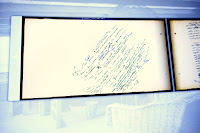
Morante's notebooks also are fascinating. She wrote longhand on one side of the page, using a consistent type of notebook for a work, but a different type for each different work. Once finished, apparently she would go back and on the reverse side of the page make notes, drawings, and basically develop more fully characters, plot lines, and ideas for the novel she was writing. For reasons of copyright protection, according to Cardinale, the notebooks are not available on the internet.
Some material on Morante is available online from the library (again, in Italian).
 |
A corner of her re-constructed study and a photo of Morante writing
in the study. |
Morante was childless, yet wrote often about mothers and children (the mother and son are the main characters in
History), and she transferred some of that love to her cats. You will hear them also in
Elsa's Room.
 |
The entrance to "Elsa's Room" with explanatory panels
(in Italian). |
The Biblioteca Nazionale is at the Castro Pretorio Metro B stop. The room is open to any visitor, without a reservation, currently during the hours of 10 a.m. - 6 p.m. Monday through Friday and 10 a.m. - 1 p.m. Saturdays. The entrance is before the turnstiles for the library itself.
Since
Elsa's Room was conceived and constructed, the Biblioteca Nazionale has added more rooms that focus on about two dozen major Italian writers of the 20th century, called
Spazi900 ("20th- Century Space"), which opened within the past year. This is also a fascinating path through Italian literary history of the last century, and includes a major focus on Pier Paolo Pasolini. More about
Spazi900 in a future post.
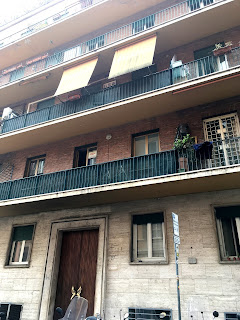 |
| via dell'Oca 27 - not much to see here. |
And now to my attempt to follow Morante through Rome. Her studio that is re-created in the Biblioteca Nazionale is from her apartment at via dell'Oca 27, basically in a building on Piazza del Popolo (though one enters it behind the piazza). She and Moravia lived in the apartment for the greater part of their troubled married life, and she continued to live there after they divorced.
 |
Dal Bolognese, the restaurant under Morante's building
at via dell'Oca 27. This woman reflected my mood that day. |
One of the restaurants she frequented was just below her apartment backing onto the piazza, but I was there on its weekly day of closure.
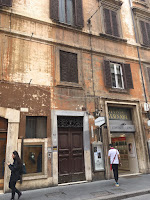 |
Building where the gallery
"La Nuova Pesa" - which
exhibited Morrow's work - is
now located on an upper floor,
via del Corso. |
I also tried to find the gallery where Bill Morrow had a major exhibition. It still exists (or rather has been revived), but in a totally different location - actually one quite close to via dell' Oca 27 on via del Corso.
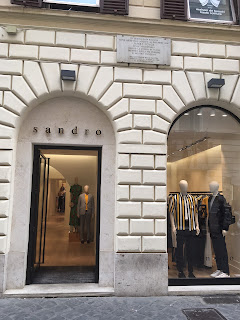 |
Instead of artisan shops, one now finds
high-priced boutiques on via Frattina,
but also a plaque indicating James
Joyce lived here. |
I also tried to find the stationery shop where Morante bought her particular notebooks, on via Frattina near the Spanish Steps. It no longer is there, replaced by upscale clothing boutiques. The address in Prati to which it supposedly relocated and should still be, seems now to be a Chinese-run housewares store.
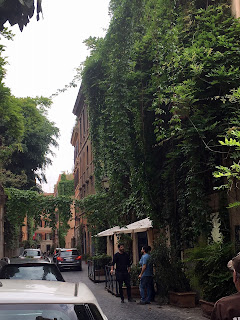 |
via Margutta still looks pretty, perhaps as it
did in Morante's day. |
Morante spent time on the once (and sort-of-still artsy street of via Margutta (where Gregory Peck had his studio in
Roman Holiday), but I saw mostly digital companies there.
 |
but this is the type of enterprise one
sees most of these days. |
She also spent a lot of time on via del Corso, which runs in a straight line from Piazza Venezia to Piazza del Popolo, but it's now mostly a tacky tourist shopping street, and I can't imagine she would find it appealing.
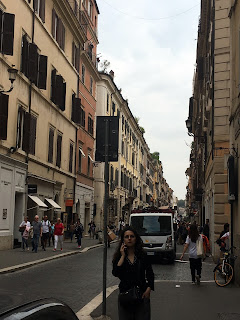 |
About as good as via del Corso can look
these days. |
Morante once called Piazza Navona the most beautiful piazza in the world. Though jammed with tourists, and those hawking wares to tourists, it still may warrant that description.
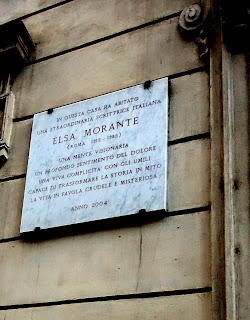 |
In Testaccio.
This plaque has a poetic tribute to her (I'm
taking some liberties in the translation):
"A visionary mind. A profound sense of pain.
A life that had the humble capacity to
transform history [la storia] into myth.
A life told in brutal and mysterious stories." |
Morante's rather lower-class family lived in various locales in Rome as she was growing up, including in Testaccio, then a working-class district. We found a plaque on a building where she once lived as an unhappy girl.
We also serendipitously visited the site where Morante's father (in name only) worked as a probation officer - the boys' and girls' reformatories of San Michele a Ripa in Trastevere (
which we covered in a recent post).
 |
The boys' "reformatory" at San Michele a Ripa
(restored recently). |
Although there are other places I could have gone to 'locate' Morante--the restaurant where she broke her leg, an accident that led eventually to her death (Da Giggetto in the ghetto, on via Portico d'Ottavia) or the nursing home where she spent her last 2 years near Villa Massimo in the Piazza Bologna area--it seemed to me the Rome of Morante was simply not psychologically and physically the Rome of today. Better to go to
La Stanza di Elsa at the Biblioteca Nazionale.
Dianne


