Rome Travel Guide

Rome Architecture, History, Art, Museums, Galleries, Fashion, Music, Photos, Walking and Hiking Itineraries, Neighborhoods, News and Social Commentary, Politics, Things to Do in Rome and Environs. Over 900 posts

Showing posts with label German occupation of Rome. Show all posts

Tuesday, April 17, 2018

The Bunker of Monte Soratte: Used for Fascists, Nazis, the Italian Army, Nuclear Shelters, and now Tours


We recently found ourselves on a third Mussolini bunker tour.  We headed about 25 miles north of Rome to Monte Soratte, a singular mountain over 2,000 feet high that stands alone on the Lazio plain--even Goethe remarked on it. [The two prior bunkers we visited were under the Casino Nobile of Villa Torlonia and under the King's then villa in Villa Ada, both in Rome.]

That's a schematic of the bunker, its galleries and depth, the mountain above,
behind our guide - we are in the bunker here.
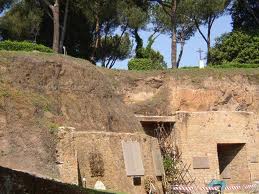
One of the many large entrances to the bunker.
 The mountain is sometimes called the "balcony of Rome," and deserves that name for its 360-degree views. [photos below] We knew there were "bunker" tours on Monte Soratte, but didn't quite know what we were getting into. More than 2 hours underground later, we knew.


Built between 1937-43 to house the Fascist government, should Rome come under siege, the bunker as exists occupies almost 500,000 cubic yards.  Mussolini's plans called for virtually an underground city that would have been at least 4 times that size, but July 25, 1943 intervened.  That's when he was deposed and Italy broke its pact with Germany and Japan.  A few days later, the Germans started occupying Italy.

A photo of the Germans using the bunker.


The bunker became Field Marshal Albert Kesserling's headquarters after those he had in Frascati were bombed on September 8, 1943.  As a result, the bunker is now known as the "German bunkers," though, as our guide was quick to point out - entirely Italian-built.  Italians have always been expert miners (since the country is basically a mountain range) and put their skills to work here in constructing the many kilometers of high-vaulted rooms and passageways.
Even vestiges of toilets remain.  The "footprint"
toilets appear to have been in use even then.


On May 12, 1944, over 100 B-17s (if we understood our guide's Italian correctly) attempted to bomb the German headquarters.  So impenetrable were they, only 100 German soldiers died of the 1,000 inhabiting the bunkers.  The Allied troops entered the bunkers on June 4, 1944, the day the Allies came into Rome.  The Germans set the bunkers on fire, destroying the interior.
The association and volunteers have added manekins and equipment of the
period to give visitors a feel for the use of the galleries of the bunker.


The nuclear retrofitting included concrete floors, walls and
ceilings that are not attached to each other (lit in this photo).
There is also a Doomsday Clock and other markers of nuclear
disaster in this part of the bunker.  We assume mainly to educate
school kids.
Other uses of the bunker took place after the war.  It was a munitions depot for the Italian Army (until 1967), and a the fallout shelter (never completed) for the Italian Government in the case of a nuclear attack on Rome.


This wall of data came from a now-destroyed bunker under
Monte Cavo in the Colli Albani.  It is from the 1970s, when Italy
as part of NATO was assigned an area (mainly Hungary) from which
to defend Western Europe from Eastern Europe.


The gallery dug out by use of this "trenino" in an attempt
to find the hidden gold.


And then there's the story of over $1.5 billion in gold ingots being buried by the Germans - who supposedly stole it from Italian banks - in the bunker.  At some point, the government started digging out another part of the bunker - with a little train ("trenino") in hopes of finding the gold.  The story involves all the Germans who were engaged in hiding the gold being killed, except one who fled, and then he was found decades later by Interpol in his apartment with his head severed.


Our indefatigable guide, showing us an incomplete tunnel,
with its steel rebar, and a newer part of the tunnel,
from the period when
the nuclear fallout shelter was being constructed.
About 10 years ago, a group of volunteers started restoring the bunkers, established a not-for-profit association, built a museum, and now give daily tours, a remarkable achievement.  You can find out more on the association's Web site, though there's nothing in English.  All tours so far are in Italian (and 2 hours worth is a lot of Italian!), though I noticed on TripAdvisor that some people have arranged private tours in English. 


As if that weren't enough for a day, we took advantage of the Monte Soratte Riserva to take a 3-hour hike.  We had been on Monte Soratte perhaps 10-15 years ago, before there was any information about a bunker.  We remembered the 'hike' as relatively easy. 


The 6th century church of San Silvestro, at the peak of Monte Soratte;
built on the ruins of a temple to Apollo.  From this peak, one can see Lazio
in all directions.

This time, with more marked paths, we managed to go up an extraordinarily steep slope and to see ruins of several hermitages, a medieval church, and an active monastery.  

Dianne (more photos below)
One of the lovely trails through a forest of, we think, beech trees.
A mock-up of a charcoal kiln on a "didactic" side trail we took,
explaining the "carbonari" - the charcoal workers.

Steeper than we recalled!


The one town on the mountain - Sant'Oreste - seen from the beginning of
the paths up the mountain.

And, yes, we got there with a car-share car.  That's Dianne
trying to figure out how to end the rental, and having to deduce
the Italian words for "ignition" and "car door" in the process.

Wednesday, August 7, 2013

Rome War Cemetery - an isolated reminder of World War II


Lesser known than its partner across the road, the Rome War Cemetery is no less peaceful, or sobering.  Here lie the remains of over 400 Commonwealth soldiers who died, defending Italy, in World War II.  Like the Protestant Cemetery in Rome, where Keats, Shelley, Gramsci and others are buried or memorialized, this cemetery is nestled against the Aurelian Walls and the tombstones are solemn reminders of the sacrifices of the English and their Commonwealth countries.  The cemetery began as a burying ground for the soldiers garrisoned in Rome, when it was occupied by the Allies after the Germans left the city on June 3, 1944, but it also includes the bodies of soldiers from the surrounding area, as well as those who died as POWs.  There are, of course, much larger British cemeteries in Cassino and Anzio, and elsewhere in Italy.

The memorial at right includes a stone from Hadrian's Wall - in the UK - the northernmost point of the Roman Empire, tying the United Kingdom historically to Italy for some 2000 years.

To visit the Rome War Cemetery, either walk around Monte Testaccio, or walk past the Protestant Cemetery - further away from the Pyramid.  Address:  via Nicola Zabaglia, 50. The cemetery is open only when the gardeners are there:  Monday-Friday 8:00 a.m. - noon, and 12:30 - 3 p.m.

Dianne
plaque with the stone from Hadrian's Wall

Thursday, June 16, 2011

RST Top 40. #3: Via Tasso


The poet Tasso in a mental institution in Ferrara.
Painting by Eugene Delacroix. 
For knowledgeable Romans, via Tasso has two meanings--two, that is, besides the obvious: an unimposing street that runs northwest for 5 blocks from behind the Scala Santa in front of San Giovanni in Laterano.  One of the other meanings, of which we were made aware only recently, by way of Goethe's many references, is the brilliant, influential 16th-century poet Torquato Tasso.  Born in Sorrento, Tasso spent his most productive (and most frustrating) years in Ferrara, where he wrote the lyrical epic Gerusalemme Liberata (1574) and, two years later, was incarcerated in a mental institution, perhaps for conduct that was only intemperate.  He died in Rome in 1595,  a few days before he was to receive from the Pope the "crown of laurels" as the king of poets.

The other meaning of via Tasso is starkly different: the Nazis' political torture prison.  The official name is the Historical Museum of the Liberation--it's open and you can visit-- but what happened here at via Tasso 145 was hardly liberating.  Between September 1943, when the Germans occupied Rome, and June 1944, when the city was liberated by allied armies, the prison on via Tasso--now often called simply "via Tasso"--was the scene of torture, abuse, and death for hundreds of prisoners, among them Jews, partisans, and the innocent.  Late in March, 1944, all the prisoners housed at via Tasso were removed and summarily executed at the Fosse Ardeatine, caves just outside the city.

Via Tasso is a haunting place to visit.  Many of the rooms of the prison now hold exhibits and documents, some of which we have translated from the Italian in Rome the Second Time.  But some of the cells are still there, and there, especially, one can see--and feel--the anguish of those held here.  A reader of a February 5 post on the Fosse Ardeatine sent us these lines (the translation is the reader's, too), scratched by a prisoner into the wall of his cell, returning us to the man Tasso, to his experience as a prisoner, and to the relationship of poetry to the human spirit.

L'anima a Dio
La vita al re
Il cuore alla donna
L'onore per me

My soul to God
My life to the king
My heart to my wife
My honour to myself


Bill

Saturday, February 5, 2011

Rome the Second Time Top 40. #12: The Fosse Ardeatine


Cells at the former SS prison on via Tasso
The grounds of the Fosse Ardeatine (Ardeatine Caves) include the caves [photo below] where, in March 1944, the German SS executed 335 Italian men--Jews, partisans, and others--in retaliation for a deadly partisan attack on the occupying German forces in via Rasella, and the haunting cemetery/memorial housing the bodies of all those killed there.  The Fosse Ardeatine are located a few miles south of the Centro on via Ardeatine, but can be easily reached by Bus 218, which has a stop in the city at the corner of Piazza San Giovanni and the wide via Amba Aradam.


Itinerary 6 ("Attack and Reprisal--a Story of Partisans and Nazis") in Rome the Second Time covers the via Rasella bombing and the SS prison on via Tasso, which now is home to the Historical Museum of the Liberation, where some of those killed at the Fosse Ardeatine had been incarcerated.   

The tombs of those killed at the Fosse Ardeatine
A good (Jewish) friend who read Rome the Second Time enjoyed and praised the book but was critical of the space devoted to Italian Fascism and the 1943/44 German occupation of Rome, which produced the Fosse Ardeatine tragedy and the deportation of many of the city's Jews to concentration camps.  We think the material is not only appropriate but vital.  More than half a century later, these issues and events--Mussolini and Fascism, the ugly Italian campaign, the role of the partisans, the inhumanity of the Germans, the occupation of the city after the withdrawal of Italy from the war, the deportation of Italian Jews--continue to resonate with and to divide Italians, shaping their social relationships, politics, foreign policies, and art and architecture, well into the 21st century.  You can't tell the players without a scorecard, and you can't fully understand contemporary Italy without knowing something about what happened between 1922, when Mussolini marched on Rome, and 1945, when sanity returned to the Eternal City.

Bill

A poster from the late 1930s, now in the Historical Museum of the Liberation, announcing the expulsion of foreign-born Jews from Italy and the exclusion of native-born Jews from banks, insurance companies and other occupations, as well as from the public schools.