Rome Travel Guide

Rome Architecture, History, Art, Museums, Galleries, Fashion, Music, Photos, Walking and Hiking Itineraries, Neighborhoods, News and Social Commentary, Politics, Things to Do in Rome and Environs. Over 900 posts

Showing posts with label Fosse Ardeatine. Show all posts

Thursday, May 1, 2014

World War II German Round-Up Remembered in Rome's Quadraro

The wasp - symbol of Quadraro/Graffiti by Luca Maleonte
Contemporary Romans continue to wrestle with memories of World War II, particularly the 9-month occupation of Rome by the Nazis.  We are currently in a period of the 70th anniversary of many of the atrocities that occurred during that occupation, which ended on June 4, 1944, when the Allies marched into Rome as the Germans, having declared Rome an "Open City" the day before, retreated.


Two weeks ago, RST participated in a short march and ceremony in the old Rome suburb of Quadraro, as part of that community's commemoration of the Nazi rastrellamento (round up) of all able-bodied men in the neighborhood.  The round-up began at 4 a.m. on April 17, 1944, when the Germans sealed off the neighborhood.  It ended with about 2,000 men being taken to nearby Cinecitta' (which served as barracks for various purposes during and after the war), winnowed, and over 1,000 sent to German labor camps.  About half returned to Quadraro.

Banner from the "Nido di Vespe" section of the national partisans'
association (Anpi)
The community was targeted by the Germans because of its left-wing, anti-Nazi and anti-Fascist sympathies.  The Germans referred to it as a nido di vespe - or "wasps' nest."  And the community proudly carries that label today. (And, yes, americani, "Vespa" means "Wasp.")

Research into those missing began only about 30 years ago, 40 years after the war ended, and calls for the event to be included in history books continue to this day.  


Sculpture in the park: wife and child protecting man
from German soldier (left)
The march, complete with military band, went from an older war monument to a sculpture in a park specifically dedicated to April 17, 1944.  Representatives of the Mayor (who was billed as attending, but sent a representative) and other politicians and labor groups spoke.  The prior mayor, Gianni Alemanno, certainly would not have been in attendance at an event celebrating leftists and with the participation of partisan organizations.  

Bill thought the crowd, which he estimated at about 130 (excluding the band and police protection) to be substantial and heartening.  I thought the number was closer to about 40 (excluding also the speakers and their entourages), and disappointingly small. 

Sisto Quaranta, 88, recalls being awakened by German soldiers
on the morning of April 17, 1944 as he lay in bed -
when they pressed the handle of a
grenade launcher into his chest
In the crowd were some residents who were part of the rastrellamento and remember it well.  


Large crowd, or small? Heartening or disappointing?

The tragedy of the Fosse Ardeatine took place only 3 weeks before this round-up, and 6 weeks later the Germans had left Rome. 

 Dianne
Anpi scarf


Thursday, June 16, 2011

RST Top 40. #3: Via Tasso


The poet Tasso in a mental institution in Ferrara.
Painting by Eugene Delacroix. 
For knowledgeable Romans, via Tasso has two meanings--two, that is, besides the obvious: an unimposing street that runs northwest for 5 blocks from behind the Scala Santa in front of San Giovanni in Laterano.  One of the other meanings, of which we were made aware only recently, by way of Goethe's many references, is the brilliant, influential 16th-century poet Torquato Tasso.  Born in Sorrento, Tasso spent his most productive (and most frustrating) years in Ferrara, where he wrote the lyrical epic Gerusalemme Liberata (1574) and, two years later, was incarcerated in a mental institution, perhaps for conduct that was only intemperate.  He died in Rome in 1595,  a few days before he was to receive from the Pope the "crown of laurels" as the king of poets.

The other meaning of via Tasso is starkly different: the Nazis' political torture prison.  The official name is the Historical Museum of the Liberation--it's open and you can visit-- but what happened here at via Tasso 145 was hardly liberating.  Between September 1943, when the Germans occupied Rome, and June 1944, when the city was liberated by allied armies, the prison on via Tasso--now often called simply "via Tasso"--was the scene of torture, abuse, and death for hundreds of prisoners, among them Jews, partisans, and the innocent.  Late in March, 1944, all the prisoners housed at via Tasso were removed and summarily executed at the Fosse Ardeatine, caves just outside the city.

Via Tasso is a haunting place to visit.  Many of the rooms of the prison now hold exhibits and documents, some of which we have translated from the Italian in Rome the Second Time.  But some of the cells are still there, and there, especially, one can see--and feel--the anguish of those held here.  A reader of a February 5 post on the Fosse Ardeatine sent us these lines (the translation is the reader's, too), scratched by a prisoner into the wall of his cell, returning us to the man Tasso, to his experience as a prisoner, and to the relationship of poetry to the human spirit.

L'anima a Dio
La vita al re
Il cuore alla donna
L'onore per me

My soul to God
My life to the king
My heart to my wife
My honour to myself


Bill

Saturday, February 5, 2011

Rome the Second Time Top 40. #12: The Fosse Ardeatine


Cells at the former SS prison on via Tasso
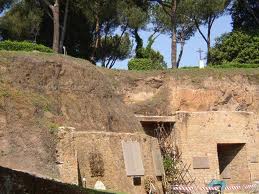
The grounds of the Fosse Ardeatine (Ardeatine Caves) include the caves [photo below] where, in March 1944, the German SS executed 335 Italian men--Jews, partisans, and others--in retaliation for a deadly partisan attack on the occupying German forces in via Rasella, and the haunting cemetery/memorial housing the bodies of all those killed there.  The Fosse Ardeatine are located a few miles south of the Centro on via Ardeatine, but can be easily reached by Bus 218, which has a stop in the city at the corner of Piazza San Giovanni and the wide via Amba Aradam.


Itinerary 6 ("Attack and Reprisal--a Story of Partisans and Nazis") in Rome the Second Time covers the via Rasella bombing and the SS prison on via Tasso, which now is home to the Historical Museum of the Liberation, where some of those killed at the Fosse Ardeatine had been incarcerated.   

The tombs of those killed at the Fosse Ardeatine
A good (Jewish) friend who read Rome the Second Time enjoyed and praised the book but was critical of the space devoted to Italian Fascism and the 1943/44 German occupation of Rome, which produced the Fosse Ardeatine tragedy and the deportation of many of the city's Jews to concentration camps.  We think the material is not only appropriate but vital.  More than half a century later, these issues and events--Mussolini and Fascism, the ugly Italian campaign, the role of the partisans, the inhumanity of the Germans, the occupation of the city after the withdrawal of Italy from the war, the deportation of Italian Jews--continue to resonate with and to divide Italians, shaping their social relationships, politics, foreign policies, and art and architecture, well into the 21st century.  You can't tell the players without a scorecard, and you can't fully understand contemporary Italy without knowing something about what happened between 1922, when Mussolini marched on Rome, and 1945, when sanity returned to the Eternal City.

Bill

A poster from the late 1930s, now in the Historical Museum of the Liberation, announcing the expulsion of foreign-born Jews from Italy and the exclusion of native-born Jews from banks, insurance companies and other occupations, as well as from the public schools.

Wednesday, April 7, 2010

Priebke Vergogna: A Reminder that the Nazis were in Rome

We know Dianne took this photograph, in Monti, on June 19, 2007. But we could probably have come close to that date by looking carefully at its content. Much is standard: a shop's metal shutter; a concert poster; one of the ubiquitous yellow advertisements for an apartment for rent; a no-parking sign (sosta vietata); and the usual excess of bad graffiti on almost everything, including the smooth marble.

The white sign is what's distinctive. It reads:

Priebke
Vergogna!
Gli Italiani
Non Dimenticano
Le
Fosse Ardeatine

Priebke
Shame!
The Italians
Don't Forget
the
Fosse Ardeatine

An old friend with whom we've shared Rome and who values our efforts in Rome the Second Time, nonetheless has expressed her irritation at the amount of attention we devote to the Nazis and the Germans in Rome. She's Jewish, and likely she's just tired of being reminded of what happened to Europe's Jews, including those who lived in Italy and Rome.

We appreciate and understand that sentiment, if it is, indeed, what she feels. But the white sheet of paper posted on the wall in Dianne's photo tells us that for many Romans these issues, and the distant past that produced them, are very much alive.
Priebe is Erich Priebke.
Born in Germany in 1913, Waffen SS Captain Priebke participated in the killings of 335 Italian civilians (including 75 Jews) at the Fosse (Caves) Ardeatine in 1944 (below right). Priebke later admitted to keeping the list of those who were to be executed, and of personally killing two people with a machine pistol. He may also have had a role in the deportation of 6,000 to 7,000 Jews from Italy to Auschwitz. But he thought the Fosse Ardeatine killings, personally ordered by Hitler, to be justifiable retaliation for the deadly bombing of a German troop column in via Rasella (we describe these events in more detail in Rome the Second Time).


Priebke was scheduled to be tried in the postwar era, but managed to flee to Argentina, where he lived as a free man for 50 years. After giving an interview to ABC's Sam Donaldson in 1994 in which he described the victims as "terrorists,"
Priebke was extradited to Italy, where before an Italian court he pleaded not guilty and again justified his actions. The judges ruled that the time limit for prosecuting the case had expired, and Priebke was released. On court appeal, Priebke was tried again in 1997, found guilty, sentenced to life in prison and, because of his age, put under house arrest in Rome.


Why, in June 2007, were Romans again concerned about Priebke? Because, on June 12 the court authorized him to leave his home in order to use his considerable skills as a multi-lingual translator in the office of his lawyer. After a day of protests led by the Italian Jewish community, a magistrate revoked the new work permit.


Dianne took the photo a week later.


Bill