Rome Travel Guide

Rome Architecture, History, Art, Museums, Galleries, Fashion, Music, Photos, Walking and Hiking Itineraries, Neighborhoods, News and Social Commentary, Politics, Things to Do in Rome and Environs. Over 900 posts

Showing posts with label Etruscans. Show all posts

Wednesday, September 14, 2022

Rome’s newest museum: The Museum of Rescued Art

photo by Larry Litman (all photos except as noted are by Litman)

Exciting recent news out of Rome: the opening of a museum dedicated to stolen – and recovered – works, rather than one-off shows such as those held once in a while in Castel Sant’Angelo’s exhibition space or the Carabinieri museum, as occurred in 2016.

Now there’s a beautifully refurbished space that Rome resident Larry Litman (retired AmBrit librarian) recently visited and writes about here (more on Larry’s bio later in this post).

Before we launch into Larry’s first-hand guide to the new museum and his many photos of the Carabinieris' marvelous finds, we'll explore some of the hot topic news and issues surrounding the museum and the works.

Hardly a week goes by without news of “stolen” artworks being discovered in places far from where they were taken. Just this month, the New York Times reported 27 ancient artifacts, valued at $13 million, were seized from the venerable Metropolitan Museum of Art. Interestingly, it’s the Manhattan District Attorney’s office that seized the items at 3 separate times, including 21 Italian pieces taken from the Met in July, pieces that are similar to the head of Esculapius, below, from the current Rome exhibit. (One has to wonder, as one does these days, why did they have to seize the works? Why didn't the Met willingly turn them over?)

This head of Esculapius, above,
copied from a Greek original,
is from the late 2nd-3rd
century AD and was taken from the
Baths of Caracalla in Rome.

A few days earlier, the FBI Art Crime Team reported in a news release that it had recently returned to Italy a 2000-year-old mosaic. “The enormous work had been cut into 16 pieces and stored in individual pallets in a Los Angeles storage facility since the 1980s. Each pallet weighed between 75 and 200 pounds.”

We, at RST, are familiar with the art recovery section of the Italian national police, the Carabinieri Tutela Patrimonio Culturale, or TPC (Cultural Heritage Protection Squad), but we hadn’t known of the Manhattan DA’s interest in these objects, nor the FBI's – it seems they have enough else going on these days!


Special Agents Elizabeth Rivas and Allen Grove traveled
to Italy for the repatriation of the mosaic to its home in Rome 
- photo from FBI news release.


Similarly flanking their "prize," the Carabinieri
at their 2016 news conference on art (which
we attended and covered in a post) they
had recovered, in this case a Canaletto, from
the 18th century (photo by William Graebner).


The “recovered” artworks raise multiple issues, including how a country such as Italy or Greece or even Ethiopia (more about Ethiopia in a future post) can conserve, protect, and display these objects. Italy has taken the approach of returning them to the regions from which they came, a somewhat controversial position.


Outside their storage area, next to Santa Maria
a Ripa in Trastevere, we saw the Carabinieri's 
art truck promoting their "100 opere tornano a casa" -
"100 works return home." (Photo by William Graebner)
This year in Rome we saw the area in Trastevere where the recovered artworks are – temporarily one hopes – stored. And then there’s the issue of where do the objects really belong? What about Greek vessels that were spoils of war in Greece, brought to Rome, and then stolen from Italy? To which region or country should they be returned?


Larry notes “Several years ago I visited Aidone in Sicily to see an amazing statue of Venus returned from the Getty museums in Los Angeles and a collection of Silver Plates from the Met. The region built a museum in a redundant convent to house these items and other artifacts from the area.” The long saga of the Getty's involvement in stolen works, including lawsuits and criminal actions, are well-reported in David Price Williams's 2015 "Looking for Aphrodite." The Getty also helped restore items for the Aidone museum, and put some of the objects on display (this time, on loan) at the Getty Villa in Los Angeles, a sort of reciprocity (we were fortunate to see Venus in Los Angeles, before she left for Sicily). So, maybe there’s an advantage to spreading this “wealth” around. Although New York Times' writer Elizabeth Polvoledo had a different experience from Larry's in the once-Etruscan hub of Cerveteri, near Rome, where the museum did not have the staff to stay open (see caption under Larry's photo of the Etruscan female antefix below).

Journalist and author Sari Gilbert also used a stolen Etruscan vessel as the key to her intriguing murder mystery set in 1980s Rome, "Deadline Rome: the Vatican Kylix," which we reviewed here. As noted above, current, exciting, hot topics involving 2000-year-old art.


This is RST's 4th post from our "man [almost always] on the ground" in Rome, Larry Litman. Larry wrote eloquently in March 2020 about being in Rome under one of the first lockdowns. He gave a virtual tour of the unusual presepi or crèches in Piazza San Pietro (St. Peter’s Square) that year when almost no one was there to see them, and he was one of the first (as he is this time) to see the inside of the Tomb of Augustus, newly opened last year.

Larry is a retired teacher/librarian from Ambrit International School and is active at St. Paul's Within the Walls (the Episcopal Church on via Nazionale). He also volunteers at the Non-Catholic Cemetery. 


Rome’s newest museum: The Museum of Rescued Art - by Larry Litman 

Entrance (after you've purchased your ticket
around the block), still with "Planetario"
above the doorway.
In June the Rome Museum of Rescued Art (Museo dell’Arte Salvata) opened in the Octagonal Hall of the Baths of Diocletian, a 3rd century AD space within the ancient baths that many Romans identify as the Old Planetarium. (The new Planetarium is in the modern neighborhood of EUR and was built in 1928.) [Note to RST readers, the Planetarium is where the Museo della civiltà romana used to be, making the cover of our Modern Rome guidebook now misleading. Bill’s office, when he taught at La Sapienza in 1993, overlooked the Old Planetarium, now the Museum of Rescued Art.]


A 2nd century AD copy of a Greek statue
 of Doriforous by Polyleitos,
from the Baths of Caracalla;
so presumably it will stay in Rome.


The Museum of Rescued Art will present changing exhibitions of objects recovered by the Carabinieri unit for the Protection of Cultural Heritage.

For the foreseeable future there will be enough recovered items to keep the museum going. It’s giving a visible profile of the Carabinieri unit involved, discouraging theft and encouraging restitution/return.


This initial exhibition features about 100 objects from more than 200 artifacts, dated from the 6th century BC to the 3rd century AD, stolen over the past 50 years, that were returned to Italy from the United States between December 2021 and June 2022. The New York Times, in a piece about the new museum, called this location a “pit stop,” because all objects at some point will be returned to their places of origin in Italy.


An Etruscan female antefix
(ornaments at the eaves of a
building), from the beginning
of the 5th century BC. It's
unclear where this statue will
end up, possibly in a special
museum in Cerveteri, home to
many Etruscan artifacts. 
But that museum does not have 
the funds to stay open much,
according to Elizabeth Polvoledo
in her New York Times piece,
cited above..

The soaring dome of the Octagonal Hall [photo at top of post] is an impressive environment for this new Museum of Rescued Art. 


Admission for the National Roman Museum also allows entrance to the exhibition of recently returned artifacts. (Note: You must buy the admission ticket at the main museum entrance facing Termini Station and then walk around the block, through Piazza della Repubblica, to enter the Museum of Rescued Art.)


Explanatory panels on the display cases are in Italian and English, identifying the objects in each case as well as presenting a narrative about the work of the Carabinieri to identify stolen art and negotiate the return of works from private collectors, museums and galleries with the cooperation of authorities in the United States.

More photos and descriptions follow.

Ceremonial Kramer with four handles
surmounted by red impasto bowls
overpainted with white ("white on red"),
produced in Northern Lazio.


Decorated Etruscan terracotta storage
vessels. Again, one wonders where these
objects will end up.


Statue of Artemis, 2nd century AD,
from the Baths of Caracalla.


Etruscan olpe (pitcher) made
 in a Corinthian style with animal friezes,
first half, 6th century BC.


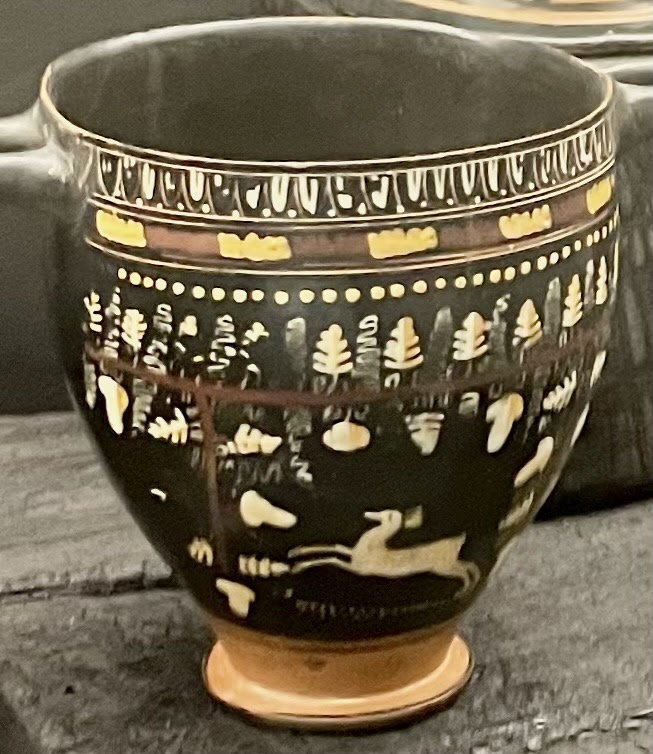
Black and white painted terracotta vessel
from the ancient town of Crustumerium,
a site now identified about 10 miles north
of Rome near Settebagni, 7th century BC.


Brown cremation urn in the shape of a house
with figured decorations (horse, soldier and boat)
on the walls and on the lid. 7th century BC.

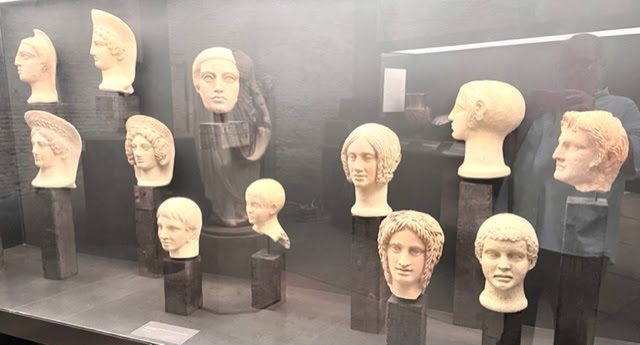
Etruscan terracotta votive heads,
8th century BC.

Sunday, August 29, 2021

Immersion in Rome: Sari Gilbert's new mystery "Deadline Rome: The Vatican Kylix"


If you want to immerse yourself in Rome but can't get there yet, Sari Gilbert's 2021 mystery novel, "Deadline Rome: The Vatican Kylix" is a perfect way to do it. 

Set mostly in Trastevere, Gilbert's novel features a British archeologist turned journalist and part-time detective, Clare Phillips, whose knowledge of Rome's news and police systems is deep and fascinating.

The story opens with a kidnaped young man, who has a head wound, and follows shortly with Clare and her archeological buddy discovering an ear in an Etruscan tomb, where they are picnicking near Tuscania. We've been in some of those tombs - and one can picnic in them - many are simply open. And Tuscania is a gorgeous town in northern Lazio. Hopefully that will  prick your appetite for this delightful book.

Etruscan tomb in Cerveteri

You can follow Gilbert's attractive protagonist as she scooters around Rome and its environs, interviewing everyone from bishops to tombaroli (grave thieves - those who plunder ancient graves for valuable artifacts). For those who watched the British TV series, "Fleabag," you'll be pleased to note there's even a hot priest in the mix.

Enjoying Tuscania


Gilbert's novel intertwines several historically important stories: the questionable provenance of ancient relics, in this case a signed Greek wine cup or the Kylix; corruption in the Italian banking system; and the anni di piombo, or "years of lead," in which kidnaping for political and monetary gain was a plague in the country - the novel is set in 1980. The author, a retired American journalist with years of experience in Rome, adroitly uses these historical themes to remind the reader of critical facets of contemporary Italian history. 


The proposed unveiling of the Kylix reminded us of a big show of recovered artifacts in the Carabinieri headquarters in Rome. Clare visits some of the same places we did, and interviews officials we - mostly unsuccessfully - tried to interview. - photo right; our post here.

On a more playful level, Clare traipses around Rome (as noted, by scooter, but also on foot, and by car), taking the reader to specific streets and locales that evoke the Rome of Romans, not of tourists. Her favorite barristas, coffee bars themselves, small restaurants, pasta, all are a delight to anyone who loves Rome. And if you don't know a specific street, you can get out your Google Map (or Tuttocitta') and follow along. She also slings the Italian slang, some of which was new to us, but some of which we were pleased to see on the page, including "conosco il mio pollo" - "I know my own chicken" - i.e. I know of what I speak; let me do it.

One complaint might be that Clare is a little too attractive, especially to the Italian men; though I suppose Gilbert might say, that's her Italian experience. One gets a little weary of Clare constantly being noted for her good looks, and those good looks opening doors for her. And a mystery fan with whom I spoke thought there were a few too many characters and that it was difficult to keep track of them all. That wasn't my experience. In any event, these are small criticisms in a wonderfully written book with a good mystery at its heart (you'll note I haven't spoiled it for you). I'm looking forward to more from Gilbert. 


At the bar/cafe Ombre Rosse, in Piazza di Sant'Egidio,
where Clare lives.

Dianne

Gilbert's book is available on Amazon and elsewhere.


Sunday, May 11, 2014

Etruria: the perfect day-trip from Rome, with the perfect guidance

At the 16th-century "monster park" - Bomarzo, near Viterbo, in Etruria
We now have a ready answer to "What's a good day trip from Rome?" - and it's Etruria... so let us explain what that is and why we have picked it.


The day trip question is one we're often asked, and we often have multiple answers, depending... on whether one likes beaches or mountains, small towns or urban museums, a day without tourists or the hottest spot in a large town, etc.

The covers to Mary Jane Cryan's latest book on Etruria in Northern Lazio, for day trips from Rome
Our easy answer now for those who want an authentic Italian experience and no or minimal tourists:  Mary Jane Cryan's Etruria.  Etruria is the area north of Rome once inhabited by Etruscans, and others before them.  Cryan draws a line between the towns of Vetralla, Tarquinia and Tuscania to form what she calls the Etruscan Triangle - a stunning area.  She has done us all a huge favor by covering the area in the kind of detail and enchanting stories one rarely finds in travel guides - no doubt because she has lived in the area for more than 20 years, and in Italy more than 50.
One way to enjoy Tuscania  (and, it's in Lazio, not Tuscany) -
from the patio of a hotel on the "new" side of town, looking over to the old.

Lago (Lake) Bracciano and the eel-dominated (in a good way)
town of Anguillara Sabazia
Her most recent book, hot off the press, is Etruria: Storie e Segreti (Etruria - Stories [Histories] and Secrets), as of now, only in Italian.  For those of you who don't want to slug it out in Italian, she has several other guidebooks.  I hesitate to call them guidebooks, because they are so much more than that.  But guide you they will, through Etruria, and they will lead you to much more than what most people go for - the Etruscan sites.  Most accessible, for those who are looking for a day or two in the region, is Cryan's, Etruria: Travel, History and Itineraries in Central Italy.  You will find wonderful itinerary chapters, such as "Mysterious Sites of Northern Lazio," or "Connoisseur's Guide to Viterbo," as well as personal stories, such as "An Old Palazzo in Etruria - the sequel." 

Her other books about Northern Lazio are intriguing as well: Travels to Tuscany and Northern Lazio, Vetralla - the English Connection, and Affreschi - Exploring Etruria. All are based on her own, in-depth travels and original scholarship.  At least one of these books is a "must have" if you are traveling in this area - and you should travel in it, imo.

Mary Jane Cryan's info can lead you to Italian spas where
you will find no tourists.  She "takes the spa" at least weekly,
she says.  So she oughtta know!
Check out Cryan's in-depth Web site, www.elegantetruria.com for ordering the books if you're not in Rome.  In Rome they are available at the few remaining English language bookstores, including Anglo-American, on via delle Vite, and Almost Corner, in Trastevere.  Or most Feltrinelli's.  

Dianne


Wednesday, April 16, 2014

Fu-turing at Cerveteri: Discovering the Etruscans through Digital Technology

RST is pleased to welcome guest blogger Theresa Potenza.  Based in Rome, Potenza is an art historian and freelance writer.  To learn more about her private tours of Rome and read her travel and feature stories about Italy check out: www.italywiththeresa.blogspot.it.


Experience the past by leaping into the future.  At Banditaccia necropolis at Cerveteri, digital technology engages raw archaeology.  The long dead come to life—well, almost. 

The city of Cerveteri, located 28 miles (50km) north of Rome, was one of the largest cities of the Mediterranean before the Roman civilization.  Its burial site offers a taste of the complicated Etruscan religion and preoccupation with death and foregrounds the Etruscans’ skillful and creative construction techniques.

A new technology program at the site, called Fu-touring, enhances an already powerful in-person experience of a city of the dead.  Inside the technology center you can watch a 20-minute 3-D video providing just enough background on the people, burial practices, and art of Cerveteri to put the 25-acre (10-hectare) site into context.  Three of the tombs are enhanced inside with a 2-minute video that recreates where objects were placed along the walls, how the architectural space was carved, who was buried there, how their funerals took place in that space, and even reconstructs earthquakes and natural disasters to show how precious terra-cotta vases and other personal items were damaged over the centuries.  


Hundreds more tombs are available to visit in order to expand your imagination, including 9th century BC small hut tombs and dice tombs, resembling shop windows, set along a main road.


The most famous tombs are those of the 5th century BC, grande tumuli (mounded) tombs indicating an elite aristocratic class and built to imitate domestic architecture of the period.

Palazzo delle Esposizioni
April 15-July 20
These technological enhancements to one of most unique burial sites in the world, connected to a leading ancient city on a par with Athens and Rome, comes at a time when the Etruscan city of Cerveteri is in the spotlight in Rome.  An exhibition at the Palazzo delle Esposizioni--on from April 15th through July 20th --assembles some of the best collections of previous archaeological discoveries from inside these tombs from significant galleries around the world, including the Vatican Museums, Paris’ Louvre, and the British Museum in London. The exhibition incorporates some of the most remarkable and well-known finds from Cerveteri, as well as material recently discovered and never before revealed, providing new insight into this mysterious metropolis and the remarkably advanced pre-Roman civilization of the Etruscans.

Theresa Potenza

Thursday, May 6, 2010

Italy's Millennial Walls, Robert Frost and us

“Good fences make good neighbors.” Robert Frost’s line came to mind as I was preparing this post.

I was thinking of appropriating and corrupting the line so it reads: “Good walls make good neighbors.”

But in finding and re-reading Frost’s poem, in which this line appears twice, my college English class came back to me. The poem is really about a wall that is a fence. The title of the poem is “Mending Wall,” and the first sentence, which is in the poet’s voice is: “Something there is that doesn’t love a wall.” The more famous line, “Good fences make good neighbors,” is actually said by his neighbor. So, Frost, the poet, does not like walls; it's his neighbor who does - and Frost is criticizing him in the poem.


The first 4 lines of the poem read:


Something there is that doesn’t love a wall,
That sends the frozen-ground-swell under it,
And spills the upper boulders in the sun,
And makes gaps even two can pass abreast.

The polygonal walls in central Italy seem to defy Frost’s notion that they will crumble and fall. There may be gaps, and spills in the upper boulders, but what’s astounding about these walls is how much of them still is standing, anywhere from 5,000 to 2,000 years later.

Some recent dating shows these walls – made of variously shaped (hence “polygonal”) stones and stacked with NO mortar – pre-date the Romans and even the Etruscans; they could be as old as the 3rd millennium before Christ, or 4,000-5,000 years-old.

We first noticed these walls in Segni, a small hill town about 1 hour outside of Rome where we (finally) had found a hotel after hiking all day (this story may sound familiar to some of you). Taking a walk through the town before dinner, we discovered these amazing walls surrounding a good portion of the city (photo above). We began reading a bit here and there and discovered for the first time the polygonal walls and how old they are.

Fortunately for us, at the same time in Rome there was a fascinating exhibit on the Lazio (Rome’s province) cities that have enormous stretches of these walls remaining. [Note the exhibit used "megalithic" - which refers to structures made of large stones and without mortar - tho' usually we see "polygonal" in references in English.]

We realized there are polygonal walls at the base of Circeo (which we’ve hiked), in Orbetello (where we’ve put our feet in the water), in Norba, and many other places. But, we were a little like the Stupids Go to Italy on this one… we had no idea what we were seeing. Sometimes we don’t read ahead, because we like to discover things for ourselves, but this time we were missing something because we were uneducated about these marvelous walls.

I’ve listed a few websites below that have a bit more information in English about the walls, as well as a link to all of Mending Wall and some analyses of the poem, one of which traces the poem’s activity of two neighbors mending their joining wall back to, guess who, the Romans! See also our earlier blog that includes Segni. Also, for you who need shelter and sustenance, we heartily recommend the hotel we found. Hotel La Pace, which caters to international business people from nearby towns and has a very good restaurant ("famous in the area," says scooter rental guy linked below).

Dianne

Websites:

Article by Giulio Magli, a mathematician in Milan, about the walls of four Italian cities. And lots of pictures in Rome Art Lover's website. And some nice photos and text from a scooter-rental guy whose home town is Segni.