Rome Travel Guide

Rome Architecture, History, Art, Museums, Galleries, Fashion, Music, Photos, Walking and Hiking Itineraries, Neighborhoods, News and Social Commentary, Politics, Things to Do in Rome and Environs. Over 900 posts

Showing posts with label war monuments. Show all posts

Wednesday, August 31, 2022

The Mystery of the Crowing Rooster: A day in the Italian hill town of Gallicano nel Lazio


The photo above gives some idea of the hilltop nature of the town, and the curving roads.

Gallicano nel Lazio (i.e., in the province of Lazio, the same province as Rome - there's a Gallicano in Tuscany that has some history involving Puccini, but it's not this one) is one of those Italian hill towns (meaning they are situated smack dab on the hill, not just "in the hills") that have great appeal for us. Bill already posted on Facebook a bit about this town of 6,000 people, but we thought it deserved more attention than Facebook allows.

Our photo from 2014. We saw buses doing the same treacherous
turn this year.

It was Bill's pick for our almost-weekly trip out of Rome. I was delighted with his choice, because I thought we would pick our way among the fabulous aqueducts that lie below the town (more about those at the end of the post). But, no, he's "been there, done that," and so after 20 miles or so from Rome, we wound our way up the town's steep, curvy approach, deciding to bail out as tilting buildings and road curves lay above us. We parked at a new-ish gas station, perched on the side of the town's cliffs. (First we had to go through a gap in the tufo rock so narrow that it now has a light and one-way traffic at times, and we were astonished that a bus could pick its way through it - so astonished we didn't take photos - but we did find a photo from 2014, when we had the sense to take a picture - above).


The gas station that became our home base.
More on this photo at the end of the post.


When Bill asked the gas station (really the woman at the bar attached to it) if we could park there, she indicated we should park in a corner. We thought that rather silly, since the station didn't seem to be attracting customers. But we did as we were told and 'hiked' our way up to the town, finding a superimposed 'modern' staircase here and there to help us get to the top.


Dianne trying one of the vicoli.

The town had many of the small "streets" and alleys (vicoli) common for hill towns (we decided the Mediterranean diet isn't so much what they eat, but that they climb up and around all these hill towns!). 


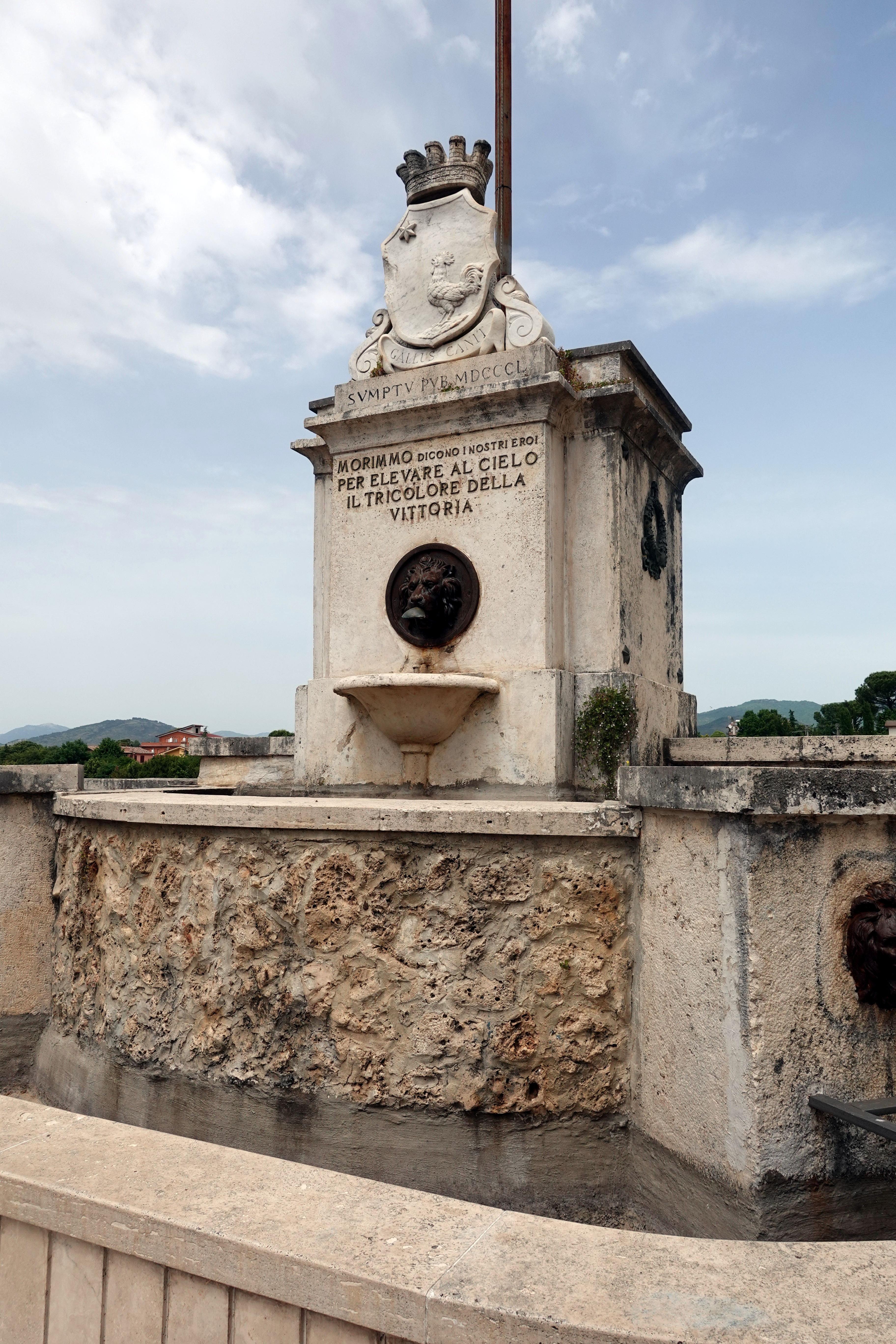
What fascinated us about the town was its various monuments, and especially the town crest, which features a crowing rooster.  We think that's what Gallus-Canit means ("canit" perhaps related to "cantare" or singing). While the town seems named after a nobleman named Gallicano who was a friend of Constantine's, there's another story about the crowing rooster that's more evocative.


The town crest worked into the sampietrini or 
cobblestones (apologies for the car covering
the star, and Dianne's legs).


Legend has it... that one night, a group of soldiers, in the service of the enemy Rospigliosi family (aristocrats of Pistoia), tried to attack the town, taking advantage of the rest of the inhabitants. But a dog started barking at strangers. A rooster echoed him and with his insistent crow woke the population from sleep. The people armed themselves with spears, swords and everything that came within range, repelling the invaders. Since then the town, to give back to those who had, unwittingly, saved the town from occupation, took the name, by which it is still known today, of Gallicano.


.
The crest appears in many forms,
in many places in the town, including
  the parking area and this fountain.


The town was full of monuments of all types. The one above right is a war memorial which has the crowing rooster crest at the top, and a reference to 1850 (maybe to the Risorgimento [Italy's effort to create a state and release itself from Papal and other control]?), and the words: "We died, say our heroes, so we could lift the tricolor [Italian flag] of victory to the skies [heavens]."

And, to show off it's not just about roosters and war, one of the town's parks had this bench, which, if you look at it from the side, is an open book:

The excerpt from Dante's Inferno, Canto 26, reads:
"Consider your origins. You were not made to live as brutes, but to follow virtue and knowledge."

A last monument is in the photo below. We found it while scouting the outskirts of the town.  Unfortunately, we don't have any more information on it. If someone does, let us know!


Close-ups reveal some interesting figures in the "windows" - women? immigrants? people in distress?


At the gas station, we found a good assortment of tramezzini (those crustless white bread sandwiches you wanted as kids - though they probably didn't come in funghi e spinaci [mushrooms and spinach]) and Coca Zero (apologies, but we can't celebrate the end of a hike with a beer when on the scooter). The people-watching there was good as well. The attendant was right - the gas station became the town center as people came and went after their 1-3 p.m. pranzo, buying milk, cigarettes, ice cream for their kids, lottery tickets, and gas. We enjoyed our front-row seat to the town's populace (Bill is at one of the tables on the left in the gas station photo above).

The railings to keep you from falling into the
stream below are now mostly gone.

Our final stop, at my insistence, was to get a glimpse of the wonderful aqueducts. Only this time, after 30 minutes one-way of walking, we found only one and then a blocked road.  We'll have to go back to find our "aqueduct trail" that we wrote about 8 years ago.


And, here's a photo from the 2014 aqueduct hike that should give you an incentive to try it (and us to go back)


Dianne


Tuesday, December 8, 2020

Castel San Pietro: of War Monuments and Movie Sites


In thinking about places we miss - and that are often missed period - my mind landed on Castel San Pietro, a small town above Palestrina. I planned to write that Palestrina (dating back farther than the 8th century BC) is one of the more important cities within 25 miles of Rome, but Wikipedia gives it short shrift. 


It gives even shorter shrift to Castel San Pietro, calling it "now occupied by a few poor houses and a ruined medieval castle of the Colonna family."  Whoa! Don't think the locals would like that description.  In fact, they worked hard to make Castel San Pietro a much-used movie site, especially in the 1950s, because of its picturesque setting. One can see Rome from its heights. Gina Lollobrigida starred in the 1953 "Bread, Love and Dreams" (Pane, Amore e Fantasia), filmed in the town. There are a dozen or so placards around  explaining the film sites in both Italian and English, though we've never seen a tourist of any nationality - or anyone speaking English.

We've always liked hiking up - and it's waaay up - to the "Rocca" or castle ruins (see photo at top) that form part of this small town above Palestrina. It's sort of (if you count going up and over the hill town when you don't have to) on our way to a hike we like that takes one down to ancient aqueducts - and Horace's tree - if we could ever find the latter.

What we found the last time we were wandering the town, looking for a coffee bar, were two war monuments, neither of which we'd seen in our previous walking around.


One monument was to the Italian combatants and Holocaust victims from the area who died in World War II, with this statue combining the two types of "caduti" - "fallen." Photo left.


The other monument, photo below, is accompanied by an inscription that reads, "In this place, on 6 July 1944, three young boys, playing with a war ordinance left over from the war, were made innocent victims. This monument is a testament to that incident, and stands against every war, past and present, against the shame of landmines and in honor of civilian victims. 8 December 2004." The Germans had left the area by early June, 1944

The two monuments together are a chilling testament to the horrors of war. And they make our casual escapade through the town, and down into the aqueducts, an after-thought. 

More later on the hike, which we do almost every year when we're in Rome, and Palestrina, home to the great 16th-century composer Giovanni Pierluigi da Palestrina, whose statue stands in a central town square, and to the fictional site where the pact with the devil was made in Thomas Mann's "Doctor Faustus." Mann spent some time in Palestrina in the late 1890s.

Dianne