Rome Travel Guide

Rome Architecture, History, Art, Museums, Galleries, Fashion, Music, Photos, Walking and Hiking Itineraries, Neighborhoods, News and Social Commentary, Politics, Things to Do in Rome and Environs. Over 900 posts

Showing posts with label via Panisperna. Show all posts

Monday, February 13, 2023

Following Fermi: The Great Physicist in Rome

Traces of Enrico Fermi, one of the world's greatest theoretical physicists, are visible in Rome, the city of his birth and where he was driven out by Fascism.

Fermi, an acknowledged prodigy in math and science, started his work on a street now more known for its night-life, via Panisperna in the Monti quarter. He and his associates were dubbed "I ragazzi di via Panisperna," - "the boys of via Panisperna," and are captured in the photo below:


Enrico Fermi at far right. The
other "ragazzi
from left to right, Oscar D'Agostino,
Emilio SegrèEdoardo Amaldi,
and Franco Rasetti. The photo
 was taken by a sixth, Bruno Pontecorvo.
The background looks very much
like the buildings on via Panisperna
today, though #90, where the institute
supposedly was, is an older church.
As a result, we are not sure exactly where on 
via Panisperna the institute was located.


Fermi's location beginning in 1935 is well-known, and now bears his name, as well as sporting a plaque commemorating his extraordinary research there. And that's in the main campus of Rome's storied university, La Sapienza, or La Città Universitaria, designed by Mario Piacentini and opened in 1935 (the subject of prior posts, including one on Gio Ponti's math building and another on Mario Sironi's "Aula Magna" mural - Great Hall - painted in 1935).

In May 2018 we joined a guided tour of the University's physics department, located in one of Piacentini's original set of buildings. 


Left, the Department of Physics is named for Fermi.


The Physics Institute itself is named for another Nobel-winning Italian physicist (and member of the Fascist Party, as was Fermi at one point), Guglielmo Marconi, as seen here:

The plaque below - inside the building - reads:
"In this institute from 1927 to 1938 Enrico Fermi taught and studied. Here he investigated the structure of materials and discovered the radioactivity caused by neutrons [actually neutrinos], opening new avenues in the world. To the knowledge and power of man." [As noted, the institute was located on via Panisperna until about 1935.]


What the plaque does not say is that in 1938, when Fermi, age 37, went to Stockholm to accept his Nobel prize in physics, he kept going - to the United States, fleeing with his family from the racial laws of Italy that had already affected the lives of many of his colleagues and potentially would affect his wife, who was of Jewish heritage.

The tour included parts of Fermi's lab (left), and a cabinet of Fermi tools and books (below, right).


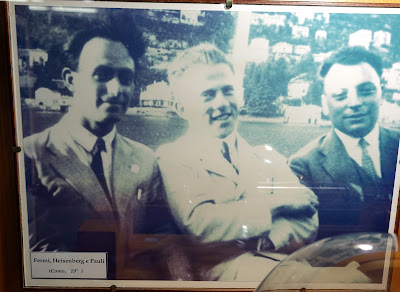
Besides the photo of i ragazzi di via Panisperna, other photos on display on the tour included the one below of Fermi with two other giants of theoretical physics, Werner Heisenberg and another Italian, Wolfgang Pauli (below, the German Heisenberg in the center, Pauli on the right), at Lake Como (date unclear).

The Nobel Prize website has a good biography of Fermi and lay-person descriptions of his scientific breakthroughs (at least one of which was developed based on Pauli's research).

Dianne


Saturday, October 2, 2021

Reading Rome: online map projects bring the 18th century to the 21st

"Giambattista Nolli's magnificent 1748 map of Rome, a milestone in the art and science of cartography and arguably one of the most accurate, beautiful and celebrated maps of Rome ever created." 


This ode to "La Grande Pianta di Roma 1748," above, is from James Tice of the University of Oregon. More importantly, for all of us missing Rome and anyone who misses 18th-century Rome, it's the introduction to the web site https://mappingrome.com/

In collaboration with Dartmouth, Stanford, and Studium Urbis, Tice and his colleagues have created a superb interactive map of both Nolli's Rome and modern Rome. By clicking on the "Layers" at the left of the website, you can add modern buildings or street labels, or even fountains and rioni to your map view. All landmarks (even small ones) have detailed information on the edifice's (if it is one) history and, if missing, what happened to it. 

The website also imports information and views from Giuseppe Vasi, who, in 1763 (he was Nolli's contemporary) published a guidebook for tourists. Dear to the heart of us walkers, Vasi's tourist tome (it complements his "magnum opus" on Rome of the day) breaks the city down into 8 walking itineraries. The website "mappingrome.com" gives an outline for those itineraries, along with Vasi's plates and details on the buildings - whether extant or destroyed. You can leaf through Vasi's magnum opus on another site (https://archive.org/details/gri_33125008696169/page/n5/mode/2up) or follow the itinerary through mappingrome.com's separate Vasi layers, as below.


Above in light green is Vasi's itinerary on Day 3, from Piazza di Spagna to Chiesa e Monastero di S. Lorenzo in Panisperna (in Monti). Part of the explanation of Vasi's plate for the last reads:  [the street angle] "argues for its [the church's] having been there before Via Panisperna was cut through. This is indeed the case: S. Lorenzo was an early Christian church, many times restored and largely redone in the 1570s. The 1551 Bufalini map shows that originally the church was approached by a street coming in from the left and parallel to the church façade. By Nolli's time that street had disappeared."


Vasi's plate at left (and on the website); a tourist photo below of the church and convent today.
Clearly a lot of armchair traveling - of the best kind - is available through this amazing map project.
Once you are 'inside' Nolli's maps, it's hard to stop looking, reading, and layering.

Dianne
PS - We first learned about this mapping project in a Zoom lecture series sponsored by the American Academy of Rome - during Covid lockdowns.