Rome Travel Guide

Rome Architecture, History, Art, Museums, Galleries, Fashion, Music, Photos, Walking and Hiking Itineraries, Neighborhoods, News and Social Commentary, Politics, Things to Do in Rome and Environs. Over 900 posts

Showing posts with label shopping center. Show all posts

Monday, July 11, 2022

Rome's Industrial Heritage: A Valley's Name, its Remaining Relics


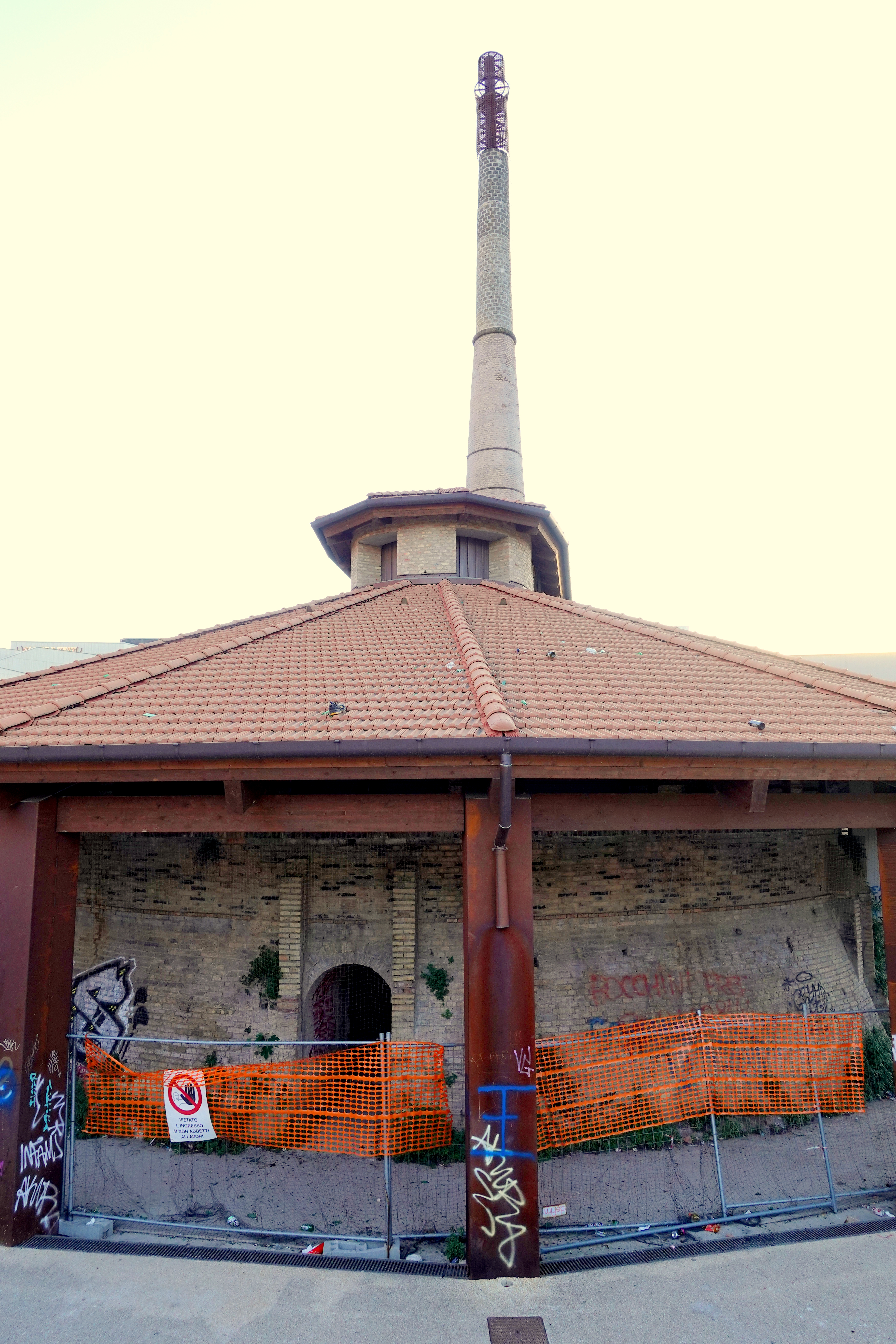
"La Fornace" - the remains today of a 20th-century industrial site, in this case the Veschi Foundry, which operated from the 1920s to 1960, taken from just below the Rome-Viterbo rail line arches - see next photo.

From this simple smokestack that we had seen on earlier treks to this area, and that now was a couple blocks from our apartment, we discovered so many stories - and theories - that it's impossible to relay them all in a blog post. The stories cover wars, names, workers' rights, vistas, government intervention, you name it.

A photo from 1890, when the Rome-Viterbo rail line was being built.

Taken from Monte Vaticano, during the construction of the bridge of the old Rome-Viterbo railroad. Clay quarries and brick-kilns are visible in the background.

Let's just start with the long-time name of the valley in which this relic stands - just behind the Vatican: "Valle dell'Inferno." - Okay, it's the "Valley of Hell" - a name the government would like to erase from memory (current official name "Valle Aurelia") Did that come from the smokestacks?  Local lore would say "yes," because once this valley (this smokestack is at the southern end of it - closest to the Vatican) was home to about 20 foundries, each with at least one smokestack.  (And, unrelated to the name, the bronze for Bernini's Baldacchino in St. Peter's may have been smelted in this area.) The best old photos I could find are the one above and here:

Two smokestacks are easily visible in this 1938 photo. Look closely and you'll see several more behind, in the greyness that no doubt was constant here, and, according to some, gave the valley its name.

Another theory is that the valley was named for the 1527 sack of Rome by German mercenaries, who massacred the Papal troops "with a ferocity to evoke the pains of hell" in this very valley. 

A third theory is that it was here that those who fell ill with the Spanish flu in 1918-1920 were sent to a hospital to die, then buried in a common grave. (A friend recently told us his great-great-grandfather's remains are in that common grave. We could find no confirming historical information on the hospital or the common grave.) Apparently the Valle dell'Inferno name was on a 1548 map, which gives credence to the sack-of-Rome origins.

What is clear is that the Valley was home to the foundries and, closer in, near where the remaining smokestack stands, it was home as well to the foundry workers and those in related professions: makers of bricks and ceramics. They lived near their workplaces, but they also lived outside of the city and outside of the Vatican, apparently (we've learned from more than one source) because the Popes, who ruled the city until 1870, did not want the working class inside the city walls, finding them too radical, having learned lessons from the French Revolution. The area was at one time known as "little Russia" because of its leftist leanings.

The smokestack above, and the walls of the foundry beneath it, were preserved as part of the development of a new shopping mall, called "Aura," that opened in 2018. The developers restored what they could of the foundry, and when we first visited it, it was pristine, at least on the outside (nothing remains inside), but in a few short years, has fallen into disrepair yet again.

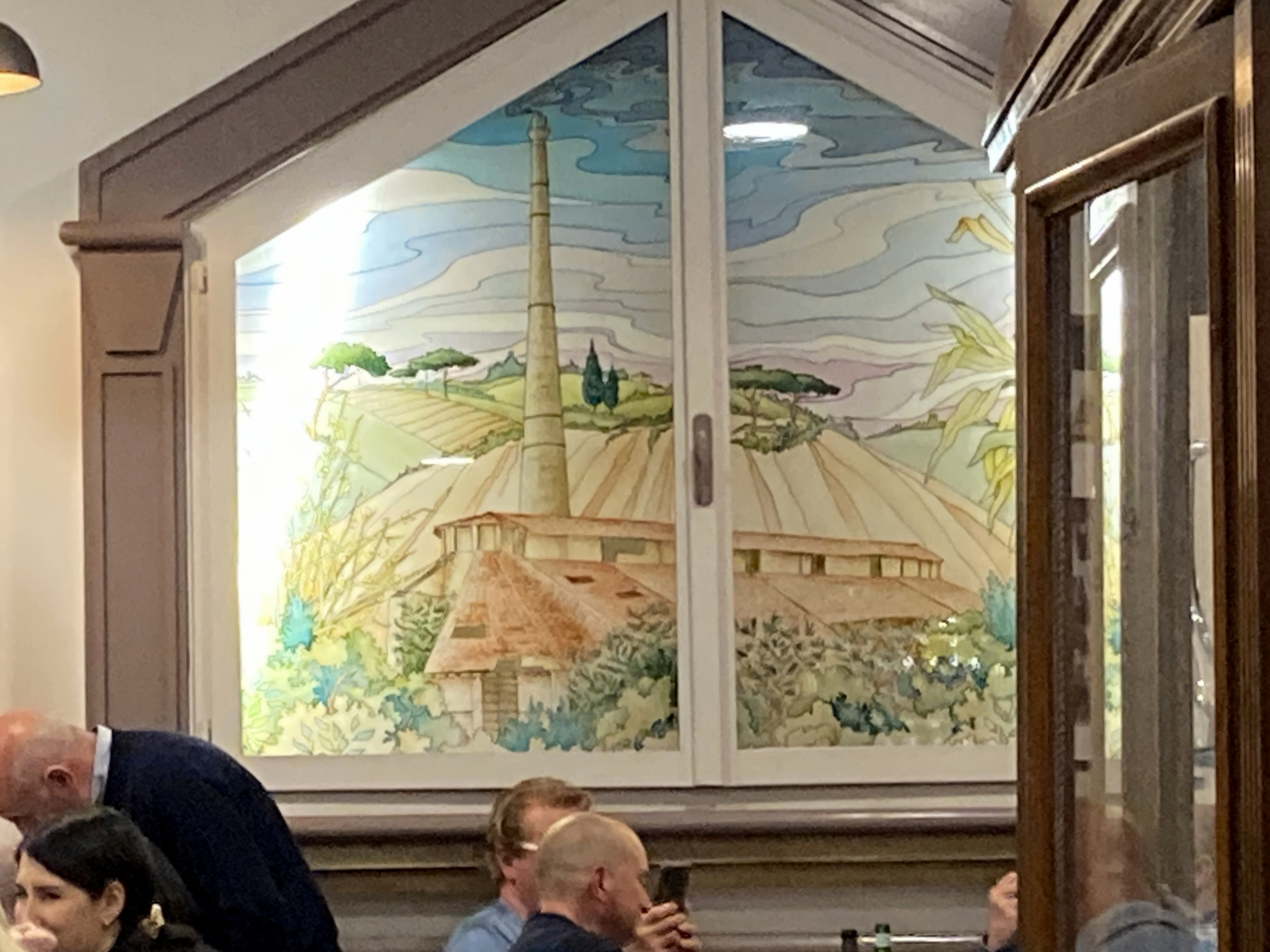
The name "La Fornace" is on a number of establishments in the area, including a good, classic Italian restaurant we enjoyed twice while staying in the area. Its symbol is of the smokestack and furnace, and a painting of those is on its walls (photo above).

Above, the foundry - now surrounded by the
ubiquitous (in Rome) orange fencing and graffiti.
There were some plans (dreams, visions)
 of instructing people about this
 continuous cycle "Hoffman" furnace.


The mall, with grand visions of being a new meeting place for the locals, a new "agora," seems to have survived the worst of the Covid years if not in great shape, at least not completely degraded. Below, a wall of signage at the mall.


The steps of the mall also are the scene of a 2021 painting (it's hard to call it "wall art" or "murales" when it's on stairs, not a wall) by the well-known 

Diavù- whom we interviewed at another mall (the Trionfale Market) not too far away. 


Diavù chose as his subject an 18th-century puppet-maker who lived in the Trionfale area nearby, but not exactly a fixture of the Valle dell'Inferno.

Diavù's steps "painting" at the Aura mall of Ghetanaccio,

the nickname of puppet maker Gaetano Santangel (note his puppets to the left and right).

Outside of the Veschi foundry, the hamlet of the foundry workers and brickmakers has only a few remaining markers of its prior existence, mainly street names: Via dei Laterizi, Via dei Mattoni, Via delle Ceramiche, Via degli Embrici - all names of the professions, basically words for bricks, ceramics, and rooftiles. These are similar to the charming streets of Rome's center - via dei Coronari (makers of rosary beads), dei Chiavari (locks and keys), etc., but the Valley's streets are not quite as charming these days as those in the center.

Even less charming is the public housing that sprung up after the last of the small houses inhabited by the descendants of the foundry and brick workers were demolished. Built (poorly, of poor materials, according to some) in the 1980s, the buildings are some of the tallest in Rome, but still compliant with the law that nothing can be higher than the "Cupolone" ("Big Dome" - of St. Peter's). These have as many stories as they do because they were built down in the valley itself. Some locals prize the buildings, with their red trim, and the wall paintings and library - all of which we found, but we also found these locales not exactly prizes. What may be a prize is the view from the top floor apartments, as one friend told us.  We couldn't get those views, but they no doubt are similar to the views from Monte Ciocci - from which we took the photos of the smokestack. (Photos below.)

Dianne

Public housing, replacing the hamlet of workers' structures.


Wall paintings in the public spaces created as part of 
the public housing; the "prized" library is in here too. It 
was closed when we visited (hours are limited). So the young
people just hang out around here.

The view from Monte Ciocci - the views from the top floors of the public housing in Valle dell'Inferno would be similar.
The writing says: "How many times have you seen the sky over Rome?"
and on the horizon is the radio tower for "Radio Maria," the Vatican radio station, and 
Michelangelo's "Cupolone" - or "Big Dome" of St. Peter's basilica.


Another view from Monte Ciocci - the housing below is upscale, not public housing.
That's the Cupolone and the crenelated Vatican walls, in back of which the workers lived, not being welcome too close to the Vatican (because the Pope did not want workers they perceived as anti-Papacy unionists too near those Papal walls).


Sunday, October 19, 2014

Tor Bella Monaca: A Church, and a Shopping Center


Our goal in heading out to the Rome suburb of Tor Bella Monaca was to see the church of Santa Maria del Redentore, one of many built in recent years on the city's outskirts.  We weren't disappointed--more on that building in a forthcoming post--but having seen it, we couldn't resist poking around.


Tor Bella Monaca suffers from a bad reputation--something along the order of
Rome's armpit--and it's not entirely underserved.  But coming from rustbelt Buffalo, with a similar reputation that we know is overdone, we're willing to give any place a chance.


We found ourselves interested in, if not quite fascinated by, the big concrete shopping center across the street.  It was built in architecture's awkward period, between 1960 and 1970, when modernism was washed up and searching, and postmodernism, despite all its flaws, hadn't yet come to the rescue.


Concrete was all the rage--the structure participates in the beginnings of brutalism--and there's plenty of it here, softened a bit with playful--or what were once playful--curving awnings of plastic.


Appropriately for Rome, it's an open-air facility.  Just a hint of postmodernism in exposed overhead steel beams.


Nice views of the Colli Albani from elevated walkways beween the 2nd and 3d floors
.


Downstairs, on the ground floor, we found the standard array of shops, including a newsstand, but also a "New York City Industry" store, solidly plugged into American mythology, including Muhammad Ali.


Nearby, a pay-to-play park for the little ones--no kids present--and a seating area with large ashtrays and now-shabby wooden benches.  At one of the building there's a performance space, with rounded concrete seating.


We stopped for coffee in a bar--with tables outside, but under cover.  Asked about Tor Bella Monaca, the barista, a woman of about 20, replied that the community was a comfortable one that had "everything," or everything she needed, anyway.


Things got toney upstairs.  A 1960-style sculpture.


And, lo and behold, a legitimate theater, whose manager, noticing our interest, talked the place up. Tor Bella Monaca has everything.


For those entertained by graffiti, there's plenty of it, mostly the colorful, less offensive kind, on the center's exterior walls.  Those walls reveal, too, that Tor Bel Monaca has a neo-Nazi or otherwise right-wing constituency.  One script read, "E Neo Fascista/L'Uomo Sano [The Neo Fascist is the Sane Man], signed by a group called Azione Frontale [Frontal Action], whose sign is a fasce.  Rapinato/Ti Hann Umiliato/Ti Hanno Tradito" [They've robbed you, they've humiliated you, they've betrayed you]: "Popolo Italiano/Alza La Testa" [Italians, Raise your Heads"].  It's by a right-wing organization, Forza Nuova.  Raising his head, and leading the charge, is our own crazy king of right-wing paranoia: Mel Gibson.


Bill