Rome Travel Guide

Rome Architecture, History, Art, Museums, Galleries, Fashion, Music, Photos, Walking and Hiking Itineraries, Neighborhoods, News and Social Commentary, Politics, Things to Do in Rome and Environs. Over 900 posts

Showing posts with label she-wolf. Show all posts

Tuesday, April 3, 2018

Quest for the Cupola: Exploring San Paolo

There it was, on the horizon: an enormous cupola (dome), but belonging to what?  RST had rented a 9th-floor apartment in Ostiense, complete with terrace, where we spent many pleasant hours with our bicchieri of white wine, taking in the view--including that cupola.  In the photo below, the cupola is under the crane, at right.


One day in May we set out on foot to locate the building housing the cupola.  Our journey took us through Garbatella (which we've written about extensively), then into the neighborhoods of the next jurisdiction--San Paolo.

San Paolo is large and diverse, home to the dramatic, reconstructed basilica, San Paolo Fuori le Mura (Saint Paul outside the walls), and to new buildings of the Universita' degli Studi Roma Tre, which provides commercial energy to a few blocks.  But on this occasion, our focus was singular: we just wanted to find that cupola.

On the way, we came across one interesting, older building: the Azienda Tramvie Autobus del Governatorato, on via Alessandro Severo.

The name on the building refers to an agency, created in 1927 under Mussolini's fascist regime.  The agency was intended to develop and change Rome's system of trams and buses, and it did that, closing trams lines in the center and opening new ones on the periphery, including some in San Paolo.  The building was basically a tram and bus barn.  It opened in 1930 and was in use until 2003.  It housed Rome's first electric tram cars.

The building was designed to be in the Liberty (art nouveau) style, and there are hints of that.  But some of the Liberty elements proved too complex and expensive to produce, and the design was scaled back and simplified.

Something in the agency's name identified it with Fascism, and when the regime fell in 1944, the name was changed.


The facade includes two nice renderings of Rome's founding myth and symbol-- Romulus, Remus, and the She-wolf--here, embedded within an elaborate sculpture.  .


A distraction from our quest: one of Rome's nasoni, painted in blues and reds.


 And another distraction: an anti-theft device at the entrance to a private residence, rendered in modernist style:


Despite its prominence from a distance, the dome proved remarkably difficult to find and approach, perhaps because it's located on a hill with somewhat limited access. The photo below was taken from behind the structure.


Still, we persevered, and there it was: the Basilica di Santa Maria Regina degli Apostoli alla Montagnolo: Basilica of St. Mary Queen of the Apostles at Montagnolo (Montagnolo, likely named after the hill on which the basilica sits, is also the name of the Rome suburb--apparently a sub-division of San Paolo--in which it is located).  The address is via Antonio Pio, 75.


Construction was to begin in 1943, but the war--especially the bombing of Rome--intervened, and no work was done until 1945.  The church (designated a minor basilica in 1983) was completed in 1954.  The architect was a native Roman, Leone Favini, who took his inspiration from the style of Roman baroque, but with a modern feel.  Favini was one of several architects who worked on the Quartiere Ina-Casa Tuscolano I (a major public housing project) in the early 1950s.

In square feet of floor space, the structure isn't all that big.  But because the dome is almost as tall as the church is wide, the volume of interior space is among the largest of Rome's churches.  The dome is nothing short of spectacular.

 The frescoes on the cupola, by A.G. Santagata, feature Mary seated among the apostles, as the Spirito Santo (the Holy Ghost) descends among them. 


To get to the Basilica, take bus 715 from Teatro Marcello, or the Metro B to the San Paolo station, and walk.

For more on the structure--in English--try the website http://romanchurches.wikia.com/wiki/Santa_Maria_Regina_degli_Apostoli_alla_Montagnola

Bill

Monday, August 28, 2017

More than the Trevi Fountain: Prosciutto, Palazzi, Prints and Paintings within a coin's throw.

The Trevi Fountain is definitely a Rome the First Time experience--and many more times after that, we think. So don't miss it.  (And some advice on visiting it below... it's not so simple these days.)


But there's more!
Three historic Renaissance palazzi, more than three free exhibition spaces, and great food abound in the small streets to the right and left of the fountain.

To fuel yourselves for fighting the crowds and police that now surround the fountain, try the mouth-watering, tiny prosciutteria off the piazza. I must admit I wasn't keen on meeting our family there, expecting something trending on Yelp or Facebook, with little local flavor.  I was so wrong, as the "before" and "after" photos illustrate. La Prosciutteria Trevi, via della Panetteria, No. 34,11 a.m. - 11:30 p.m.

Sonia Delaunay print
Now for some art.  The Trevi Fountain overwhelms everything near it; thus, it's understandable that three or more (depending on how one counts them) art exhibition spaces are almost on top of the fountain and yet usually quite devoid of visitors. Istituto Centrale per la Grafica - the Central Graphics Institute - is contiguous with the building on which the fountain is built.  Go along the street on the right of the fountain and you'll find the entrance on your left.  It has excellent shows.  We've seen many there - from Piranesi's fantasy prints to Sonia Delaunay's work.  Free.  Via della Stamperia, 6.
Piranesi - from his fantastica "jails" series.

Borromini's 17th-century frieze at
Accademia di San Luca, with an Ontani
sculpture in the niche inside.
This is one of several exhibition spaces behind the fountain. The main one is in Palazzo della Calcografia - an 18th-century building by Giuseppe Valadier.  A second one is in Palazzo Poli, with an entrance on the left side of the Trevi Fountain (as we recall), and which is considered to house the Trevi. Some of the space is devoted to a permanent exhibition of older print-making machines and explanations of the techniques then and today.  You might be lucky, too, as we were one day, to find yourself on the second floor of the palazzo and looking out the window right onto the fountain itself.

Across from Palazzo della Calcografia is the main building of Rome's exclusive arts academy - Accademia Nazionale di San Luca, founded in 1577.  In this palazzo, Palazzo Carpegna,you can simply walk in to see the famed Borromini ramp and friezes from the mid-17th century.  Prominent exhibits often are installed on the ramp and elsewhere throughout the building.  We've seen excellent architectural drawings by contemporary Italian Starchitect Renzo Piano,who also designed the New York Times headquarters in New York and the newer buildings at the Los Angeles County Museum of Art.


That's Ontani in the shimmery pale blue silk
 suit and pony tail.  We caught a glimpse of
him touring his own exhibition
while we were doing so as well.

This summer the Accademia's primary installation is of works by an Italian sculptor and painter of whom we hadn't heard - Luigi Ontani. We found his capricious sculptures technically superb as well as fun and a bit bizarre. The exhibit is open until September 22 of this year. The building also houses a permanent exhibition of works donated by some of the famous members of the Academy, including Bernini.
Ontani's version of the lupa, Rome's she-wolf, with himself as the wolf.


Part of an Ontani sculpture channeling
Gertrude Stein.

Okay, advice on the Trevi Fountain.  Try to go very early in the morning or late at night.  Otherwise, it's a mob scene.  Don't try to wade in the fountain ala Anita Eckberg in La Dolce Vita.   There are police patrolling and pushing tourists to obey an unwritten code of conduct.  Eating lunch isn't in the code (see below).  Nor, for some of the fountain police, is sitting on the edge of the fountain. 
Trevi Fountain code police:
The couple is being told to put their food away.


Last photo - Curator and professor (Temple University, Rome) Shara Wasserman --she with the gold purse -- takes a group to the exhibition space in Accademia di San Luca.

Dianne


Sunday, March 5, 2017

Anna Magnani, Rome Icon


Anna Magnani died in 1973 in Rome.  The story goes that a passer-by at a funeral observance in Piazza della Minerva, behind the Pantheon (above), impressed by the enormous crowd--much too large for the space--asked one of the participants: "What's going on?  Did the Pope die?"  "No," was the reply. "Much more important than that--Anna Magnani."

Almost a half century later, the actress who personified postwar Italian neo-realist cinema remains an iconic figure.  Images of Magnani--her face, especially, but her body, too--continue to appear on


Rome's walls and, recently, on a set of stairs at one of Rome's large public markets.


In 2013, the artist Biodpi explored Magnani imagery in an exhibition at one of Rome's alternative galleries, an ex-factory space known as the Lanificio

Front gate of the Lanificio (wool factory)

Part of the Biodpi show on Magnani

A chic Magnani walking a hip she-wolf.  Biodpi  

An unattractive rendering, Pigneto


Anna Magnani was born in Rome March 7, 1908, and not at Porta Pia (as some claim) but in a house at via Salaria 126.  Her mother, Marina, was 20 years old, unmarried, and Roman; her father, who had left the household for good before she was born, was Calabrese.  For reasons that remain unclear, Marina spent much of Anna's childhood in Egypt, leaving her daughter in Rome to be raised by her grandmother and five aunts.  As a young child, Anna lived briefly in an apartment in Piazza Costaguti, then for some time in a substantial 4th floor apartment on via di San Teodoro--in a neighborhood between the Campidoglio and Circo Massimo.  She recalled those years fondly: a large living room, an expansive terrace, and a pet hen.

Pigneto 
When she was about 12 years old, Anna left elementary school and enrolled as a piano student (she took 6 years of lessons) at the Academy of Santa Cecilia in via Vittoria, not far from via del Corso (and still there).


At some point she discovered that the same building housed a well-known acting school--the Eleonora Duse Royal School of Acting--and at age 18 (1926), she began to study acting.  For several years she financed her lessons by singing in clubs while accompanying herself on the piano.  She was good enough to be known as the "Edith Piaf of Rome."  By 1930/31 she was traveling around Italy to take a variety of acting jobs.


Magnani married film director and script writer Goffredo Alessandrini in October 1935, in a civil ceremony at the Campidoglio, then took religious vows in December at the church of San Roberto Bellarmino in Piazza Ungheria (Parioli).  The couple lived for a time at viale Parioli 48. The marriage lasted until 1950.

Rome, Open City (1945).  Magnani as Pina, moments before her death.


Magnani became a star in 1945, in the now-classic film Rome, Open City.  She played Pina, the fiancée of Francesco, a resistance fighter.  With the Nazis occupying Rome, Francesco and others in the neighborhood are arrested in a Gestapo raid and put in a truck to be taken to a place of interrogation--or worse.  In one of the most famous scenes in all of Italian cinema, a distraught Pina runs after the truck, and is shot and killed.

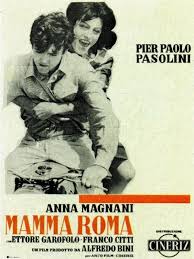
In Mama Roma (1963), the Pier Paolo Pasolini film set in Rome, Magnani played a prostitute and mother.

Magnani, wearing the wolf.  Rome's Nomentana train station, 2016. LAC 68.
In both these films, and in many others, Magnani played a tough, no-nonsense, working-class woman, usually wearing a simple house dress.  Perhaps as a result, she is often identified with the Lupa (the mythic she-wolf that nourished Romulus and Remus, the founders of Rome)--indeed, she was sometimes referred to as "La Lupa" or a "living she-wolf symbol."


Anna Magnani died in Rome in 1973.  She is buried in the Verano cemetery.
Bill

Somewhere

1962

Tuesday, April 1, 2014

Fascist Design--in Miami Beach

RST is pleased to once again have Paul Baxa, an outstanding scholar and interpreter of the Fascist experience, as a guest blogger.  Here, Baxa takes us through the Wolfsonian Museum in Miami Beach, currently (through May 18) hosting 3 exhibits on the Fascist era.  A smaller, fourth exhibit on Italo Balbo's air exploits, closes April 29.  Baxa is Associate Professor of History at Ave Maria University in Naples, Florida and the author of  (University of Toronto Press, Roads and Ruins: The Symbolic Landscape of Fascist Rome (20l0).  


Mural study, Antonio Santagata
Ferruccio Ferrazzi's Il Mito di Roma, 1940
For those interested in the intersection of Modernist design and twentieth-century politics, a visit to current exhibitions at the Wolfsonian Museum in Miami Beach cannot be missed.  This museum, run by Florida International University, was established by Mitchell Wolfson Jr. who collected documents and artifacts of modernism and was especially interested in materials that connected modernist design with totalitarian regimes.  As a result, there is a wealth of material from Fascist Italy.  I’ve had the good fortune of spending many hours in the Wolfsonian reading room this past fall and also to visit their three special exhibits pertaining to Italy:  The Birth of Rome; Rendering War: The Murals of A.G. Santagata; and Echoes and Origins: Italian Interwar Design.  All opened in the fall of 2013 and will close May 18, 2014. 

The Birth of Rome exhibit displays materials related to Mussolini’s attempts to revive ancient Rome in a Fascist mode.  On display are renderings of the E42 (EUR) as it might have been—including sketches of the never-to-be-built arch.*  Next to these are posters, sketches, and photographs of the Foro Mussolini and its sports complex.  Included are maquettes of statues from the Foro Mussolini designed by Eugenio Baroni.  The centerpiece of the exhibit is a massive detail for Ferruccio Ferrazzi’s tempera on paper drawing, Il Mito di Roma, designed in 1940. Spanning two floors of the Wolfsonian's atrium, the detail is an allegory of the Tiber River holding the twins with the she-wolf at its feet.  To be sure, Baroni and Ferrazzi were not star names of the interwar generation of artists but they figured prominently in the attempts to make a Fascist aesthetic.

Antonio Santagata.  Fascism looks back at the
Great War 


Off to the right of the Birth of Rome exhibit are several rooms filled with large-scale mural studies by Antonio G. Santagata.  These superb studies were designed for the walls of Marcello Piacentini’s Casa dei Mutilati in Rome (on the Tevere, sandwiched between the Palace of Justice and Hadrian's Castle).  The subjects of the murals all deal with the First World War and provide a glimpse of the myth of the Grande Guerra under Fascism. 


Up a floor, one finds the Echoes and Origins exhibit.  This is a perfect complement to the propaganda of the previous exhibits as it demonstrates another side of Fascist Italy—that of consumerism and style.  Here one finds vases and furniture by Giò Ponti, as well as exquisite cupboards by Gustavo Pulitzer Finali.  There is some wonderful kitsch here as well including a 
Fascist-inspired wall lamp
wall lamp designed as lictors rods.
  A magnificent La Cimbali espresso machine is one corner next to artifacts from the famous ocean liner Rex.  Posters advertising FIAT, chocolates and cruises are plastered on the wall.  This was another face of Fascist Italy—no less propagandistic than the Imperial Roman bluster but revealing a desire to create a modern, consumerist culture. 

The magic of the Wolfsonian exhibit is found not just in the materials on display but also in the mounting of the exhibits.  The curators create spaces that enhance the impact of the displays.  For example, the Birth of Rome exhibit is displayed in an all-white, minimalist space which emphasizes the Novecento (20th-century) style of the drawings.  In the Echoes and Origins space the visitor is greeted by a massive, amber-glass bowl and pedestal from the Fontana Arte group next to a pillar containing the famous, Futurist-style bust of Mussolini by Renato Bertelli. 

The effect of the exhibits is to immerse the visitor into the visions of the Fascist regime as interpreted by less famous artists and sculptors.  None of these artists had the fame of the likes of Piacentini, Terragni, Sironi et al, but they all in their own way contributed to the Fascist program of reviving Rome in a way that harmonized modernism with classicism.


Paul Baxa 


*  The arch for E42 was intended to span the multiple lanes of the via Cristoforo Colombo, a task that proved beyond the skills of Italian engineers at the time.  Many designs were offered, among them a poster rendering by architect Ludovico Quaroni (left), which closely resembled Eero Saarinen's winning entry in a 1948 competition to honor Thomas Jefferson's Louisiana Purchase--the design that in 1966 became the St. Louis Arch.  The site of the E42 arch is on Walk 2, "EUR: Mid-Century Spectacle," in RST's new guidebook, Modern Rome: 4 Great Walks for the Curious Traveler  (2014).  On the Quaroni/Saarinen controversy, see William Graebner, "Gateway to Empire: An Interpretation of Eero Saarinen's 1948 Design for the St. Louis Arch," Prospects: An Annual of American Cultural Studies, vol, 18 (1993).  Ed.