Rome Travel Guide

Rome Architecture, History, Art, Museums, Galleries, Fashion, Music, Photos, Walking and Hiking Itineraries, Neighborhoods, News and Social Commentary, Politics, Things to Do in Rome and Environs. Over 900 posts

Showing posts with label church. Show all posts

Monday, March 6, 2023

Exploring Romanina


When we told our Roman friends that we had spent the afternoon in Romanina, one said "that's not even a place." That's a harsh judgment, but not entirely inaccurate. Romanina is a third-or-fourth-ring suburb of Rome, southwest of the Center and flanked on one side by via Tuscolana. It has the feel of an area, rather than a town or village. There's some commerce on the streets that course around it, but there's little to be found on the residential streets. The furniture store in the photo above is "the exception that proves the rule" (one of our favorite phrases, guaranteed to win most arguments). Despite our friends' cool response to our venture into Romanina, we came away once again appreciating what we found--the "Roman" experience.  

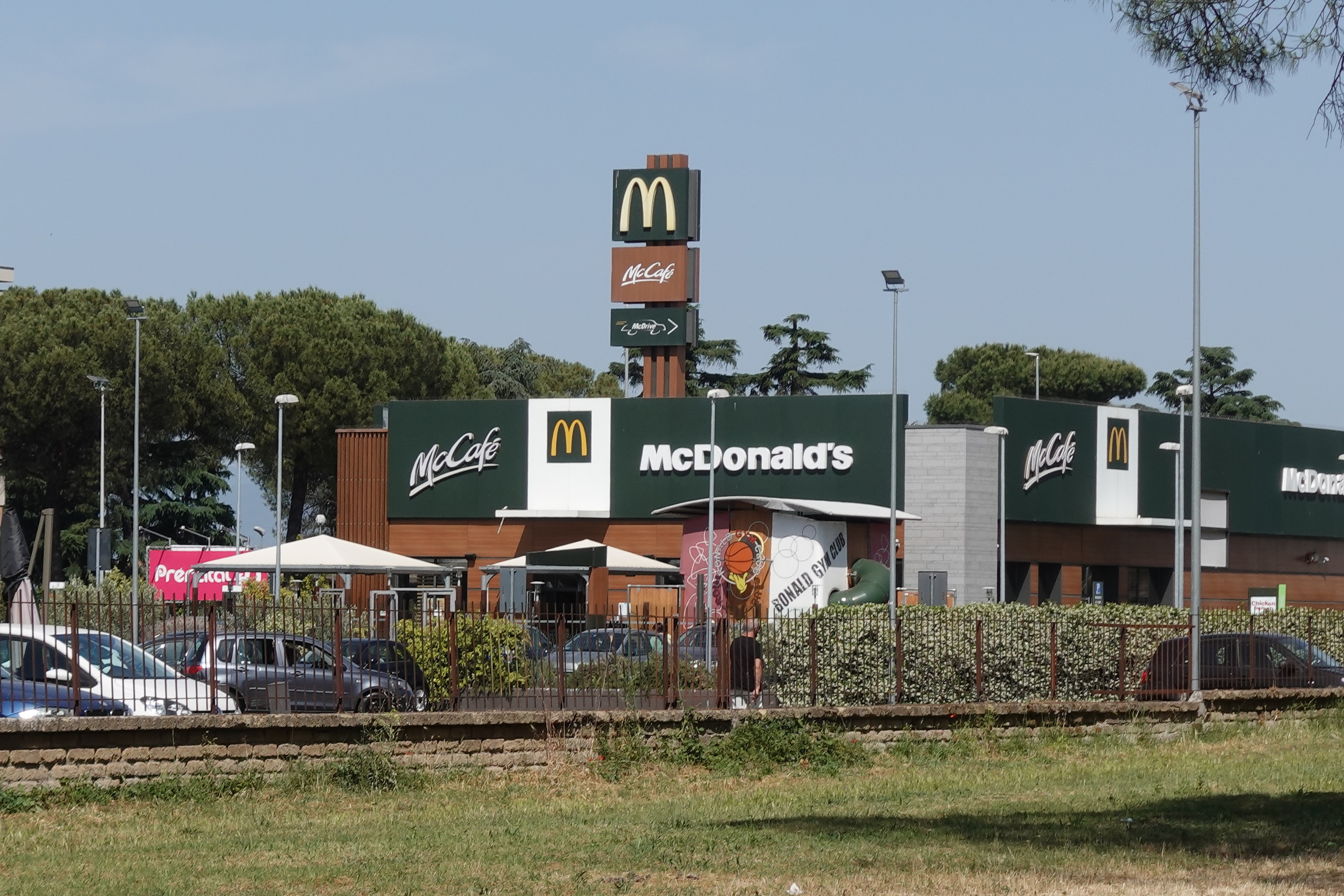
We parked our scooter at a McDonald's--here seen from in back--on one of the area's major thoroughfares. 


Down the street was an establishment that could have been in "beautiful downtown Burbank" (as Johnny Carson put it) or in Waco, Texas--or anywhere. The signage on the long building with a classic suburban parking lot reads "Old Wild West," and inside the structure, part of it was (in English) a "Steak House."


Across the busy street was a very Italian-looking building, whose function was impossible to determine.


Within 5 minutes we'd located the area's treasure--a long, thin, slightly curving park: Parco della Romanina. At each end, a painted arch welcomed patrons to (at that time) its parched grounds. Pine trees bent from prevailing winds.


It was mid-day and hot, and not much was happening in the park.


On one wall, a painted sign featured drawings (and names) of two women, presumably from Romanina, and the words "For all the women who struggle against the mafia(s)."


In contrast to the somewhat inviting Parco della Romanina, a small neighborhood park was overgrown to the point of being unusable--not uncommon in Rome and environs. 


We always enjoy looking at housing, including apartment buildings.


And we found an unusual single-family residence with a castle-like turret. Perhaps abandoned. Or they're just not picking up their mail.


The La Mela Hotel, not far from the western entrance to the park, had some interesting high balconies. 


We found an open (and worthy) church to explore and admire.


After combing the neighborhood for some time, we finally came across a compact shopping area. It's a relief to know you can buy stuff in Romanina. Dianne appears uninterested.


Exhausted by the richness and splendors of Romanina, we returned to McDonald's--and our scooter.  

Bill


Monday, December 1, 2014

Marcello and Sophia's Wild Ride in the South of Rome OR, an RST itinerary for the Jet Set

Sophia - photo explanation below
Arizona State University historian friends of ours asked us to lay out an auto itinerary for them… outside Rome, à la the second time.  We asked what they liked – small towns (we’re okay at that), beaches (hmmm, we’re not so good at that). 
We came up with an itinerary mainly to the south of Rome that includes the Castelli Romani, Norma/Norba, the Mussolini-created town of Latina (near the beaches), Anzio (more beaches + WWII), Ostia (more beaches), and Ostia Antica.   The itinerary is a full and interesting one, developed mostly by Bill.  We’ve included Bill's original itinerary at the end of this post; for those RSTers who want to go farther afield.
Brian and Cathy amended the trip somewhat, as we hoped they would.  They went off in a convertible with an unusual June rainstorm looming and added more religious sites – the latter makes sense since Catherine – of the Loren car scarf - is a specialist in Catholic church history.
Brian dutifully wrote us a report of their trip – which we found interesting and funny and fun.  And he included photos.  We asked him if we could use his text and photos as a guest blog post.  In a weak moment, he said “yes” – and so it follows (again, with Bill’s original itinerary and a map at the end):


               I will send in a moment a link to a set of photographs that will bore you [included rather than linked here, and photos of Italy never bore us], but they do demonstrate a high level of compliance to your commands. Obedience paid nice dividends, thank you very much.  Our getaway into the Castelli Romani was smooth, and the temperature dropped 10 degrees—on the road trip the front brought in rain, but not all the time, hence Marcello and Sophia (pictured) looked really sharp with the ragtop down, RayBans on. 

Norma - and to the left, Norba
        I freaked out over Norma, its precarious position alone quite stimulating save when drunk.  
I provide photographic evidence of the scholastic role the Mussolini family played there, but the best part were the chistes [Brian, being Arizonan, prefers Spanish to Italian; apparently this means “jokes”] between the old men and the old ladies in the piazza. The old ladies won. 


Meanwhile, Cathy danced in the street, flipping her Loren car scarf at the pious inhabitants of the tortured dank alleyways. 


We dropped down onto the malarial plane [the Agro Pontino] and found it a place not unlike Phoenix…agriculture being king as it once was in that American desert city.  And, like that city, there are some pretty conservative views there, as a photo of a sign on the gate to a “pilgrim’s way” suggests.  


Near Latina, we found an inexpensive luxury beach hotel, and you will see the proof of that. 

Someone with an engineering sense had laid out these weird, for Italy, straight roads called migliara [ok, Brian – that refers to “miles”].  Once we found these we were set.  Primarily to head back to the hills and examine monasteries that my perfect spouse insists on visiting.  I think she prays in them, god forbid. Indeed, it was claimed we stood in the very cell in which Thomas of Aquinas died, joining in that moment the natural law with the divine one. 
I attach a shot of me standing around while Loren recited the rosary, and of the cool Solomon’s riddle that the Cistercian monks had placed in the chapter room of their truly beautiful abbey. 

I failed in my search for porchetta.  Sophia kept insisting I could get it in the next town, waving her scarf “adelante,” until we ended up in another monastery town, Sermoneta, in a torrential rain.  The waiter, hearing the word as I pronounced it and seeing as I pointed to the trattoria sign that said they had it, motioned us to sit down at a soaking table under a suspect umbrella, napkins drenched, water dripping on our heads, and Italians in doorways barely suppressing their laughter at these Yanks, too slow to come in out of the rain.  I did prevail upon the man to seat us inside.  He presented us with bending plates of excellent cheeses and first-rate olives and scrumptious red peppers, the display heavy with delicious meats, all of the porcine variety but well cured and lacking a trace of porchetta. [Hey, Brian – note we said porchetta in Ariccia – in the Castelli Romani.  Local means local in Italy.]

We surmised that, desperate for customers, he had decided that the Americans were going to get a “big pig feast” all right, just not the one we indicated.  It was grand, as was the cool castle at the top of the town where we listened, with some comprehension, to the tale of the Castiglione, dukes of the town and of the pestilential plain, one of whom, at the battle of Lepanto, met a fetching Aragonesa and married her, bringing Spanish ducados into the ducato.
Sermoneta

As we returned we visited Anzio, a sad thing really, all those young, slender boys with smiles on their faces and guns in their hands. Going along the road to Ostia Antica, with its mosaics and its Roman playwright’s coffin carved in honor of the muse, we encountered what Bill once did, a sign for a bar named Tom and Jerry, a reminder of my purpose in life, which is, it appears, to give a TnJ party every year.


Ciao!

PS… threw in your picture again, as a sign of thanks for being so kind to us.  We offer sincere congratulations for finishing the f*!@#g wall.  [You may surmise that Brian accompanied us on one of our “wall walks” of Rome.  That section was posted on the blog in early November.  From his comment, you may – or may not – want to replicate that section of the wall, esp. in blistering Rome heat.]

           
The itinerary as offered by us:

Hi Brian and Cathy,
   "Small towns, a beach" isn't much to go on.  But with those guidelines, here's something you might like: 
1.  First day.  Drive into the Alban Hills (Colli Albani/Castelli Romani) on highway 7, catching towns of Castel Gandolfo (Pope's summer residence, town just OK, not so fascinating; view spectacular), Albano (great cistern there, better town), Genzano (famous for Pane (bread) Genzano); Ariccia (home of porchetta, and a Bernini church, castle, etc., one of our favorite towns).  There are two lakes up there, Albano and Nemi (smaller), though if you choose to explore them you likely won't be able to reach your "destination" (Norma), archeological sites, etc.  Then through Velletri (site of 5th army breakthrough; mostly rebuilt after the war) and onto an area on the fringe of the Monte Lepini that's pretty cool.  Latter includes Ninfa  (an amazing park-like area, sometimes open to the public - on the flats before Norma/Norba) and, on the bluff, Norma (where's there's a hotel - and it's decent).  Norma is paired with "Norba" - an ancient Roman site, mostly buried now and the land used for grazing - but Norba/Norma is spectacular area for views and distinctive tiny town.
2.  Day 2   Drive southwest off the bluff and (back) onto the flat plain of the Agro Pontino, once famous for mosquitos, then for eradicating them, to the town of Latina, one of several in this area constructed by the Mussolini regime.  Nifty Fascist-era modernism. Don't miss the "M" building.  From there, over to Nettuno/Anzio, where the allies landed and where I assume you can find a beach.  Good (if idiosyncratic; run by an individual) World War II museum and, of course, cemeteries.  OR from Latina you can head to the coast and go SOUTH, cruising along a spectacular beach /Lido, spending some time in another of the Fascist cities, Sabaudia, and finding your way (not far) to Monte Circeo, which you can hike--it's not hard and there's a great view from the top up the coast.  There are hotels in Circeo and wine (labeled Circeo) is made there.  If you stop short of Circeo, there's another very small fascist town, Pontinia, which has one (good) hotel.  Note that the hotels often have the best dinners.  It's sometimes not easy to find good dinner eating (lunch, yes - including full meal lunches) in small towns.
3.  Day 3  (assuming you don't head south on Day 2).  
From Anzio you can either shoot straight north to Aprilia, then left to Pomezia (both Mussolini towns) or putter along the coast going northwest til you find a good beach.  Lido di Ostia is a great large beach town and has some wonderful modernist architecture.  From there, head toward Rome to Ostia Antica, the 2000 year old port city, the remains of which are quite something.  Then to Rome.  OR if you're into the Etruscan scene, continue NW to Cerveteri for some quality time with tombs.  Another good beach town, instead of the more crowded Ostia, is Fregene.  You can get access to public beaches in all these places (though many beaches are private), and there's a good public one in Fregene.  Then to Rome.  You can also do Ostia and Ostia Antica by train from Rome.  Fregene no.  
   Nota bene:  though we've seen everything mentioned above, we have never done this as a three day itinerary, and we don't know your habits, whether you're into 3-hour lunches, etc.  Some of the roads are very curvy and slow, others straight and fast.  Traffic and curvy mountain roads will slow you down, maybe significantly.  So it's hard to know if this sequence will work for you. 
   You'll need a Lazio map to get a sense of distances and to plan in detail.
Hope this helps!
Bill (and Dianne)


Saturday, December 24, 2011

Not Quite a Christmas Story: A Bar and a Church

In the early years of the last century, a Roman family bought a nice piece of land in Monteverde Vecchio, then sparsely developed.  They hoped--indeed, expected--that the parcel's location, just a 10-minute walk from the Trastevere train station, and on what they knew would be the main road up the hill, would position the family to serve and profit from the expected traffic.  Location, location, location. 

Bar Vitali, modestly promoted
(the sign says only "BAR")
And it happened that way--or sort of.  The Vitali family started a business there that evolved into a bar, on Via Lorenzo Valla, and it's still there, and very successful, more than 75 years later.  Today it's owned by Mario Vitali, a grandson of the original owners, and it's become a bar/restaurant (lunch only), and one of more than local reputation, if only because Italian movie director Nanni Moretti lives nearby and eats there from time to time.  On the MAP below, Mario's bar lies at the intersection of Via Lorenzo Valla and Via Pindemonte, the dog-leg street coming in from above.

Monteverde Vecchio in 1935.  The photo hangs
in a back room of Mario's place. 
The flow of automobiles and scooters by the bar is substantial, too, certainly all that one could expect in an area of one-way streets.  But it is not what the Vitali family had in mind when they purchased the property.  They believed then, and it seemed a very good bet, that traffic flowing uphill into Monteverde Vecchio would move straight out of the small piazza fronting the train station (and off two major thoroughfares, the Gianicolense and Viale Trastevere, which come together there) and directly northwest, onto Via Lorenzo Valla: a straight shot to the bar.  Visions of coining money. 

But it didn't happen that way.  If you look at a map, or stroll the area, you'll see that there is no street running straight uphill from the train station.  Instead, there's a church (on the map, the blue rectangle at lower right, with a cross).
The church was built in 1942 (Mario knows the date, all too well), in the last years of Fascism, and it's situated right where the anticipated road would have been.   It's an undistinguished, late-Fascist-era building, just the sort of place that Bill enjoys and to which Dianne must be dragged.  I don't think you'll ever get Mario Vitali inside.  And now you know why.

Bill

PS from Dianne - Mario is something of a local historian and has written (in Italian only and now out of print) an intriguing family history.  His grandmother, widowed young with 4 very young children, simply started cooking for local construction workers, then selling anything she could buy and break up into smaller lots.  Her home turned into a luncheonette, then a store, then the bar and tobacco shop owned by Mario's father.  Mario's grandmother, who had built her business from scratch, was the one most upset by the church's closing off of via Lorenzo Valla, Mario told me when I asked.  But she did attend the church and her burial procession, down via Lorenzo Valla, ended there - a touch of irony in the whole story.

Monday, January 3, 2011

The hidden, hard-to-find, and worth-it churches of Rome, at least 3 of them


Recent painting of Santa Bibiana and train station tower

There’s no hard and fast count on the number of churches in Rome, and even beyond the total, there are hidden (in the sense that the guidebooks rarely get you there) churches in Rome that are real gems. Because we are Rome the Second Time, we don’t focus much on churches at all, but now and then Bill lets me be the “church lady” and point out a couple I love.


Here are 3 of my favorite “second time” churches: Santa Bibiana, Santa Sabina and San Giorgio in Velabro (note the Santa Costanza/Sant’Agnese fuori le mura complex made it into Rome the Second Time and RST's Top 40, coming in at #21 - even with Bill getting an equal vote – you can see them in our March 15, 2010 post.)

Altar with Bernini's Santa Bibiana
Santa Bibiana is the most central, yet in some ways the hardest to get to. We included it in our “10 things to do around the train station” post of August 5 of this yearSanta Bibiana is on via Giolitti – the street that runs along the south side of Stazione Termini. It sits improbably next to the station’s outer buildings (look for the adjoining tall round tower, covered in travertine with spiral staircase – a fine example of modernism, rather than “ugly” as some have said – at least in our opinion and in the opinion of a recent Rome academy painter whose painting is at the top of this post). No doubt not in Bernini’s time, but it is now dangerous to approach the church across intra-city train tracks and the entrance to the underground passageway that leads to the other side of the major tracks – these look fairly peaceful in the painting, but believe me, they’re not.  In fact the painting relocates the church past the tower from the station, which it is not (i.e., don't use this painting as a guide to getting there). 


Santa Bibiana

The photo at right is more realistic (Bernini, if you only could see your church now! - also, a counter to those who say graffiti "artists" don't touch church buildings). 


Although the first building on the site dates to the 5th century, the extant church of 1624-26 is Bernini's, his first major commission. He already was in fine form, as shown in his portico, façade and sculpture of the saint.

Glen Thompson of Wisconsin Lutheran College, a scholar of Early Church History, has an elaborate post on the church and the saint: http://blogs.wlc.edu/history/2010/03/10/two-most-unusual-saints/ He calls Bibiana or “Vivian”…one of the strangest saints around.”

In additional to general praise of Bernini and the church, Prof. Thompson recounts: “On the interior walls are a beautiful set of frescoes from the same century by Pietro da Cortona illustrating the life of St. Bibiana. Above the altar is a breathtaking marble statue of the saint carved by Bernini, and under the altar is an alabaster urn containing her remains (or relics), found under the altar of the previous church during its seventeenth century renovations.
"But who was St. Bibiana? The early medieval stories center on one Christian family in Rome in the mid-fourth century. Bibiana’s father Flavian, her mother Dafrosa, and her sister Demetria all suffered in various ways for refusing to deny their faith, and Bibiana was executed – all during the time of Julian the Apostate. Julian was emperor from 361-363, and he tried to turn the empire back to paganism 50 years after Constantine had made Christianity legal. However he died before he got his program off the ground, and there is no record of any overt persecution of Christians in Rome during Julian’s time, much less any martyrdoms! The legends about Bibiana were made up about a century later. To us,"  Prof. Thompson continues, "it seems strange that people would invent a saint for whom to dedicate their church, rather than merely choose the name of a well-documented one. My theory is that the land for the church was donated by someone, and that the story was created to give that particular spot meaning. According to the legend, the church occupies the spot where Bibiana’s house once stood.”

You may want to pray to the saint if you make it safely to her church and also hit the unusual opening hours: 7:30 - 10 a.m. and 4:30-7:30 p.m. You can’t enter as a gawker during masses (weekdays 8 a.m. and 6:30 p.m. and Sundays 8:30, 10, 11:30 in the morning and 6:30 in the evening.

Interior of Santa Sabina

Another favorite second-time church of ours, also allegedly built on a saint’s home, is Santa Sabina. It's central enough that it makes it into some guidebooks; nonetheless, it's usually not on the Rome first-timer's list.  Santa Sabina is the mother church of the Dominicans in Rome, beautifully sited atop the Aventine Hill, next to a park well-used and favored by Romans for its with views of the city and Tiber. The church also dates to the 5th century and, while modified over the years (including by Bernini), as recently as the 20th century, it was taken back to its earlier style by an architect working under the Fascists, Antonio Munez. The inside of the church is cool, open and airy. The 1st millennium artifacts are impressive and stand out in this atmosphere. For more on the church and its history, see http://www.italyguides.it/us/roma/rome/aventine/basilica-santa-sabina.htm.  Also, Bill photographed the smoking (literally) bride and groom in the park there, as shown in his blog of June 23 this year
Interior of San Giorgio in Velabro
And finally below the Aventine, swim through the crowds waiting to put their hand in Bocca della Verita' (the mouth of truth) at the Santa Maria in Cosmedin church; go behind that to the winding streets via Velabro and via di San Teodoro.

There are several churches there with impressive histories, but we suggest first stepping in San Giorgio di Velabro. Here again, one inhales the air of the first millennium (and earlier). Definitely worth taking in that whiff of history. Bear in mind, much of this was reconstructed not only during the Fascist era but also after an explosion in 1993; the reconstruction is superb and the ancient artifacts stand out.  See http://en.wikipedia.org/wiki/San_Giorgio_in_Velabro for more details.

Exterior and portico of San Giorgio in Velabro
We’ll pick up some other “hidden,” second-time churches in another post - some time in the far distant future when Bill once more unshackles church lady.
Dianne

Monday, March 15, 2010

RST Top 40. #21: Sant'Agnese fuori le mura: a haven in a heartless world


Churches - they're everywhere in Rome; are there 300 of them? 500? 900 say some. Should one even be in the Top 40 of RST? With some coaxing from me (Bill never saw a church he willingly would go into - unless it was brutalist architecture - see his post of 8/30/09), Sant'Agnese fuori le mura ("outside the walls") comes in at #21.

One of the divine qualities of this church is where it is - amid the busy traffic of multi-laned via Nomentana, pushed up against the now dense high-rise residential area of Trieste, decidedly outside the walls of ancient, even Renaissance Rome. But there it is, placed in "a courtyard bathed in peace, greenery, and light" (to quote ourselves from Chapter 3 - "Beyond the Wall" - of Rome the Second Time).

Sant'Agnese fuori le mura is also one of those fabulous lessons in the layers of Rome: pagan, Christian, Medieval, Renaissance, contemporary. There are ruins from a 4th century AD covered cemetery built by the Emperor Constantine (the first Emperor who converted to Christianity) or by (or for) his daughter or possibly granddaughter, both named Constantia. There is the mausoleum for Constantia, now called the mausoleum of "Santa Costanza" (a nun, not Constantia, and not officially a saint), reputedly built over the bones of Sant'Agnese - got all that?. And, there is the 7th century basilica of martyred Sant'Agnese - built (over the 4th century one) alongside the mausoleum and containing extensive catacombs (which one can visit). The catacomb level was then the first floor; now it is several floors below ground level. The portico is 16th century. Add a medieval tower. The soccer fields and snack bar (when we were last there) are contemporary.

Saint Agnes is the patron saint of virgins, because she refused to give herself to anyone except God. In various versions of her story (in one she is 13, in another an adult), the pagan Romans strip her of her clothes, and her hair grows to cover her nakedness. She's also the patron saint of the wonderful Borromini church in Piazza Navona, Sant'Agnese in Agonia (Saint Agnes in Agony).

That toughest of art critics, Georgina Masson, calls Sant'Agnese fuori le mura "one of the rare Roman churches which has best preserved the appearance--and the atmosphere--of a very ancient Christian place of worship."

Dianne - This one's for you, Bruce P!

Sunday, August 30, 2009

Brutalist Rome


Brutalist architecture is an offshoot of the International Style. It was popular (or unpopular) from about 1955 to 1980. Coined in 1954, the term "brutalist" is apparently derived from the French "beton brut," meaning raw concrete, the building material most identified with the style, and the word "brutalist" was popularized by architectural historian Reyner Banham in the 1966 book, The New Brutalism.

Brutualist architecture has some or all of the following characteristics, in order of importance: the use of lots of poured concrete slabs; unfinished surfaces and, more generally, the desire NOT to disguise the rough materials of which buildings are made; geometric repetition of building elements and forms; and the exposure of steel beams, ventilation ducts, and other elements of a building that are normally hidden from view. Many brutalist buildings would be described as massive, and most clash with their environment is ways that many observers find unappealing.

Brutalist architecture looked for inspiration to the work of Swiss architect Le Corbusier, particularly his 1953 Secretariat Building in Chandigarh, India. Among the most influential Brutalist works is Paul Rudolph's Yale University Art and Architecture Building, completed in 1963.

There isn't much brutalism in Rome and environs. We found this high school (left) in Monteverde Vecchio, off via Fonteiana, just above via di Donna Olimpia.


One project that has some of brutalism's characteristics but not others is Corviale, a housing project southwest of Rome's Centro. Corviale was begun in 1972 and the first tenants moved in a decade later. It is certainly massive: 1200 apartments, 9 floors, 980 meters long! Although the front of the building does not use concrete in the way most brutalist buildings do, the concrete corridors in back are classically brutalist (below right). As one might expect, Corviale has had its critics, among them Prince Charles, who once remarked after visiting the building, "You have to give this much to the Luftwaffe. When it knocked down our buildings, it didn't replace them with anything more offensive than rubble." A story from the popular culture has it that Corviale's architect committed suicide when he saw the finished product.


The lovely example of brutalism at top and at right is in our own neighborhood, right behind the market in Piazza San Giovanni di Dio, up the Gianicolense in Trastevere. The Church of Our Lady of Salette occupies the highest ground in the immediate area. The main entrance is off the Piazza Madonna della Salette (La Salette refers to a small town in the Alps where a miracle occurred in 1846--the sighting of the Virgin Mary, or perhaps the last date someone found a parking place in the piazza).

The church was designed by architects Viviana Rizzi and Ennio Canino, about which not much is known except that they also designed the Church of San Giovanni Crisostomo (1969) in the zone of Monte Sacro Alto. The Salette structure was begun in 1957 and completed in 1965, to serve a new parish in the then rapidly expanding Monteverde Nuovo. The photograph of the interior was taken on Easter Sunday. Bill