Rome Travel Guide

Rome Architecture, History, Art, Museums, Galleries, Fashion, Music, Photos, Walking and Hiking Itineraries, Neighborhoods, News and Social Commentary, Politics, Things to Do in Rome and Environs. Over 900 posts

Showing posts with label Italian colonies. Show all posts

Monday, December 5, 2022

The Colonial Museum in a Post-Colonial World

What remains on display of the original "Colonial Museum" is half-way down these stairs on either side of the landing.

There is, buried in the complex of Italian museums that sit mostly unvisited in EUR (about 8 kilometers/5 miles from the Coliseum but easily accessible by metro) a "museum" that purports to display, and deal with, Italy's colonial past. Just finding this collection tells one something about the country's failure to confront its activities in northern Africa, colonial activities that stretched from the 1890s to the fall of Fascism in World War II. (encyclopedia.com has excellent historical background on the Italian colonies.)

Changes in the museum's name and location over the years underscore Italy's approach to the colonies. 

Likely the entrance near the zoo,
before the museum acquired
its new name.  
The museum opened in 1924, in the early years of Fascism, as Museo Coloniale, the Colonial Museum, on the Quirinale, near the seat of government, and it was designed to create pride in Italy's quests. It was not conceived of as scientific (as were similar museums in other European countries), but very much like a trade show, under the Ministry of the Colonies. There were 20 rooms, each featuring a different city or region. (There was an earlier version, dating from 1904, featuring flora from the colonies, located near a botanical institute on via Panisperna in the Monti quarter).

In 1932, the Colonial Museum was moved next to the zoo, perhaps indicating the attraction of the "exotic other," including animals like the lion. Mussolini inaugurated it with a new name a year or so later, "Museo dell'Africa Italiana" (Museum of Italian Africa). It showcased "dangerous" African fauna and the bravery of collectors, deemed "pioneers." In addition to animal trophies, there was the blood-stained uniform of General Rodolfo Graziani, known as the "butcher of Fezzan" for his brutal methods in Libya. (There's a fascinating, unsympathetic portrayal of him [by Oliver Reed] in The Lion in the Desert, an excellent 1980 film by Moustapha Akkad [Anthony Quinn plays the heroic Bedouin leader, Omar Mukhtar]. Banned in Italy when released, it was first available there in 2009 via pay TV, and now one can purchase it on DVD - worth the price.)

The museum remained closed from 1937 (ostensibly to be redesigned; there's some dispute over this date - Wikipedia [Italian] suggests it remained open until 1943) to 1947. 

The museum reopened after World War II as "Museo Africano" ("African Museum"), but even then, the Italians described it (in a 1948 memo to the United Nations) as dealing with "previously unproductive tribes." It remained open until 1970, when it was essentially abandoned. There was also a major theft in 1977. None of this information appears in Wikipedia, which simply says its tutelage was "then entrusted to the Italian-African Institute, which from 1995 was reorganized as the Italian Institute for Africa and the East, both placed under the supervision of the Ministry of Foreign Affairs. In 2011 that Institute was considered defunct, and the collection (in very poor condition and without proper labelling) was transferred again to the overall Ministero dei beni culturali (Ministry of cultural works) and warehoused.

So where is it, and where are the 12,000 objects - objects of "others" gathered to be observed by Europeans - and what is its name now?


From EUR's central Piazza Marconi, we trooped around to
several of the museum buildings, past many entrances closed
and others open to other activities, finally to find a
temporary entrance to "the
Pigorini" and a woman behind
the desk who finally knew what we were talking about.
We had read the museum was located in the newly-reorganized complex under the overall name "Museo della Civiltà" - which was the name of one of the several museums in EUR, and whose entrance graced the cover of our second guidebook, "Modern Rome" (that entrance now leads to the planetarium! - yes, we tried asking there about the "Museo Africano," which the visitor desk had never heard of), re-branded as "MuCiv" (!) and incorporating the several museums that were in EUR, including the original "Museo della Civiltà," which has been closed "for renovations" since 2014 (and it's unfortunate that the public cannot see its great model of ancient Rome). In 2022, MuCiv is asking the public for input on its plans for a radical refashioning of its collections. In English and Italian you can find those current plans here and here.

The entrance on our book cover
won't get you there.

Success! of a sort.  We found our way to a temporary, new entrance to another part of MuCiv, the crown jewel of the museums, Museo Nazionale Preistorico Etnografico Luigi Pigorini (known as "the Pigorini"), and after some discussion with the ticket seller, she gave us free journalists' passes, and we found what is now called the Museo Italo Africano Ilaria Alpi, or the Italian-African Museum, now named for a young Italian journalist killed in Mogadishu in 1994. 


What exists are a few objects (photos right and left and below) on either side of the landing of a stairway (albeit a monumental, large stairway, photo at top of post), accompanied by some plastic sheets indicating the questions raised by retaining and showing objects collected by colonists

The object at right is a "statuette of the Konso," "donated" by a Captain. It's hard to read the inscription (left) but it says something to the effect that "when a Konso (from SW Ethiopia) husband died, his wives were buried with him, and that this (I assume the tall statuette next to the plaque) was the tomb of a woman buried alive, according to superstition...
and that this was the first of the objects the Captain "astutely brought back - in 1927."


The plastic sheet hanging alongside these objects says, in Italian and English, "From the seventies of the last century up to 2017, the colonial collections had been locked in cases. They were moved, over several decades, between various institutions in Rome. The colonial Museum, and the history that it represents, were never challenged either on a museographic stage or in a public debate. Opening the cases through the collections, rescuing the latter with conservation interventions and making them accessible to the civil society are the first necessary steps so as to not allow the Italian colonial experience to be forgotten."

Italy is one of many countries confronting its colonial past. According to the panel discussion I observed at the Swiss Institute in Rome, "Erased Memories: Italian colonialism and its material legacies," it has done a very poor job so far in this regard. The scholars talked about "historical amnesia, cancelling, and the failure of Italian memory to accept" its colonial past. Waves of ex-colonial subjects, including Albanians as well as Africans, came into Italy in the 1990s, raising issues of responsibility and acceptance. The new prime minister, Giorgia Meloni, has run, like Trump, on a fiercely anti-immigrant platform. I should point out as well that while the objects were put under the auspices of the Ministry of beni culturali, the paper objects, including labels and such material as there is on provenance, were given to the National Library, according to the speakers at the Swiss Institute, which included Beatrice Falcucci who has written on  "The former Museo Coloniale in Rome and beyond: colonial collections in Italy between history and the present." The separation of objects and paper does not auger well for placing the materials in their proper context. In other words, it will be difficult for Italy, given its current custody arrangements, to make the claim that it can do a better job of preserving these materials than can their places of origin.

Admittedly, this project (the objects we saw and their measly space) is a first step and is designed to let the public participate in the "unveiling." It is in fact called "Unveiled storages" and is described as "an installation that aims to place the former Museo coloniale collections at the heart of the MuCiv's museum spaces...to render objects accessible to everyone, even if only partially, that seem hidden from view and that had been hidden for several decades."

Above, the well-designed hall on the first floor of the Pigorini ethnographic museum.
This floor is mostly devoted to objects from Africa.

On the first floor (second floor, English style) of the Pigorini is a very high-quality exhibition of African objects collected before the Fascist era. But don't these raise similar questions? Where do they belong? Who "gave" them and why? The Swiss Institute speakers asked if there even could be a post-colonial museum. Should the main purpose be a cross-cultural approach, or preservation, or repatriation?

There is an informative video, in English by the Goethe Institute, on the ongoing project.

I've put more photos at the end of this post. The first one describes the Fascists' use of ancient Roman imagery, including colonialism; most of the rest are of the ethnographic exhibit.

Dianne


Certainly looks like the artworks that inspired Picasso.

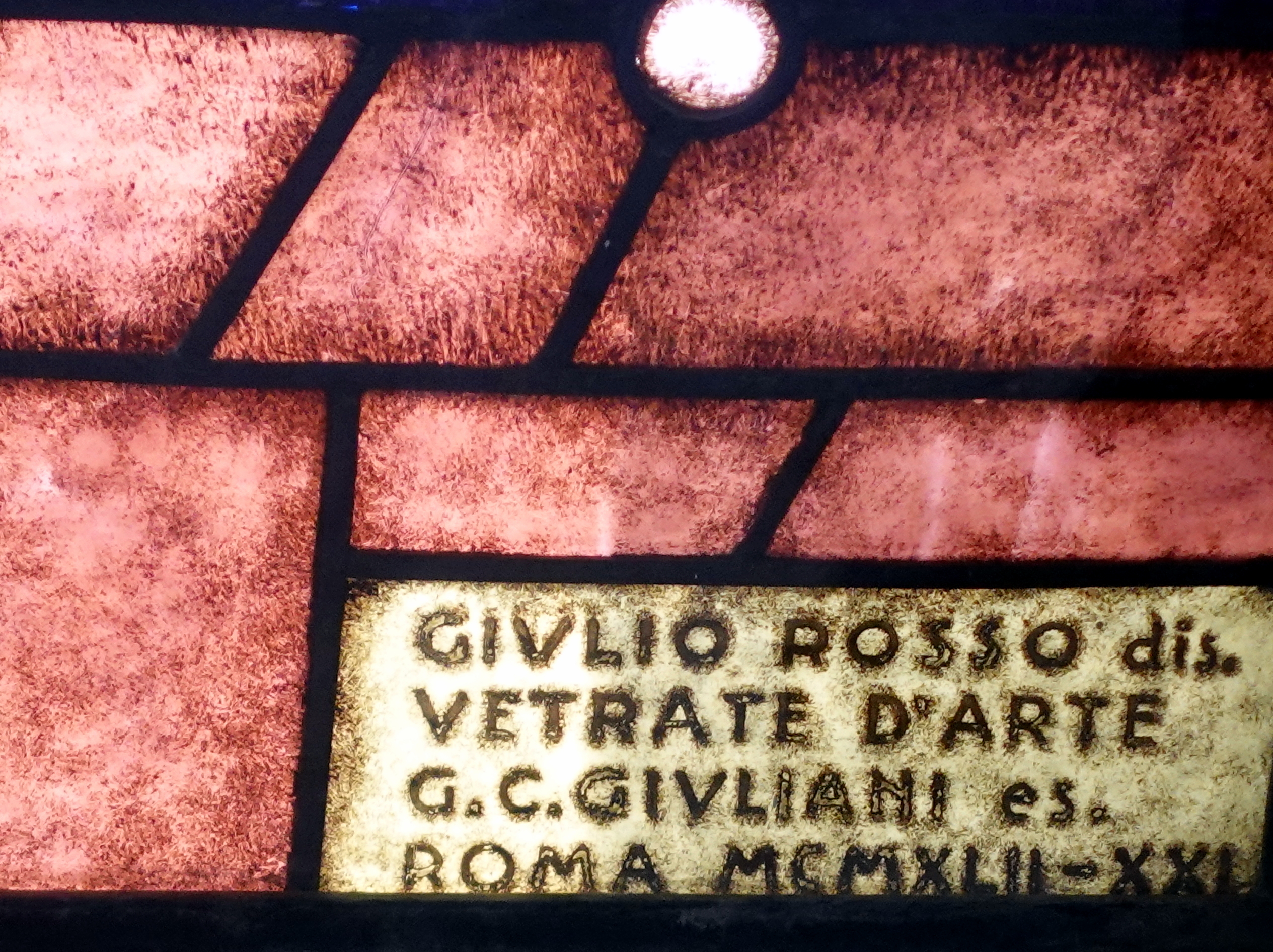
A beautiful stained glass window is at the end of the large staircase.

It's signed by "Giulio Rosso, dis. [designed by],
Art glass window. G.C. Giuliani, es. [the window maker]
Rome 1942 - XXI [Fascist year 21]"


Monday, March 7, 2011

Libya: the Bitter Fruits of Italian Colonialism

Buds? Italian Prime Minister Silvio
Berlusconi and Libyan leader
Moammar Gadhafi
As the conflict in Libya ebbs and flows, we thought our readers might be interested in knowing more about Libya's historical relationship with the western nation that has been most significant in its past: Italy.  More specifically, could the century-old relationship between Italy and Libya provide a ground for overtures that could lead to a resolution of the conflict?

Probably not. And here's why. 

Italy's deepening relationship with Libya began 100 years ago, when Italy invaded the north African nation, a country dominated by the Ottoman Turks since the mid-1500s.  When the colonial tie ended in the 1940s, the Italian and Libyan economies remained linked in a variety of areas, including oil, banking, arms and foreign trade.  According to the 3/6/11 New York Times, Italy is Libya's largest trading partner.  Nonetheless, in other ways the relationship has been congenial only since the mid-1980s; in 1986, Italian Prime Minister Bettino Craxi bought some Libyan good will by warning Moammar Gadhafi that the United States was about to bomb Tripoli.  The two nations took another step forward in 1999, when a left/liberal Italian government apologized to the Libyan people and formally acknowledged its reprehensible conduct as an occupying colonial power.  In Libya, the Italian premier condemned the killings of Libyan patriots and agreed to return to Libya the Venus of Leptis Magna, confiscated by Libya's Fascist-era governor, Italo Balbo, and given to the Nazi Hermann Goering.  In 2008, Italy and Libya signed a "Friendship Treaty" with Libya (suspended by Italy last week), followed by a commitment by Eni, the Italian energy company, to invest billions in Libyan oil and gas.  A mixed picture. 


The Arch of Marcus Aurelius.  As in Rome,
the occupying Italians chose to reveal the
arch by tearing down many nearby structures

Let's go back a bit.  The Libyan revolution of 1969, the revolution that produced Moammar Gadhafi, has been described by one historian as a "direct reaction to the negligence, torture, and disdain suffered by the Libyan Arabs during half a century of colonization."  The following year, the Gadhafi government confiscated the properties of some 20,000 Italians living in Libya, while insisting that the expropriations were insufficient compensation for colonial damages.  So let's return to 1911 and the colonial occupation and find out what happened.

Although the Italians presented themselves as "returning" to North Africa (it had been colonized by the ancient Romans, and Tripoli featured the Arch of Marcus Aurelius--see photo above left) and assumed that Italian soldiers would be welcomed as "liberators" from Turkish rule, the Libyans didn't see it that way.  They made common cause with the Turks, who lost the war anyway, signed a treaty with Italy, and left in 1912. 

The Italian army encamped near Tripoli

But Libyan resistance to occupation did not end, and those opposed to Italian colonial status fought on--for another 20 years.  The resistance was especially notable in the Cyrenaica region--the eastern part of Libya, and the area that today is under control of the anti-Gadhafi forces.  During the 1910s, resistance was especially strong among the Sanusi, a tribal and religious movement/group with its own army that in 1916 declared itself an official state.  Sanusi resistance in the east meant that the Italian state could not expand beyond the coast until 1922.  There was resistance, too, in western Libya; in 1915, the Tripolitanian resistance had an estimated 15,000 fighters.  The creation of a Tripolitanian Republic in 1920 delayed full Italian occupation of Tripolitania--meaning northern and eastern Libya--until 1925.  Eastern Libya--Cyrenaica--remained at war with the Italians for another 7 years. 

Resistance leader Umar al-Mukhtar
The occupying Italians were frustrated and, one presumes, angry.  As resistance escalated, so did deportation of troublesome Libyans, including several thousand who were packed off to Italy.  Later, the entire population of the Jabal area of Cyrenaica was deported.   In 1931, the Fascist regime in Libya constructed a 270 km barbed wire fence on the border between Egypt and Libya to limit aid to the resistance coming in from the east.  That same year, it conducted a public execution of Umar al-Mukhtar, the 69-year-old resistance leader, before some 20,000 Cyrenaican tribesmen, thereby creating a martyr to the resistance cause.

In the late 1920s, perhaps still mystified that some Libyans failed to understand what Italy was trying to do in their country, the Fascist authorities decided to put local populations that supported the resistance in internment or concentration camps, isolating them from the rebels.  Between 1930 and 1933, 16 internment camps were opened in the Cyrenaica region.  About half the population of eastern Libya--about 100,000 people--was forced into the camps.   Many of them were farmers and herders who consequently lost their occupations and their animals and were forced into inactivity.  Of those interned, about forty percent--40,000 people--died.  Most Libyan resistance to Italian rule ended in 1932, 21 years after the invasion. 

The Italians had elaborate--one might say, grandiose--plans for Libya that went beyond subduing the local population.  Among the sensible ideas was a road-building program designed to knit the eastern and western sections of the country together.  Not so sensibly, Libya was to serve as a place for millions of unemployed Italian workers and underemployed Italian farmers.  To create space for these destitute hordes, Libyans were forced to sell their lands to Italians, or the lands of rebel tribes were expropriated, the Libyans were put into camps, and the lands were given to Italians. In 1933, sheep-herdng families from Affile, outside Rome, arrived to take up expropriated lands.  The areas dominated by the Sanusi--still without enthusiasm for the Italian occupation--were among the first to be dealt with in this way. 

Fascist bon vivant Italo Balbo
became the Governor of Libya in
1934


Despite the lofty goals, few Italians were resettled: by 1934 only about 1,000, and by the end of the decade, only about 30,000--well short of the "millions" anticipated.  Most of this work was accomplished under Balbo, a strong-willed Fascist who had risen to heroic status by leading a squadron of aircraft from Italy to Chicago and back in 1933.

Arch of the Fileni
One can get a good measure of the high tension that surrounded the colonial project some 25 years after its beginnings by looking at Benito Mussolini's March, 1937 visit to Libya--his second of three, and by far the most successful.  One of his goals was to celebrate Italian road-building projects in the country, particularly the essential and welcome Litoranea highway, tying east and west.  To emphasize the road-building achievement and Italy's civilizing mission, Balbo had comissioned the Arch of the Fileni.  The ceremony took place at night, the Arch illuminated by searchlights and flaming tripods, the Duce's appearance welcomed (or so it seems) by the shouts of Libyan soldiers, work crews, and native honor guards, some aboard camels.  It was all very dramatic. 

The highlight of Mussolini's visit was the Tripoli Trade Fair, where he was committed to showing that Italy, although a Christian country, was sympathetic to Islam.  His first act, unveiling a statue of Julius Caesar that bore a curious resemblance to the Duce, seemed unlikely to contribute much to that goal.  But the main event was yet to come.  The following day Mussolini arrived at a sand dune outside Tripoli, riding a black stallion (he was an avid horseback rider).  He was greeted by 2,000 Libyan calvarymen who cried out that he was "Founder of the Empire" (not exactly true), then presented him with the "Sword of Islam" before he galloped back to Tripoli for a major public address.  He played to the Muslims in his audience and to the 9 million Muslims who were not part of the Italian north African empire.

"Fascist Italy," Mussolini announced, "intends to guarantee the Muslim people of Libya and Ethiopia peace, justice, well-being, respect for the laws of the Prophet: and it wishes, moreover, to demonstrate sympathy towards Islam and towards Muslims the world over.  Soon, with its laws, Rome will show how anxious it is for your future welfare.  Muslims of Tripoli and Libya!  Pass on my words through your towns and villages, right into the tents of the nomads.  You know that I am temperate in my promises, but what I promise, I fulfill."

By this time most Libyans knew that Mussolini was anything but temperate, and the Duce's promises were greeted with considerable skepticism.  A special dose of skepticism was reserved for Mussolini's claim to be "Protector of Islam," a role that for most Libyans ought properly to be assumed only by a Muslim. 

Mussolini's less temperate side emerged full blown in only a few years, when he threw an unprepared Italian nation into a fateful alliance with Hitler's Germany.  North Africa would become a key front in the ensuing world conflict, and the allied campaign in the region was well underway when Mussolini made his next visit to Libya in 1942.  In 1943, Italian rule in Libya came to an end. 

Bill

With thanks: The material in this post is gathered from the excellent essays in Italian Colonialism, ed. Ruth Ben-Ghiat and Mia Fuller (Palgrave-Macmillan, 2005).  See also Bill's earlier post on more of the uglier side of Italian colonialization, including use of mustard gas.