Rome Travel Guide

Rome Architecture, History, Art, Museums, Galleries, Fashion, Music, Photos, Walking and Hiking Itineraries, Neighborhoods, News and Social Commentary, Politics, Things to Do in Rome and Environs. Over 900 posts

Showing posts with label Cimitero Verano. Show all posts

Saturday, November 9, 2024

San Lorenzo: Where Maria Montessori Got Her Start

One of the surprises of the San Lorenzo neighborhood we inhabited this year is its discrete harboring of the birthplace of Maria Montessori's Casa dei bambini ("Children's house"), where she developed and put in practice her early childhood educational theories.

At right, the brightly polished brass door marker for Maria Montessori's first casa dei bambini.


San Lorenzo is an appropriate locale for Montessori's then-experimentation because it was one of the poorest and most degraded areas of Rome, home--at the turn of the last century--to the crowded and woefully underserved Italian working class. As we have noted in other posts, San Lorenzo, sometimes called the "most Roman of neighborhoods" outside the Roman walls, is almost an urban island, hemmed in by an enormous cemetery (Verano), multiple-track trainyards, and those ancient Roman walls. The end of the 19th century saw a building boom in Rome, but it was a boom insufficient to house the thousands of workers pouring into the city from the countryside. There was "deep social distress," explains one of the placards on the walls of the still-standing building that housed Montessori's first casa, resulting from illegal crowding and poverty. 


Left, the unassuming building at via dei Marsi 58, in San Lorenzo, where in 1907 the first casa moderna was built (there would be more than 400 within a couple years), part of an attempt to clear slums and provide "socialization." Today, not even this historical building is free from tags and other graffiti that mark the San Lorenzo area.


A senator and engineer, Edoardo Talamo, was put in charge of the new Istituto Romano dei Beni Stabili (The Roman Institute for Public Buildings might be a decent translation), established in 1904 to produce new buildings, case moderne ("modern houses"). And this unassuming building, at via dei Marsi 58, in San Lorenzo, was one of the first, with plans for it made as early as 1905. Talamo and his colleagues at the Institute wanted more than providing "a roof over the head of the neediest," as one description of the "modern houses" read. Jane Addams-like, they wanted "a social transformation of the inhabitants" through "common spaces with various advantages and facilities in each building." The children's space was a kind of early day-care for working parents (such as I attended in Seattle during the World War II years), with mothers helping to implement the plan. 


Right, an interior wall, with the first casa labeled, now with Maria Montessori's name.

In the early 1900s (after receiving multiple degrees that were highly unusual for women, including a medical doctorate), Montessori was a professor of pedagogy at Rome's La Sapienza university, working on her theories. Talamo engaged her to develop the "children's houses" within the "modern houses." She credits him with "the brilliant idea" (maybe the brilliant idea was hiring her) "of welcoming tenants--young children between 3 and 7--to gather in one room under the direction of a teacher who would live in the same building. Each building would have its own school." The Institute by 1907 owned more than 400 buildings in Rome, and so the project had great potential for development, an ideal incubator for the innovative Montessori.

The courtyard, left, where the children tended their own vegetable garden, one of the Montessori educational tasks. One of our friends recalls attending a Montessori school in the 1950s, but he didn't recall the place, only that "I barfed in the courtyard."


That first casa dei bambini is still there, almost 120 years later, in the building on via dei Marsi. It was turned over to the city of Rome in 1938, operated through World War II (the Fascists no doubt salivated over this ready-made educational plant), then was completely abandoned. It was reopened in 1966 by Associazione opera Montessori (Association of Montessori work). Under various organizations, the basic educational structure, with several schools, continues to this day. The casa dei bambini in San Lorenzo remains as a kind of in-place Montessori museum, that, along with the educational institution, "preserves the initial spirit and methodological tradition theorized" by her.

Dianne

Educational panels in Italian and English inside the building complex explain the casa, Montessori's role, and the specific layout.


Right, the memorial plaque from 2007, commemorating the centennial of the casa. It says (as I would translate it) it's the centenary of her birth, but it isn't. It's the centenary of the birth of her educational system. The plaque loftily states: "here, the first casa dei bambini was created January 6, 1907, initiating the rich and productive work of the great educator in service to infancy for the freedom of man."


Saturday, May 18, 2024

Rome's Election Billboards: Dinosaurs in the Age of Social Media?


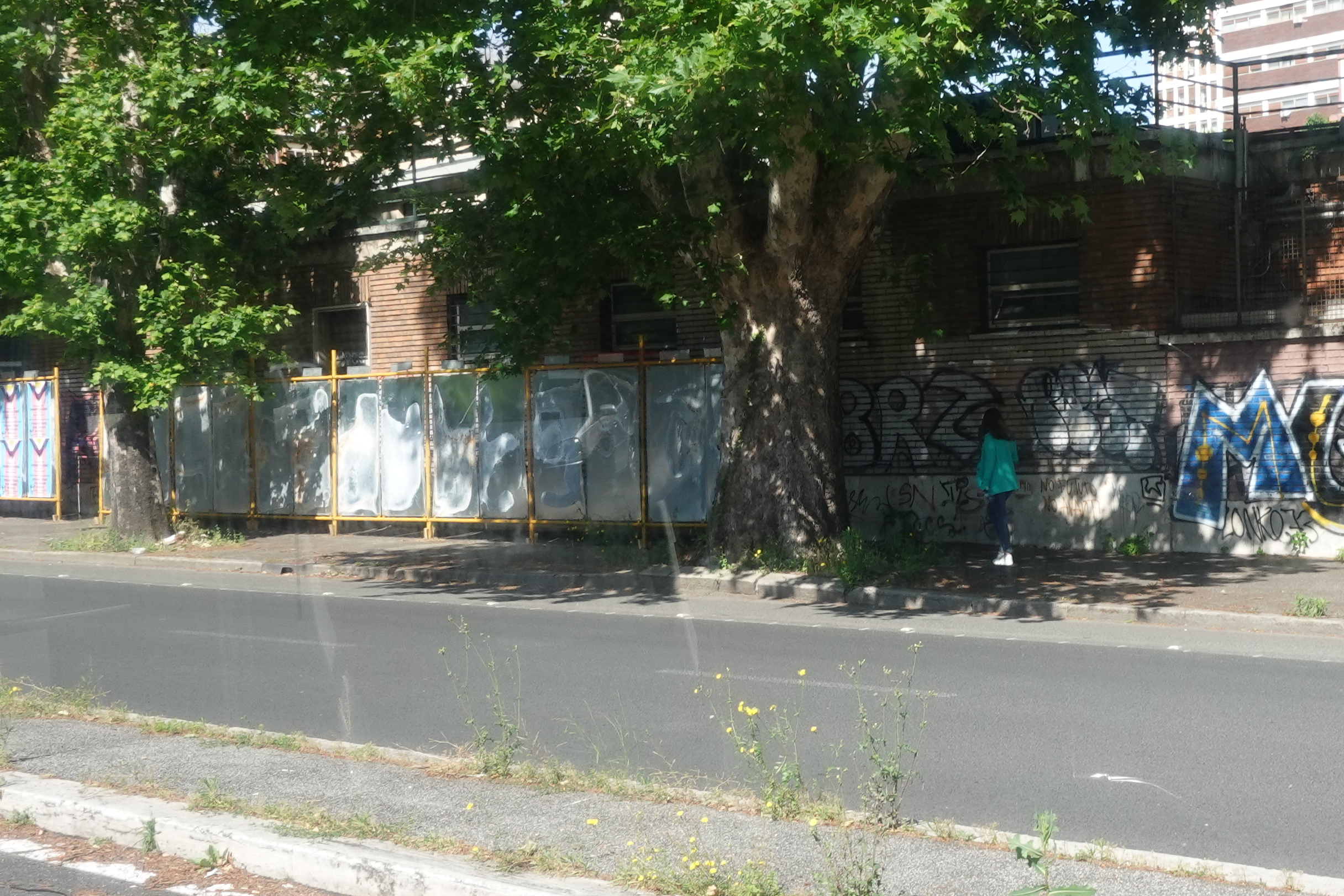
This set of billboards, on via Tiburtina across from the Verano cemetery, is one of many in Rome intended for the the display of large political posters ("maxi-manifesti") that for decades have been a part of Rome's electoral campaigns, in this case European parliamentary elections that will take place in June. 

They are installed every year about this time on the city's sidewalks, which are mostly asphalt, then removed after the elections. Some say they interfere with the movement of pedestrians (especially those with disabilities), others that the installation process can damage the sidewalks. It is clear that they are costly; the cost each year to Rome taxpayers is about 300,000 Euro, or about $325,000. There are more than 5,000 of them, distributed in 166 locations within the 15 local jurisdictions in the capital. 

But the most interesting criticism is that they are increasingly irrelevant in an age when political communication takes place not through posters but on the social media, not to mention radio and television. A recent article in the Rome daily newspaper, Il Messaggero, describes the billboards as "immortal," resisting the inevitable: AI. One city official calls the billboards "medieval," an epithet that wouldn't have much resonance for Americans, but means something to Europeans. 

In 2023 critics advanced a proposal to eliminate the billboards. It failed because to do so would require changing a 1956 national law that established and underpins the system. 

Bill 


The set of billboards at center left have just been installed; they've been cleaned of old posters.


This set of billboards has also been recently installed, but already someone has put up posters for a trans/non-binary demonstration--probably an "illegal" poster.  


Tuesday, April 16, 2019

Raffaele de Vico: Everywhere, but Hardly a Household Name


A dapper de Vico, appropriately in the bushes
If you're headed to Rome and been brushing up on your Rick Steves, you'll have read about Michelangelo, Borromini, Caravaggio, Piranesi, Bernini and a dozen other luminaries of Rome's art and architectural past. Maybe even Marcello Piacentini, who was the creative force behind EUR on the city's outskirts, or Luigi Moretti, who designed several of Rome's best modernist buildings.

A name you won't find in the index to your Blue Guide is Raffaele de Vico, though in your week or two in Rome you'll probably experience more of his work than that of any of his much more famous counterparts. Before Palazzo Braschi gave de Vico his own show in the spring of 2018, we had never heard of him.  And now, for us, he's everywhere.


Raffaele de Vico (1881-1969), an architect, designed a few buildings and other structures in Rome, but none are notable--indeed, none are "tourist attractions."  One that we've always liked--we've been by it hundreds of times and wondered what it housed--is a serbatoio (literally a tank--a building housing a waterworks) --in via Eleniana, a few steps from Porta Maggiore.  It was completed in 1934.


Another, in the famous Verano Cemetery, is an impressive memorial to those who died in the Great War.  We've been in the cemetery more than once, but because it's so large--or because the architect in this case is not so well known--never had it pointed out.

Great War monument, Verano Cemetery

Monument to the regions of Italy, never built.


De Vico also designed (1944) a spectacular monument to the regions of Italy, which--had it been constructed (if it could have been constructed)--would have
been off-the-charts cool.


There's a hint of de Vico's future importance early on, when as a youth he became interested in plants.  Yes, plants.  At the Academia di Belle Art di Roma, he studied classical plants with Giacomo Boni while pursuing a degree in architecture. For a while he worked with many other professionals on the monument to Vittorio Emanuele II, making important friends and contacts, including sculptor Adolfo Cozza.  In about 1913 he was appointed professor of architecture at the Liceo artistico di Roma, while exploring "green" (plant-related) projects.

Impressive neo-classical serbatoio, Villa Borghese


After serving four years in a non-combat role in World War I, in 1920 de Vico took up residence in a house in Villa Borghese, where he lived the rest of his life. The Villa is the site of another of his few buildings--a second serbatoio, and an impressive one.


De Vico completed his degree in architecture in 1923, then (1924) took a position as a consultant to the city's garden services agency. Marcello Piacentini nominated him to be general advisor for the EUR gardens, and he was appointed in 1940. He served as head of EUR garden services from 1955 to 1961. In 1950, he and others founded the Italian Association of Landscape Architects.

And that's why you'll see so much of de Vico as you tour the city.  As a landscape architect (and perhaps to a lesser extent, as an architect), he had a hand in designing and planting dozens of Rome's piazzas, boulevards, and parks, as well as some of its hills and "mountains." He landscaped Parco Savello (better known as Garden of the Oranges) on the Aventino (1931). He was involved in the restoration of Villa Sciarra (1930). He worked on Piazza Bologna and Piazza Verbano (1930), on the Piazza Sempione gardens in Monte Sacro (1926), on Piazza Monte Grappa (in della Vittoria, 1930), and the still-lovely Parco Virgiliano (in the Trieste quartiere).

Parco Virgiliano
He drew up some elaborate plans for Monte Mario (1951), though most of his ideas were never realized:

He is also credited with designing Testaccio Park, though, having been up Monte Testaccio, it's hard to see that any of his contributions remain.

Carlo Montani painting of Testaccio Park, 1935
Several of de Vico's "creations" are specially notable.  One is his contribution to Colle Oppio, the hilly area just across from the Coliseum. If you're near the Coliseum it's worth trekking the few paces up the hill--and especially so these days, when volunteers have been cleaning things up.

Montani, Colle Oppio, looking toward the Coliseum
The fountain in Parco Cestio (below)--part of the Colle Oppio--is attractively designed and remains a favorite spot for sitting and relaxing:

View of the Coliseum, fountain in foreground
Here's de Vico, photographed while supervising the the installation of the fountain (1939): 


Then there is the landscaping along viale Carlo Felice, which runs east from the basilica

Viale Carlo Felice (right) and adjacent park, 
of San Giovanni in Laterano. Today it's a favorite place for itinerant merchants to lay out their
wares.

The charm of Piazza dell'Indipendenza (charming despite a taxi lane running through its center, replacing the trolleys of yesteryear) is indebted to de Vico's skills. It's close to the Termini station. There's a nice cafe in center of the piazza, which somehow seems immune to the traffic.

Piazza dell'Indipendenza, then with trams

De Vico also did significant "green" work on Villa Glori, on the city's north side, including the viale dei Settanta, in the Parco della Rimembranza (1924) and a reconstructed portal of Villa Capponi on via Flaminia at the entrance to the viale dei Settanta.

Villa Glori, viale dei Settanta, as it looked in 1924
One of de Vico's greatest achievements is the design and landscaping of Piazza Mazzini, and the intersecting Viale Mazzini, both completed in 1926. The sculptures that grace the marvelous fountain in the piazza were done by someone else. The fasci--the symbol of Mussolini's Fascist regime--remain.

Piazza Mazzini, 1926 and, above, painting by Moldani, 1935

Lots of de Vico to see in Rome--if you know what you're looking for, and at.

Bill


Friday, November 2, 2018

Cemetery wanderings - a great trek through Cimitero Verano in Rome

We should've known from the size of the huge green oval on Rome maps that the main Rome cemetery, Cimitero Verano, was much, much larger than it first appears.  We had visited it many years ago and appreciated its almost Rococo excesses in funerary monuments as well as notables buried there. Like much else in Rome, it was (and is) in a state of disrepair.

Also, like much else in Rome, burials in this location--along the via Tiburtina consular road and adjacent to the Basilica of San Lorenzo fuori le mura ("San Lorenzo outside the walls")--have been going on for over 2,000 years.  

Virginio Vespignani's "Meditation," at the entrance
to Rome's Verano Cemetery. Note the skull under
her foot.  She is meditating on death. About 1880.
The current cemetery is basically attributable to Napoleon, who wanted to displace the Church. During his 1805-14 reign, he established the rule that burials must be outside Rome's walls (and not within church yards) and brought in Rome's notable architect, Giuseppe Valadier, to design Verano. Although the Popes took over again after Napoleon, the cemetery was expanded just after the establishment of the secular Italy monarchy in 1870.  As a result the basic design of the cemetery is not particularly religious.  The imposing entrance is dominated by four huge statues of  Meditation, Hope, Charity and Silence, rather than statues to saints.


The monument to Goffredo Mameli, who, on July 6, 1849 [here in Roman numerals]
 died at 22 of wounds in the campaign to free Italy from the Popes (the Risorgimento).
Mameli also wrote the lyrics for what is now the Italian national anthem "Il Canto degli Italiani,"
also known as Inno di Mameli (Mameli's Hymn). The monument has the Rome she-wolf
and the twins Romulus and Remus at the top. It has fasci on the sides, indicating
it might have been erected in the Fascist era. The quote on the back is from
Mameli's friend and Risorgimento giant, Giuseppe Mazzini.

Once through the entrance, and once through the older part of the cemetery, enormous newer areas open up, often in mid-20th-century architectural styles. One reason for the newer parts of the cemetery as well is the extensive bombing by the Allies of the church, the cemetery and the areas around it in World War II. 

The cemetery also is rightly famous for the famous people buried there, from actors to politicians. We found particularly interesting the monument to Goffredo Mameli in the older part.


Actor Alberto Sordi's mausoleum is one,
if not the only one, with an alarm system.
Apparently Sordi was known for wanting
to make sure no one took his "stuff,"
even in death.


The mausoleums of beloved comedic actor Alberto Sordi and Mussolini Mistress Clara Petacci are in the newer part. 

The cemetery also was divided into Catholic and Jewish sections, with an additional World War I section.  Today the burials are not so divided.  There is also a powerful memorial to those who died in the German concentration camps.
But Sordi couldn't prevent a bit of
fan graffiti.

More on those monuments and other parts of the cemetery in the captions of the photos below. There are also lists of notable people buried in the cemetery on both English and Italian sites.
And the "Find a Grave" site has Verano listed with many "Famous Memorials." such as philosopher George Santayana (who famously said, "Those who cannot remember the past are condemned to repeat it") and author Alberto Moravia, about whom we've written.

After I wrote this post but before it was published, Cynthia Coco Camille Korzekwa posted in RST's Facebook site on work she had done and an excellent Web site (in English), with descriptions of art work in the cemetery.

One of the 20th century mausoleums and our guide,
Diego, with "lo zainetto rosso," his little red
backpack.

We owe our great trek through the newer parts of the cemetery to the guide, "Lo zainetto rosso" ("the little red backpack), aka Diego Cruciani.  Diego has an unusual sensibility and is incredibly knowledgeable.  He guides in two languages at once, basically--Italian and English. You can see his latest plans on his Facebook page. And you can join his email list (diego1cruciani@gmail.com). You just show up - no prior reservations. And he accepts very modest donations at the end (I think - after asking our other fellow followers - we contributed 5 Euros each after 2.5 hours of a tour with about 10 people).

The cemetery's Web site in English: http://www.cimitericapitolini.it/english-version/list-of-cemeteries/79-the-verano-monumental-cemetery.html.  The site also lists all the trams and buses that go to the cemetery (and San Lorenzo fuori le mura), and the hours it's open.

More photos and history below.  Dianne

And for another capital city and its history through the cemetery, see Abby A. Johnson and Ronald M. Johnson's "In the Shadow of the United States Capitol: Congressional Cemetery and the Memory of the Nation."
"In memory of the 2,728 Roman citizens eliminated in the Nazi extermination camps, 1943-1945."


Diego explains this monument to Attilio Ferraris, which calls him "Champion of the world,"
and has a bas-relief of a fallen soccer player.  Ferraris was part of Italy's 1934 World
Championship team and died at 43, in 1947,  while playing an old-timers game.
The mausoleum of  Clara Petacci, Mussolini's mistress
 who was executed with him by partisans near Lake Como in 1945.
The monument was at one time in shambles, but somebody obviously
 paid to restore it. The people in our tour group who approached
the mausoleum (several declined) are reading a recent
hand-written note to Clara.


.


A children's section.


An elaborate monument to architect Vittorio Ballio Morpurgo. He was notably active in Rome in the 1930s, including working on what was to be the Fascist Party Headquarters (now "La Farnesina," the State Department) and the
Fascist Piazza Augusto Imperatore, where Mussolini wanted to be buried (in Emperor Augustus's tomb). That didn't work out, but the piazza still carries its rationalist design and is in RST's Top 40. Interestingly Morpurgo was Jewish. One biographical note says simply "He was not much affected by the race laws." And he added his mother's name to his last name (Ballio) after World War II and managed to continue his profession, as did many architect's associated with the Fascist regime. He died in 1966.
A small part of a lovely grotto-like section, composed mainly of "in
memento mori" - memorials rather than tombs.


I can't find out anything more about this Guglielmotti
family.  We rather liked the mausoleum, and the sculpture--
which looks like it's from the 1970s.